
Hello,
we want to build with a clinker brick facade.
However, we don’t want the perfectly smooth, uniform bricks but rather the more "rustic" ones.
In a conversation, we were told that the latter are "hand-formed" bricks, while the others are fired at higher temperatures.
If I understood correctly, the hand-fired bricks are also referred to as "Dutch clinkers."
Is that correct?
Besides the appearance, the main difference is how much water the bricks can absorb.
Hard-fired clinkers absorb very little water (< 2%?), while hand-fired bricks can absorb up to 15%, depending on the type.
People from the older generation around me always say, "Don’t choose Dutch clinkers; they absorb water." However, I was told in stores that this is no longer the case.
This is what we have in mind:
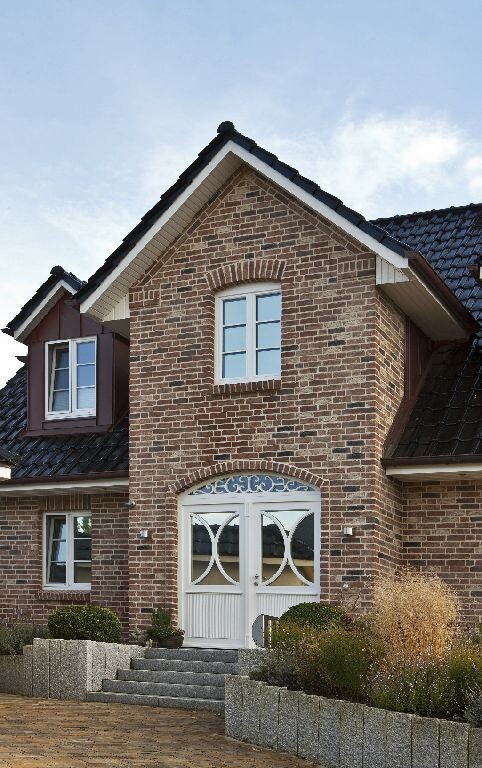
we want to build with a clinker brick facade.
However, we don’t want the perfectly smooth, uniform bricks but rather the more "rustic" ones.
In a conversation, we were told that the latter are "hand-formed" bricks, while the others are fired at higher temperatures.
If I understood correctly, the hand-fired bricks are also referred to as "Dutch clinkers."
Is that correct?
Besides the appearance, the main difference is how much water the bricks can absorb.
Hard-fired clinkers absorb very little water (< 2%?), while hand-fired bricks can absorb up to 15%, depending on the type.
People from the older generation around me always say, "Don’t choose Dutch clinkers; they absorb water." However, I was told in stores that this is no longer the case.
This is what we have in mind:
K
Knallkörper13 Feb 2017 12:41Then you can just use impregnated bricks as well; we used them too.
With a facing brick facade, the dew point is always on the inside. If the brick absorbs water, its inside will dry faster as well. If the brick does not absorb water, like a true clinker brick, then all the condensation must escape through the joints.
With a facing brick facade, the dew point is always on the inside. If the brick absorbs water, its inside will dry faster as well. If the brick does not absorb water, like a true clinker brick, then all the condensation must escape through the joints.

Does this mean that EVERY brick is also available from the factory as an impregnated version? Or does the criterion "impregnated" limit the product range?
The latter would be undesirable for aesthetic reasons. In that case, we would impregnate the bricks ourselves again.
"If the brick absorbs water, its interior also dries faster. If the brick does not absorb water, like a real clinker brick, then all the condensation water must escape through the joints."
What does that mean?
Is it good or bad that the interior dries faster? I would say it’s good. The interior dries faster because the water "creeps" back into the brick? Does that also mean that at the dew point, i.e., on the inside, no condensation forms or less condensation than with regular clinker bricks? I would assume that neither is true.
I would expect the same behavior with "real" clinker bricks, except that, first, less water penetrates the brick at all, and second, accordingly, less water needs to "creep back." But according to your statement, that doesn’t seem to be the case.
With real clinker bricks, the water must exit through the joints. Does that mean the water "creeps" back through the brick joints, or that it runs/flows/drips down and then can escape somewhere through ventilation openings in the joints?
Or does the latter mainly apply to clinker bricks that absorb more water? Or does it not apply to any type at all?
Is any of the mentioned "creeping methods" detrimental regarding efflorescence, or do these only occur, if at all, in the initial period before everything has fully dried out?
The latter would be undesirable for aesthetic reasons. In that case, we would impregnate the bricks ourselves again.
"If the brick absorbs water, its interior also dries faster. If the brick does not absorb water, like a real clinker brick, then all the condensation water must escape through the joints."
What does that mean?
Is it good or bad that the interior dries faster? I would say it’s good. The interior dries faster because the water "creeps" back into the brick? Does that also mean that at the dew point, i.e., on the inside, no condensation forms or less condensation than with regular clinker bricks? I would assume that neither is true.
I would expect the same behavior with "real" clinker bricks, except that, first, less water penetrates the brick at all, and second, accordingly, less water needs to "creep back." But according to your statement, that doesn’t seem to be the case.
With real clinker bricks, the water must exit through the joints. Does that mean the water "creeps" back through the brick joints, or that it runs/flows/drips down and then can escape somewhere through ventilation openings in the joints?
Or does the latter mainly apply to clinker bricks that absorb more water? Or does it not apply to any type at all?
Is any of the mentioned "creeping methods" detrimental regarding efflorescence, or do these only occur, if at all, in the initial period before everything has fully dried out?
K
Knallkörper13 Feb 2017 14:22There are only a limited number of designs available for impregnated facing bricks, which I forgot to mention. For example, we have the Olfry 1707 Antique with factory impregnation.
Regarding the dew point: The moisture I’m referring to comes from the interior, meaning from the living space. Humidity diffuses through the plaster, your backup wall, and the cavity insulation. On the cold side of the cavity insulation, that is the exterior side, this moisture condenses. If there is a lot of moisture, it runs down the inside of the facing bricks and exits at the joints at the bottom. Usually, however, the amount of water isn’t enough to cause dripping. Normally, the dew moisture is transported outward by diffusion through the facing bricks and the joints, where it evaporates. This is, of course, an invisible process. For this scenario, a “permeable” facing brick is “better.”
If the facing brick gets soaked by driving rain, it needs to dry in the same way. A “true brick” without water absorption capacity cannot get soaked, so in this case it would be “better.”
Overall, this is not really a relevant issue for your choice. The “true bricks” certainly have their justification in the HafenCity area, but you are probably not building right on the coast.
Regarding the dew point: The moisture I’m referring to comes from the interior, meaning from the living space. Humidity diffuses through the plaster, your backup wall, and the cavity insulation. On the cold side of the cavity insulation, that is the exterior side, this moisture condenses. If there is a lot of moisture, it runs down the inside of the facing bricks and exits at the joints at the bottom. Usually, however, the amount of water isn’t enough to cause dripping. Normally, the dew moisture is transported outward by diffusion through the facing bricks and the joints, where it evaporates. This is, of course, an invisible process. For this scenario, a “permeable” facing brick is “better.”
If the facing brick gets soaked by driving rain, it needs to dry in the same way. A “true brick” without water absorption capacity cannot get soaked, so in this case it would be “better.”
Overall, this is not really a relevant issue for your choice. The “true bricks” certainly have their justification in the HafenCity area, but you are probably not building right on the coast.
Similar topics