
Hello,
we want to build with a clinker brick facade.
However, we don’t want the perfectly smooth, uniform bricks but rather the more "rustic" ones.
In a conversation, we were told that the latter are "hand-formed" bricks, while the others are fired at higher temperatures.
If I understood correctly, the hand-fired bricks are also referred to as "Dutch clinkers."
Is that correct?
Besides the appearance, the main difference is how much water the bricks can absorb.
Hard-fired clinkers absorb very little water (< 2%?), while hand-fired bricks can absorb up to 15%, depending on the type.
People from the older generation around me always say, "Don’t choose Dutch clinkers; they absorb water." However, I was told in stores that this is no longer the case.
This is what we have in mind:
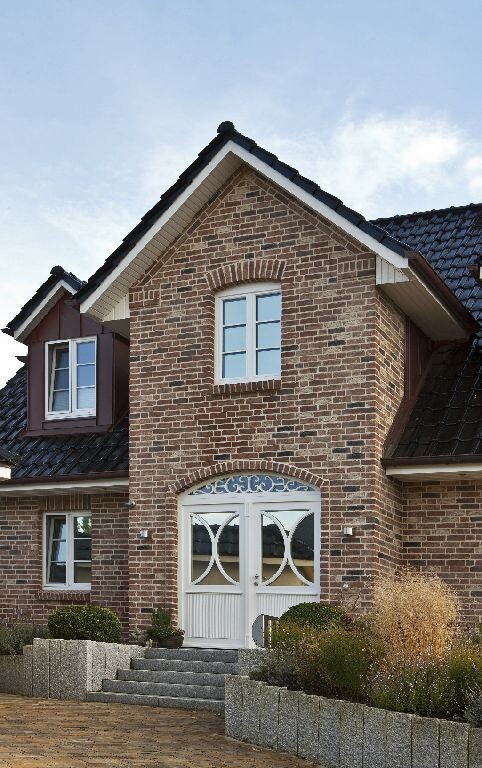
we want to build with a clinker brick facade.
However, we don’t want the perfectly smooth, uniform bricks but rather the more "rustic" ones.
In a conversation, we were told that the latter are "hand-formed" bricks, while the others are fired at higher temperatures.
If I understood correctly, the hand-fired bricks are also referred to as "Dutch clinkers."
Is that correct?
Besides the appearance, the main difference is how much water the bricks can absorb.
Hard-fired clinkers absorb very little water (< 2%?), while hand-fired bricks can absorb up to 15%, depending on the type.
People from the older generation around me always say, "Don’t choose Dutch clinkers; they absorb water." However, I was told in stores that this is no longer the case.
This is what we have in mind:
D
DragonyxXL6 Feb 2017 14:36Kaspatoo schrieb:
For the same brick pattern, we find several houses that look quite different.
Is this due to the batch, or can the proportion of a specific brick type within the pattern be varied, for example, using fewer dark bricks and more light-colored ones? When choosing bricks ourselves, we also noticed that bricks look very different online, in catalogs, and on finished houses. Therefore, we visited a local building materials supplier, where they had approximately 30 x 60 cm (12 x 24 inch) brick samples. Then we went to the manufacturer’s showroom, which displayed 80 x 120 cm (31 x 47 inch) panels. At the manufacturer’s larger exhibition (Röben), there were also 1 x 2 m (3.3 x 6.6 ft) panels. Finally, we toured 10 houses across two federal states to see our shortlisted bricks in real-life conditions with shadows and sunlight. Our choice eventually fell on the Röben Formback graphite-multicolor bricks.
K
Knallkörper6 Feb 2017 15:20In our case, we made a preliminary selection at the building materials supplier. The manager knew at least one house for each choice that was clad with that material. Sometimes he even knew the joint color used, and could show houses with the same cladding but different joint colors. All the houses were within a 20 km (12 miles) radius. However, I wouldn’t visit more than 5 different ones, as it simply becomes too much after a while.

Hello Kaspatoo,
We also chose a colorful, rustic brick and I strongly recommend not making a decision based solely on pictures from the internet or the small sample boards at the building supply store. It’s best to pick a few favorites and ask the supplier or brick manufacturer for addresses of reference houses.
It is also very important to look at several houses for each brick, ideally with different mortar colors, because the brick can look completely different depending on the mortar shade, to the point where you wouldn’t guess at first glance that it’s the same brick. For example, we found our brick quite boring with gray mortar, and wouldn’t have chosen it that way, but with lighter mortar we really liked it.
Don’t make this decision lightly, because remember, you probably won’t be able to change the brick later, so it needs to please you in the long term—not just because it’s trendy now or your actual favorite might be a little more expensive.
We also chose a colorful, rustic brick and I strongly recommend not making a decision based solely on pictures from the internet or the small sample boards at the building supply store. It’s best to pick a few favorites and ask the supplier or brick manufacturer for addresses of reference houses.
It is also very important to look at several houses for each brick, ideally with different mortar colors, because the brick can look completely different depending on the mortar shade, to the point where you wouldn’t guess at first glance that it’s the same brick. For example, we found our brick quite boring with gray mortar, and wouldn’t have chosen it that way, but with lighter mortar we really liked it.
Don’t make this decision lightly, because remember, you probably won’t be able to change the brick later, so it needs to please you in the long term—not just because it’s trendy now or your actual favorite might be a little more expensive.

Hello, thanks for the tips, but to me it is obvious that you need to visit real houses.
What I meant is that photos of houses (so not computer-generated images, but probably from catalogs) show the same brick type looking quite different just because of the pattern.
In other words, if I see a house with great bricks and order the same bricks, my house might end up looking really bad because it could be a different batch.
If you want to have some control over the quantity of bricks used, you need to order more pallets than necessary and use fewer bricks from each pallet.
In the end, the "bad" bricks remain unused.
What I meant is that photos of houses (so not computer-generated images, but probably from catalogs) show the same brick type looking quite different just because of the pattern.
In other words, if I see a house with great bricks and order the same bricks, my house might end up looking really bad because it could be a different batch.
If you want to have some control over the quantity of bricks used, you need to order more pallets than necessary and use fewer bricks from each pallet.
In the end, the "bad" bricks remain unused.
Yes, you can definitely order more pallets, but do you want to stand next to the bricklayer and tell him whether you find each individual brick "ugly"?
And as I said, once the pointing is done, the overall look changes completely, so during the bricklaying process you can’t really see the final appearance yet.
I think it will be very difficult to determine the overall look beforehand with such a “mixed” batch of facing bricks, since you can’t know whether you will like the delivered batch or how the bricklayer will arrange the bricks from the mixture according to your preferences. The facing bricks are all mixed on a single pallet; the bricklayer should mix bricks from several pallets and then lay them. I don’t think he’ll have time to experiment with the best combination for long — otherwise the house would never be finished.
If you want to know exactly how your house will look once it’s finished, you should probably choose a more uniform, smooth brick where all the bricks look the same.
And as I said, once the pointing is done, the overall look changes completely, so during the bricklaying process you can’t really see the final appearance yet.
I think it will be very difficult to determine the overall look beforehand with such a “mixed” batch of facing bricks, since you can’t know whether you will like the delivered batch or how the bricklayer will arrange the bricks from the mixture according to your preferences. The facing bricks are all mixed on a single pallet; the bricklayer should mix bricks from several pallets and then lay them. I don’t think he’ll have time to experiment with the best combination for long — otherwise the house would never be finished.
If you want to know exactly how your house will look once it’s finished, you should probably choose a more uniform, smooth brick where all the bricks look the same.
We had a “guided tour” at the building materials supplier.
In the store, we saw a brick that looked quite similar to the one in the original photo posted (it was one from Nelissen).
However, the real reference houses looked strange or inconsistent.
At the end, they showed us a brick that immediately caught our attention, which had not even been part of the selection in the store beforehand. So: looking in the store isn’t very helpful, better to have the supplier show you reference houses or get addresses.
Or drive around in new housing developments and randomly look for a nice brick, then ask the supplier which brick it could be.
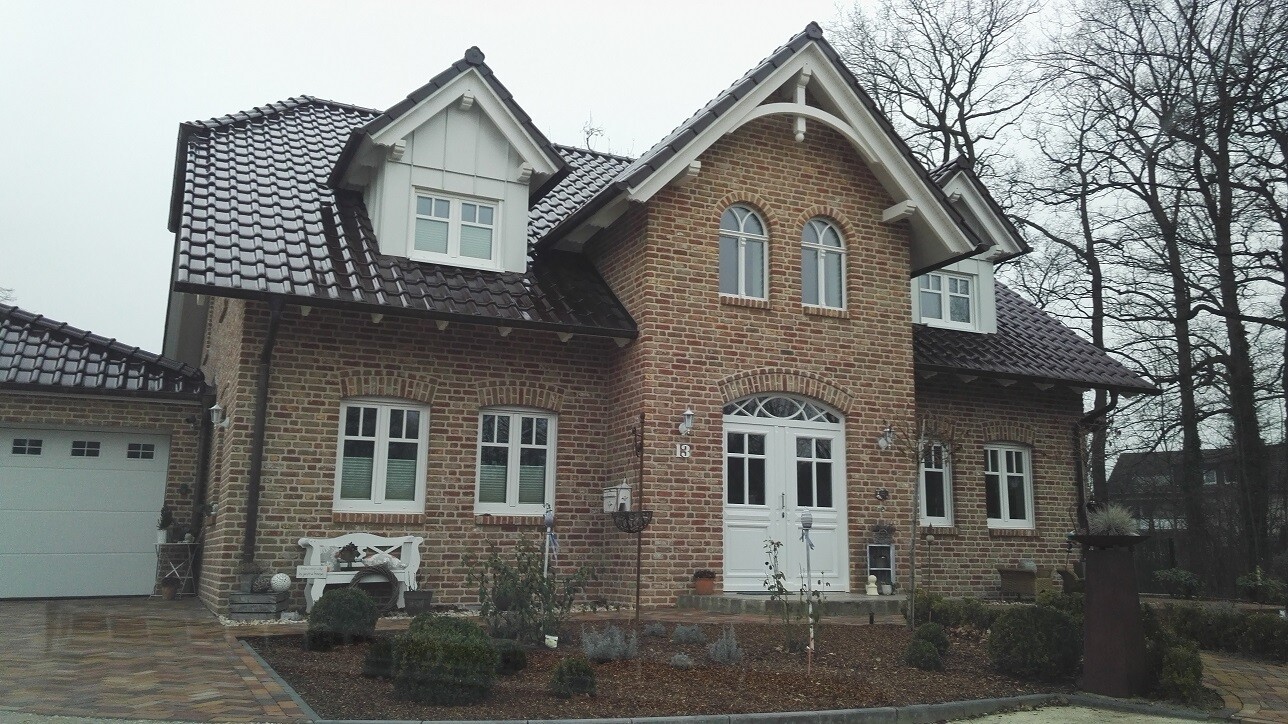
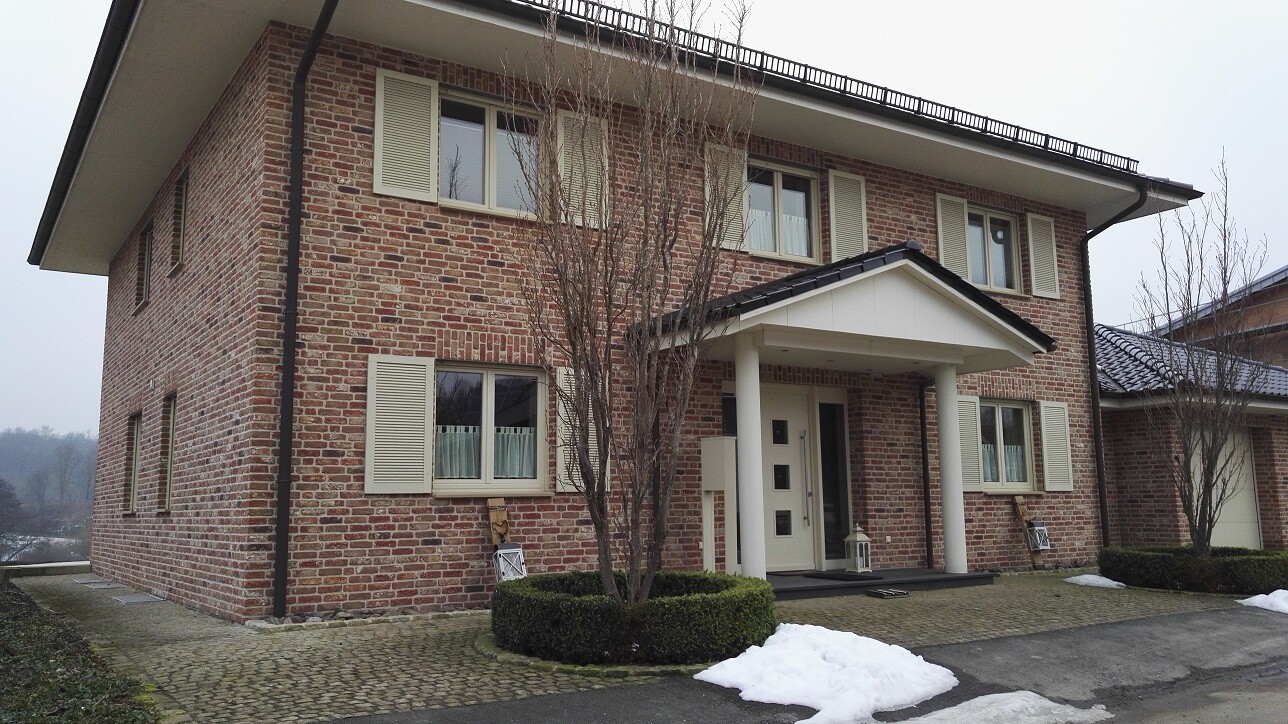
The two attached photos show the brick we now prefer.
Both houses have exactly the same brick installed.
However, one house does not have any black/dark bricks.
According to the supplier, there are two reasons for this:
- In this case, the brick manufacturer already made a pre-selection during palletizing and left out the dark bricks.
- According to the supplier, this can be done with certain suppliers.
- Alternatively or additionally, the dark bricks can be turned 180°.
- Usually, only one side of these dark bricks is heavily fired, so the back side is not nearly as dark as the front side (at least for the dark bricks).
So, there are basically ways to influence this.
By the way, the brick is Vandersan "Helgoland Antik".
I’m still struggling with the fact that it can absorb over 10% water, even though we have a 60cm (24 inch) roof overhang.
As an option for a north-facing or weather-exposed wall, the building materials supplier also mentioned a spray-on impregnating treatment.
In the store, we saw a brick that looked quite similar to the one in the original photo posted (it was one from Nelissen).
However, the real reference houses looked strange or inconsistent.
At the end, they showed us a brick that immediately caught our attention, which had not even been part of the selection in the store beforehand. So: looking in the store isn’t very helpful, better to have the supplier show you reference houses or get addresses.
Or drive around in new housing developments and randomly look for a nice brick, then ask the supplier which brick it could be.
The two attached photos show the brick we now prefer.
Both houses have exactly the same brick installed.
However, one house does not have any black/dark bricks.
According to the supplier, there are two reasons for this:
- In this case, the brick manufacturer already made a pre-selection during palletizing and left out the dark bricks.
- According to the supplier, this can be done with certain suppliers.
- Alternatively or additionally, the dark bricks can be turned 180°.
- Usually, only one side of these dark bricks is heavily fired, so the back side is not nearly as dark as the front side (at least for the dark bricks).
So, there are basically ways to influence this.
By the way, the brick is Vandersan "Helgoland Antik".
I’m still struggling with the fact that it can absorb over 10% water, even though we have a 60cm (24 inch) roof overhang.
As an option for a north-facing or weather-exposed wall, the building materials supplier also mentioned a spray-on impregnating treatment.
Similar topics