
ᐅ Air Tightness of the Timber Beam Ceiling for Attic Conversion
Created on: 15 May 2021 11:29
D
dubidodooD
dubidodoo15 May 2021 11:29Hello, we want to convert the attic in our bungalow. I would like to ask for your advice on this.
The wooden beam ceiling (240mm (9.5 inches)) is already insulated with mineral wool (220mm (8.7 inches)). Below it, there is a vapor barrier installed to prevent moisture from rising from below and to ensure airtightness.
Now we want to finish the attic above, and I have two questions.
1) At the exterior masonry wall, the wooden beam rests on it, but it is not airtight. How should I address this, since I can no longer access it from above (see sketch)? Is it sufficient to insulate the rafters of the wooden beam ceiling with the remaining 20mm (0.8 inches) and install a vapor retarder above that?
2) What would be the ideal build-up after that:
wooden beam ceiling, vapor retarder, OSB board (already have), dry screed?
Should there be an insulation strip below the OSB board to reduce impact sound? And should this be installed as a floating layer or screwed down?
I would appreciate any tips.
Best regards, olli
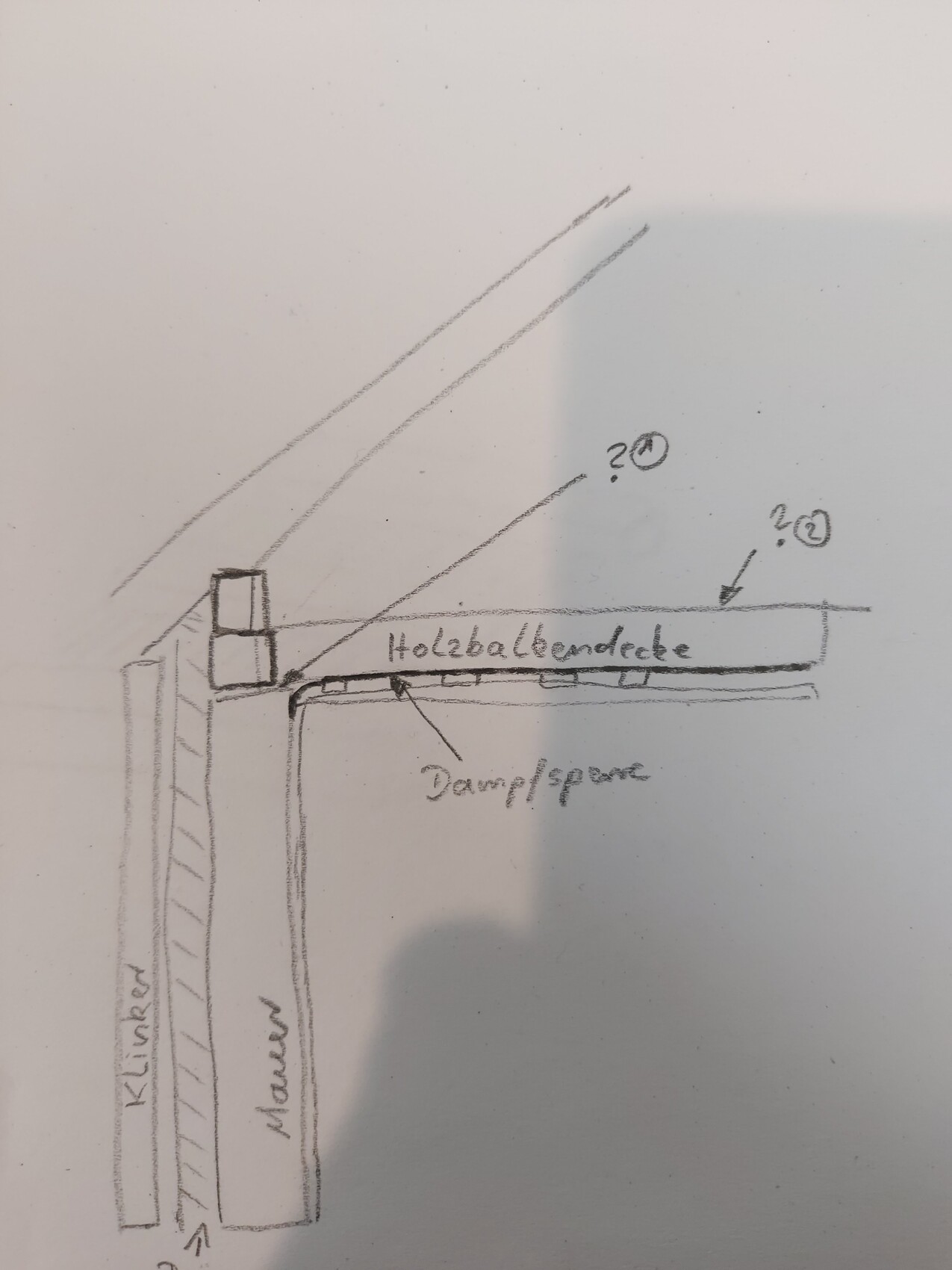
The wooden beam ceiling (240mm (9.5 inches)) is already insulated with mineral wool (220mm (8.7 inches)). Below it, there is a vapor barrier installed to prevent moisture from rising from below and to ensure airtightness.
Now we want to finish the attic above, and I have two questions.
1) At the exterior masonry wall, the wooden beam rests on it, but it is not airtight. How should I address this, since I can no longer access it from above (see sketch)? Is it sufficient to insulate the rafters of the wooden beam ceiling with the remaining 20mm (0.8 inches) and install a vapor retarder above that?
2) What would be the ideal build-up after that:
wooden beam ceiling, vapor retarder, OSB board (already have), dry screed?
Should there be an insulation strip below the OSB board to reduce impact sound? And should this be installed as a floating layer or screwed down?
I would appreciate any tips.
Best regards, olli
 HausiKlausi16 May 2021 23:29
Well, I’m not an expert. But from a physical standpoint, a vapor retarder should always prevent moisture from condensing at the coldest point ahead. Installing a second vapor barrier or retarder on the floor does not make sense, especially since converted attics will eventually have access points that would also negate the vapor retarder UNDER the ceiling. Warm air absorbs moisture – then rises and meets a cooler surface: Therefore, according to the principles of heat and moisture flow, the membrane should be installed under the roof (if it is not already in place). Much more important than the question of the floor structure is whether the roof is well prepared for the conversion.
D
dubidodoo16 May 2021 23:59Hello, thanks for the reply. The roof will still be insulated and then fitted with a vapor retarder, which I know how to do. However, this area won’t be airtight in the part I marked on the drawing. I have no idea how this area should be properly handled.
Similar topics