
Hi,
I am currently looking for solutions for a new heating system. There is nothing installed at the moment, which means everything needs to be done from scratch.
I tried comparing a traditional oil heating system with an air conditioning unit that has a SCOP of 4 and an 18kW (18,000 BTU/h) instantaneous water heater for the bathroom and kitchen. For reference in the calculations, I used 2000 liters (530 gallons) of heating oil, which was also the basis for calculating the energy consumption of the air conditioning unit.
I created a table to theoretically calculate and compare this: (Hot water with the oil heating system is calculated based on the kW values of the instantaneous water heater)
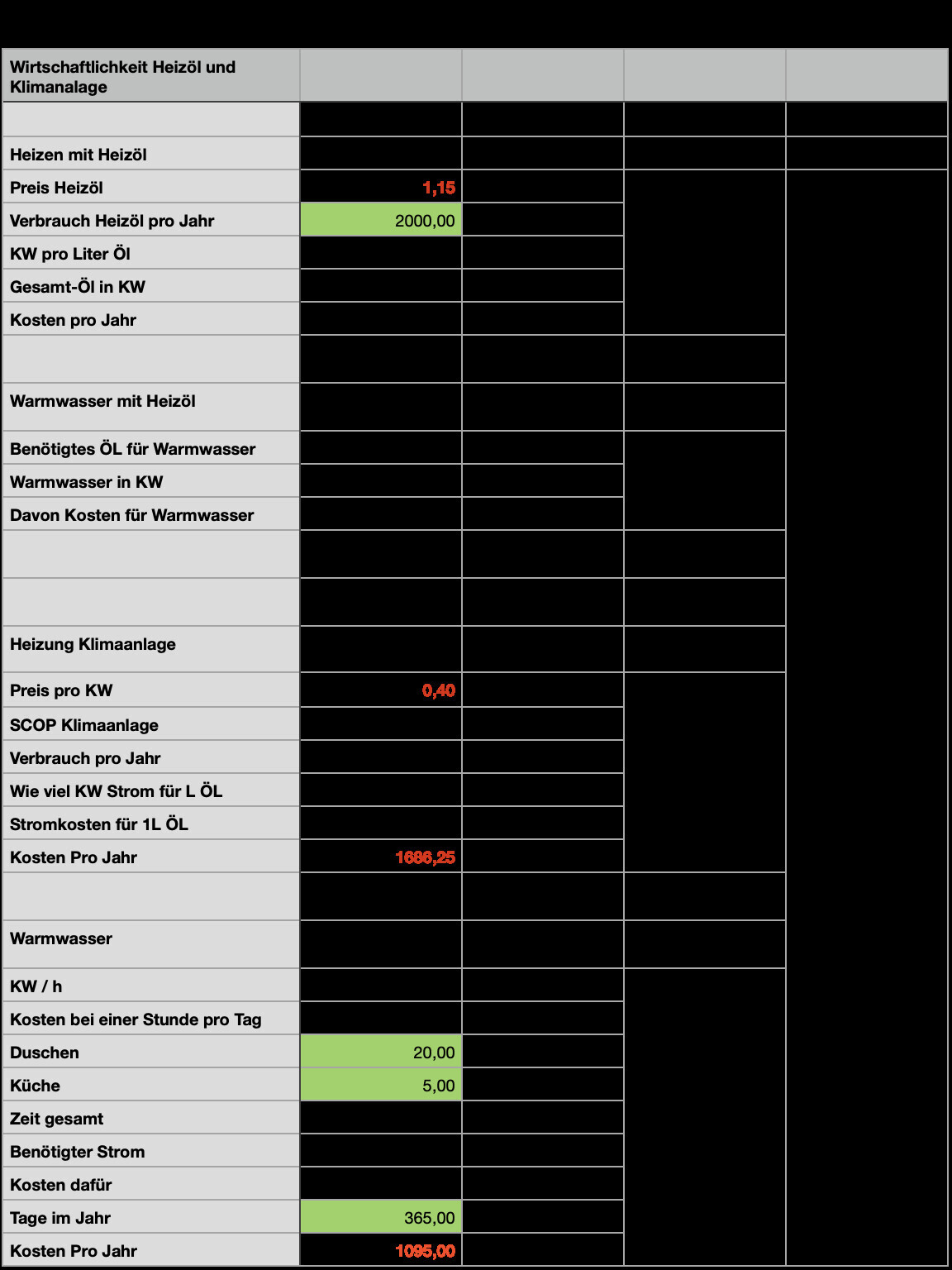
I hope this is understandable. Has anyone had experience with this?
Did I forget to consider anything?
The values are purely theoretical. There would also be a wood stove added, which would reduce the heating demand, and it is planned to install a photovoltaic system in the near future.
Thanks
I am currently looking for solutions for a new heating system. There is nothing installed at the moment, which means everything needs to be done from scratch.
I tried comparing a traditional oil heating system with an air conditioning unit that has a SCOP of 4 and an 18kW (18,000 BTU/h) instantaneous water heater for the bathroom and kitchen. For reference in the calculations, I used 2000 liters (530 gallons) of heating oil, which was also the basis for calculating the energy consumption of the air conditioning unit.
I created a table to theoretically calculate and compare this: (Hot water with the oil heating system is calculated based on the kW values of the instantaneous water heater)
I hope this is understandable. Has anyone had experience with this?
Did I forget to consider anything?
The values are purely theoretical. There would also be a wood stove added, which would reduce the heating demand, and it is planned to install a photovoltaic system in the near future.
Thanks
Hi,
thanks for the posts. I tried to create a site plan showing roughly how things are planned. I included the air conditioning unit and wood stove in the site plan.
Ground floor:
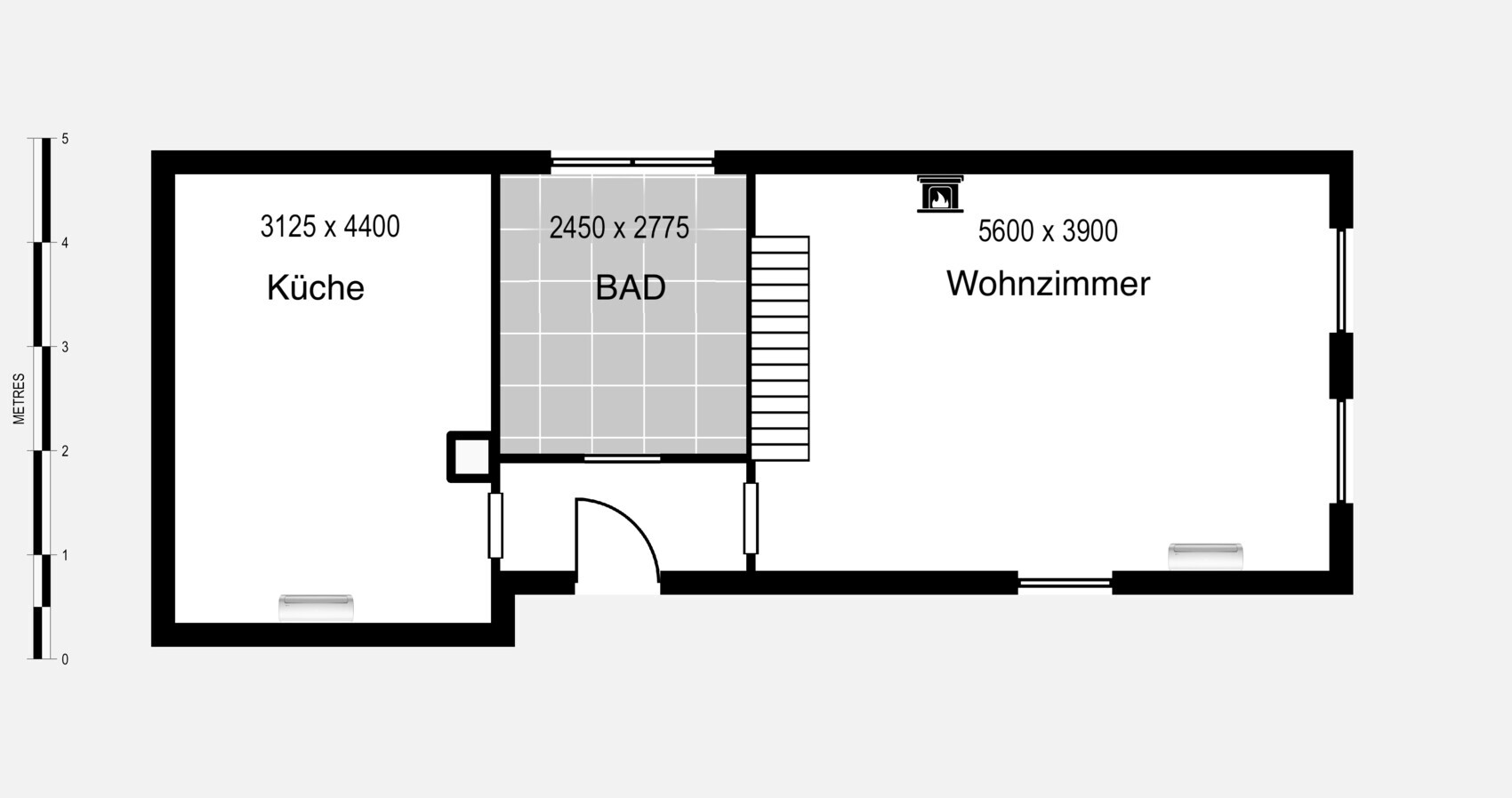
Upper floor: the grey area represents the sloping roof (without knee wall)
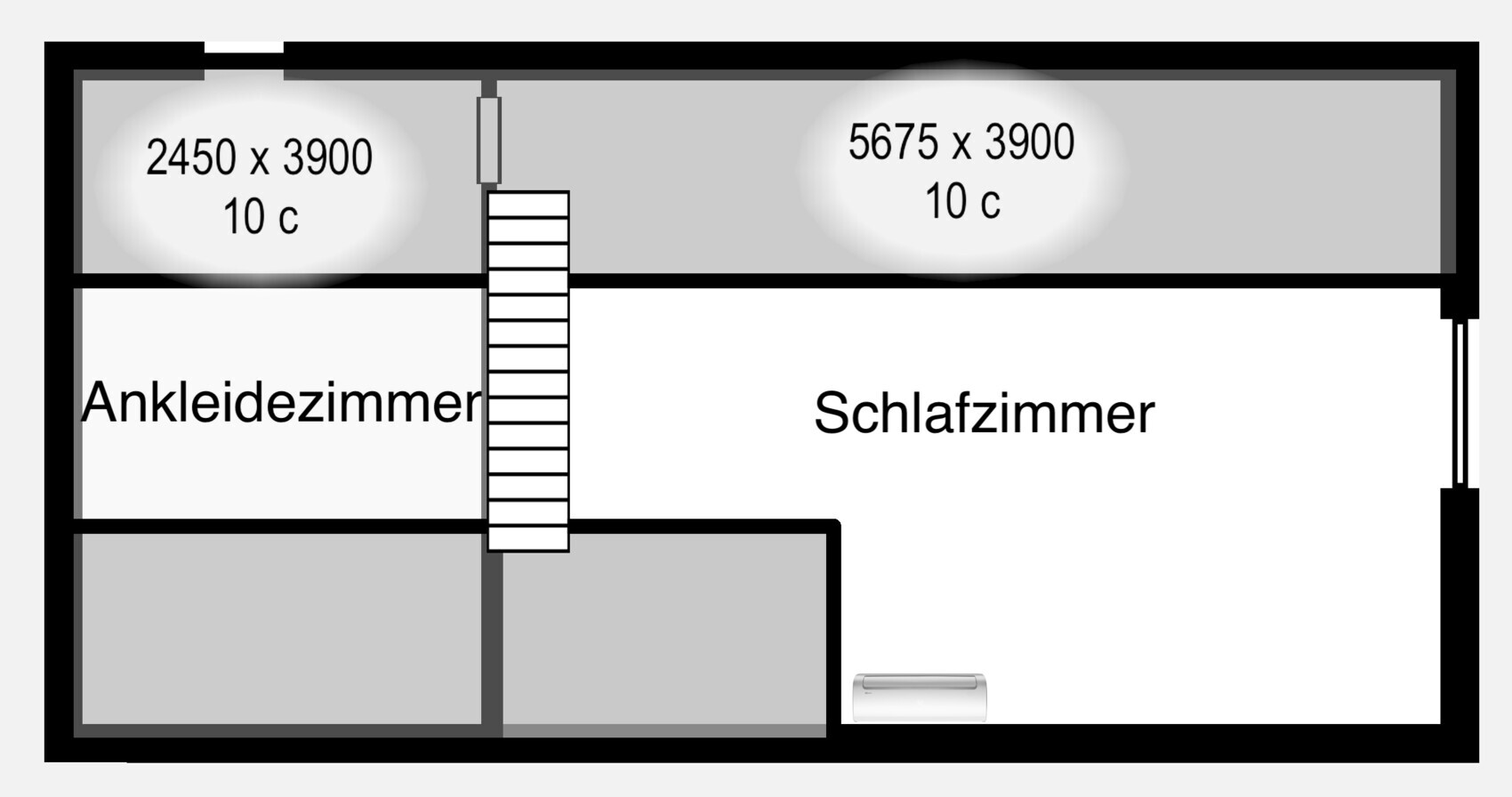
My remaining issues are the hot water and the heating in the bathroom. I have read that an air conditioner in the bathroom doesn’t make sense because of drafts or it doesn’t work well due to the high humidity.
Regarding the 20 MWh, I deliberately chose a higher value. Since the two occupants prefer it warm and 20 degrees is too cold (this has already been discussed multiple times – and you have to pay for it) it will definitely be a room temperature of 22-23 degrees. I hope this will balance out when the first billing comes.
Domestic hot water heat pump:
If I install this, it will run on electricity and heat the water using ambient temperature and electricity – correct? I found various tables online that roughly estimate the electricity consumption. With 40 liters (15.7 gallons) of water consumption per person (so multiplied by 2), it would require about 4 kW (almost half as much as the district heating) – can that be correct? Is this realistic? How high would the electricity consumption be on days when no water is drawn?
Bathroom heating:
What heating system would you recommend installing in the bathroom?
I hope I haven’t forgotten anything and have accounted for everything.
Thanks
thanks for the posts. I tried to create a site plan showing roughly how things are planned. I included the air conditioning unit and wood stove in the site plan.
Ground floor:
Upper floor: the grey area represents the sloping roof (without knee wall)
My remaining issues are the hot water and the heating in the bathroom. I have read that an air conditioner in the bathroom doesn’t make sense because of drafts or it doesn’t work well due to the high humidity.
Regarding the 20 MWh, I deliberately chose a higher value. Since the two occupants prefer it warm and 20 degrees is too cold (this has already been discussed multiple times – and you have to pay for it) it will definitely be a room temperature of 22-23 degrees. I hope this will balance out when the first billing comes.
Domestic hot water heat pump:
If I install this, it will run on electricity and heat the water using ambient temperature and electricity – correct? I found various tables online that roughly estimate the electricity consumption. With 40 liters (15.7 gallons) of water consumption per person (so multiplied by 2), it would require about 4 kW (almost half as much as the district heating) – can that be correct? Is this realistic? How high would the electricity consumption be on days when no water is drawn?
Bathroom heating:
What heating system would you recommend installing in the bathroom?
I hope I haven’t forgotten anything and have accounted for everything.
Thanks
K
KarstenausNRW19 Jan 2023 13:55Wolf6660 schrieb:
Domestic Hot Water Heat Pump:
If I install one, it runs on electricity and heats the water using ambient temperature and electricity – is that correct? I found various tables online that roughly estimate the electricity consumption. With a water usage of 40 liters (about 10.5 gallons) per person (so doubled for two people), the consumption would be around 4 kW (almost half as much as a direct electric water heater). Could that be accurate? Is this realistic? How much electricity is consumed approximately on days when no water is drawn?Then you will also find a figure of about 400 kWh per year for a two-person household on that site. That is realistic. With a good system, the consumption can be even lower.Wolf6660 schrieb:
One problem is still the hot water and heating in the bathroom. I have read that an air conditioner in the bathroom doesn’t make sense due to drafts or that it doesn’t work because of the high humidity. When heating, humidity is not an issue, but air conditioning alone in the bathroom is not very comfortable. For the base load, I would still install it in many cases. At a low setting, you hardly notice any drafts, and you can also link the air conditioner to the light switch or a motion sensor that switches off the indoor unit when the room is occupied. Additionally, I would install radiant heating— for example, infrared heaters in the mirror or ceiling, or electric underfloor heating with a timer. Even the smallest panels are sufficient since it doesn’t really need to heat the whole room.
Your bathroom has only one exterior wall, so the heat demand is correspondingly low. If you insulate the wall on the inside (e.g., with PIR rigid foam insulation followed by moisture-resistant drywall), the heating load will be very low and you might be able to skip an additional indoor unit and just use radiant heating to warm the space.
Wolf6660 schrieb:
What is the approximate electricity consumption if no hot water is used that day? That depends on the model. Radiant heat losses are naturally present compared to the delivery heat (distribution losses). For a hot water storage tank with 200 liters (53 gallons), you can expect about 30 W of radiant heat loss. However, this heat also contributes to heating your living space and can be neglected during the heating season.
Hi,
to push the idea of the BWWP to the extreme, I thought of the following. If I place it in the living room under the stairs, it could draw in draft air from outside in the summer and from inside in the winter, right? Since there is a wood stove in the living room, it would then help use the heat pump more efficiently – or am I wrong?
If the HVAC system doesn’t have an issue with humidity, I will definitely install it. Just heating or cooling in the bathroom doesn’t make much sense, even in summer.
I’ll add this to my spreadsheet and take a look at the numbers.
Thanks
to push the idea of the BWWP to the extreme, I thought of the following. If I place it in the living room under the stairs, it could draw in draft air from outside in the summer and from inside in the winter, right? Since there is a wood stove in the living room, it would then help use the heat pump more efficiently – or am I wrong?
If the HVAC system doesn’t have an issue with humidity, I will definitely install it. Just heating or cooling in the bathroom doesn’t make much sense, even in summer.
I’ll add this to my spreadsheet and take a look at the numbers.
Thanks
Wolf6660 schrieb:
To take the idea of the earth-to-air heat exchanger (BWWP) to the extreme, I thought of this: If I place it under the stairs in the living room, then in summer it could draw in outside air and in winter inside air, right? Since there is a wood stove in the living room, it would then help to use the heat pump more efficiently – correct? Such an earth-to-air heat exchanger has an airflow of about 300 m³/h (176 cfm). In a living room of 60 m³ (2,118 ft³), that would be 5 air changes per hour. That is quite a lot, and combined with a split air conditioner, it would not be comfortable to live with. Additionally, the sound power level varies between 50 and 60 dB depending on the model. This is not comparable to the 20 dB of a split air conditioner; it can be quite annoying. Technically, this setup is possible if the outlet vents into the room. But if the outlet is directed outside, you create negative pressure inside the apartment → plus a chimney = a disaster.
If you don’t have a basement, there are two options for installation in the technical room: intake and exhaust air inside the room. However, the room will probably be too small for this. Intake and exhaust air outside. The efficiency in winter is lower but still better than ventilation with heat recovery (MVHR).
In your floor plan, I see only three indoor units. I would simply use the Hitachi Yutampo solution and supply the earth-to-air heat exchanger via the outdoor unit. That way, you avoid the airflow issue and can also install the heat pump under the stairs since it does not produce noise.
Hi,
thanks for your idea.
However, there will be a fourth indoor unit added for the bathroom. I thought it might not work because of the humidity. Since it is only used for heating, this is probably not a problem.
The positioning in the living room was just an idea because it will definitely be the warmest room and the wood stove will be there. If that’s not a good idea, we will place the unit in the utility room that still needs to be planned (possibly behind part of the kitchen or in a small extension next to the kitchen). Then the question arises whether the Hitachi Yutampo makes sense. The SCOP is quite similar to that of the air-to-water heat pump, and if I direct the intake and outlet to the outside, that should be feasible. The Hitachi Yutampo system costs about €1000 more than an air-to-water heat pump without the outdoor unit.
I hope I have now considered everything.
4 climate control units (living room, kitchen, bathroom, and bedroom)
1 air-to-water heat pump
possibly electric underfloor heating or heater in the bathroom for quick and short-term heating if needed
wood stove, which will definitely help save a significant amount of electricity on cold days.
All of this is intended to be integrated with the smart home system, and electricity consumption will be recorded and analyzed for each climate control unit and the heat pump to provide an overview of cost-effectiveness and consumption values.
If the photovoltaic system is added next year (maybe even by the end of this year), this will definitely be a comprehensive and hopefully future-proof solution.
What do you think? This should work compared to a conventional fossil fuel heating system, right?
Great how I get supplied with information here and what ideas come up.
thanks for your idea.
However, there will be a fourth indoor unit added for the bathroom. I thought it might not work because of the humidity. Since it is only used for heating, this is probably not a problem.
The positioning in the living room was just an idea because it will definitely be the warmest room and the wood stove will be there. If that’s not a good idea, we will place the unit in the utility room that still needs to be planned (possibly behind part of the kitchen or in a small extension next to the kitchen). Then the question arises whether the Hitachi Yutampo makes sense. The SCOP is quite similar to that of the air-to-water heat pump, and if I direct the intake and outlet to the outside, that should be feasible. The Hitachi Yutampo system costs about €1000 more than an air-to-water heat pump without the outdoor unit.
I hope I have now considered everything.
4 climate control units (living room, kitchen, bathroom, and bedroom)
1 air-to-water heat pump
possibly electric underfloor heating or heater in the bathroom for quick and short-term heating if needed
wood stove, which will definitely help save a significant amount of electricity on cold days.
All of this is intended to be integrated with the smart home system, and electricity consumption will be recorded and analyzed for each climate control unit and the heat pump to provide an overview of cost-effectiveness and consumption values.
If the photovoltaic system is added next year (maybe even by the end of this year), this will definitely be a comprehensive and hopefully future-proof solution.
What do you think? This should work compared to a conventional fossil fuel heating system, right?
Great how I get supplied with information here and what ideas come up.
Similar topics