
Hi,
I am currently looking for solutions for a new heating system. There is nothing installed at the moment, which means everything needs to be done from scratch.
I tried comparing a traditional oil heating system with an air conditioning unit that has a SCOP of 4 and an 18kW (18,000 BTU/h) instantaneous water heater for the bathroom and kitchen. For reference in the calculations, I used 2000 liters (530 gallons) of heating oil, which was also the basis for calculating the energy consumption of the air conditioning unit.
I created a table to theoretically calculate and compare this: (Hot water with the oil heating system is calculated based on the kW values of the instantaneous water heater)
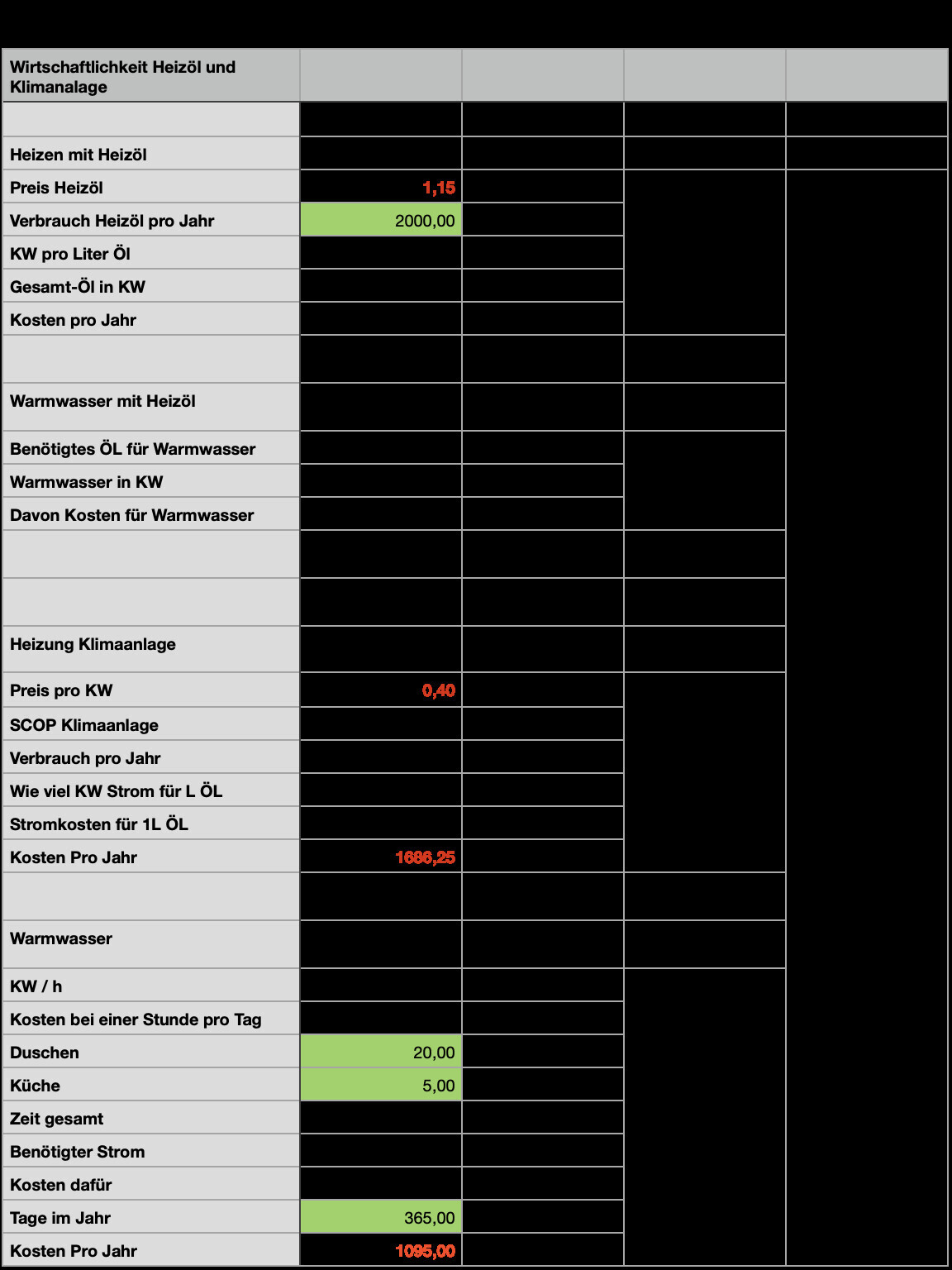
I hope this is understandable. Has anyone had experience with this?
Did I forget to consider anything?
The values are purely theoretical. There would also be a wood stove added, which would reduce the heating demand, and it is planned to install a photovoltaic system in the near future.
Thanks
I am currently looking for solutions for a new heating system. There is nothing installed at the moment, which means everything needs to be done from scratch.
I tried comparing a traditional oil heating system with an air conditioning unit that has a SCOP of 4 and an 18kW (18,000 BTU/h) instantaneous water heater for the bathroom and kitchen. For reference in the calculations, I used 2000 liters (530 gallons) of heating oil, which was also the basis for calculating the energy consumption of the air conditioning unit.
I created a table to theoretically calculate and compare this: (Hot water with the oil heating system is calculated based on the kW values of the instantaneous water heater)
I hope this is understandable. Has anyone had experience with this?
Did I forget to consider anything?
The values are purely theoretical. There would also be a wood stove added, which would reduce the heating demand, and it is planned to install a photovoltaic system in the near future.
Thanks
Wolf6660 schrieb:
I hope this is clear. Does anyone have experience with this?
Have I forgotten to consider anything? Are you allowed (or do you want) to install an oil heating system at your place? Without solar thermal?
Capital and maintenance costs should also be taken into account. For an oil system with a 3000-liter (790-gallon) oil tank, the total costs should be around 12,000-15,000 euros. Are radiators / distribution / underfloor heating already installed? If not, these costs will be additional.
For the multi-split system (5-6 indoor units?) and the decentralized ventilation units (DLHs), the total costs should be similar. So you could leave those out.
However, maintenance for the oil heating system with chimney service is more expensive than just cleaning the indoor units.
For consumption, you are calculating an efficiency of 100% for the oil heater. I would rather assume 90%, and for hot water preparation, including heat storage and distribution losses, rather 60-70%.
The energy demand for hot water of 2800 kWh is realistic for a household of four people (unless they take lots of baths and long hot showers).
Given the amount of hot water, I would recommend a domestic hot water heat pump. If installed in the basement, it achieves a yearly coefficient of performance (COP) of about 3.0. Yes, you have roughly 20% more consumption due to storage and distribution losses, but still significantly less overall. The heat pump unit itself, including a 200-liter (53-gallon) tank, costs around 2000-2500 euros. Installation is very simple: connect the inlet with the safety group, connect the outlet (or screw, solder, press, whatever is suitable), and plug it in. But some plumbers charge exorbitant fees for this. A good decentralized ventilation unit with installation also won’t cost less than 1000 euros, and the kitchen and possibly the guest toilet also need to be supplied.
The domestic hot water heat pump is especially practical if you plan to use photovoltaic electricity in the future. By scheduling the heating during the half-day (e.g., starting at 9:00 a.m.), the photovoltaic power can be optimally used without intermediate storage. With decentralized ventilation units, you get very short peaks, so direct use is not feasible and the inverters cannot store the power reliably at this load.
If you need two outdoor units anyway, there is also the option to use one of the outputs on the outdoor unit for hot water preparation in a hot water tank. Some manufacturers offer systems where one outdoor unit can serve 3 indoor units plus hot water, or up to 4 indoor units plus hot water.
You should also compare operating costs over 10 years, as price developments will play a role... but nobody can predict that for you.
Edit: And check again what kW and kWh mean and understand their relationship. Your calculations don’t seem wrong, only the labels are misleading.

Regardless of your question, please do not start a new thread for every topic (which ultimately all relate to "Can a wood stove be operated with water heating without a central heating system?" or "Heating for a small older house of about 80m² (860 sq ft) with low ceiling height"). By now, we have a rough idea of what has happened but still lack technical data, photos, or comprehensive information. Instead, there are only fragmented threads that reflect your thoughts bit by bit.
To achieve a reasonable outcome for you, please provide a detailed description of the building project or, in this case, the property you are planning to purchase, as well as the intended use. Based on that, the forum members will be able to offer good advice on how to reach your goal within appropriate conditions (or if it is not feasible).
Please always specify the federal state, or better, the town, as some options depend on the location and what is permitted.
To achieve a reasonable outcome for you, please provide a detailed description of the building project or, in this case, the property you are planning to purchase, as well as the intended use. Based on that, the forum members will be able to offer good advice on how to reach your goal within appropriate conditions (or if it is not feasible).
Please always specify the federal state, or better, the town, as some options depend on the location and what is permitted.
dertill schrieb:
Are you allowed to (or do you want to) install an oil heating system at your place? Without solar thermal?
Capital and maintenance costs should also be considered. For an oil system with a 3000 l (790 gallons) oil tank, total costs should be around 12,000–15,000 euros. Are radiators, distribution piping, or underfloor heating already installed? Otherwise, those will add to the costs.
For a multi-split system (5–6 indoor units?) and the instantaneous water heaters, the total costs should be similar. So, you could leave them out.
Maintenance for oil heating with chimney cleaner service is more expensive than just cleaning out the indoor units.
You are calculating oil consumption assuming 100% efficiency. I would rather estimate 90% efficiency for the heating system and about 60–70% for hot water production, considering losses from the storage tank and distribution.
The amount of energy for hot water at 2800 kWh is realistic for a 4-person household (unless you have frequent baths and long showers).
With that amount of hot water, I would recommend a domestic hot water heat pump. If installed in the basement, it can achieve a Coefficient of Performance (COP) of nearly 3.0 over the year. Yes, there is about 20% additional energy demand due to storage and distribution losses, but still significantly less than other methods. The pump itself with a 200 l (53 gallons) storage tank costs around 2,000–2,500 euros. Installation is very simple: connect the inlet with a safety group, connect the outlet (screw, plug, solder, press – whatever applies), and plug it into the socket. However, some installers charge very high prices. A good instantaneous water heater with installation is also not available for less than 1,000 euros, and the kitchen and possibly a guest bathroom also need to be supplied.
The domestic hot water heat pump makes particular sense if you plan to use photovoltaic (PV) electricity in the future. Because it charges over half a day (e.g., set to start at 9:00 AM), the PV electricity can be optimally used without intermediate storage. With instantaneous water heaters, the usage peaks are short, so direct PV use is not feasible and inverters cannot store excess power effectively.
If you need two outdoor units anyway, there is also the option to use one of the outdoor unit's outputs for hot water heating in a storage tank. For example, Daikin offers a system called Multi+ for three indoor units plus hot water, and Hitachi offers the Multi + Yutampo system for hot water plus four indoor units.
You should also compare operating costs over ten years, as price trends matter... but no one can predict those.
Edit: Also, take another look at what kW and kWh mean and understand the difference. Your calculations don't seem wrong, but the terminology is misleading. Hi,
thank you for your detailed reply.
The plan was either heating oil or air conditioning.
We have calculated roughly 15,000 euros for the oil heating (including DIY work like laying pipes, installing radiators, etc.).
For the air conditioning project, the numbers are:
- 1,000 euros per room, with 4 units totaling 4,000 euros and an SCOP of around 4–4.5 (e.g., LG).
- 400 euros for the instantaneous water heater serving both bathroom and kitchen, which are next to each other. This will cover hot water for the bathroom and kitchen—obviously, either showers or kitchen hot water, but I think that’s manageable. Unfortunately, two people in the household like 10-minute showers. I usually shower for at most 3 minutes, but I’m not the standard.
- 1,500 euros for a wood stove
- 1,000 euros for a stainless steel chimney, possibly if the current chimney is no longer usable. This will be decided by the chimney service.
Total is approximately 6,900 euros.
A friend who works in refrigeration and air conditioning will do the installations—costs are some beer and food 🙂
If I take the saving of about 8,000 euros and add a little more savings, I can install the photovoltaic system next year at the latest.
I am not sure whether the domestic hot water heat pump can operate without a central heating system or whether it is cost-effective. The basement is minimal, with only a small crawl space of about 15 m² (160 ft²) and a ceiling height of 1.5 m (5 ft). The heat pump could be placed in the utility room where electricity and network distribution are located. However, cost-effectiveness is important here. You mentioned a purchase price of 2,500 euros with a COP of 3. I need to find out how much I would spend and if it is really worthwhile.
The instantaneous water heater uses a lot of electricity but only when hot water is needed. If we don’t use water that day because we showered at the gym and then went out for dinner, there is no electricity use. With a heat pump, the question is whether it continuously draws electricity to keep the water warm or not.
I am considering if all of this makes sense. No one can predict what will happen in the coming years. The oil price will certainly not drop significantly anytime soon, and I doubt it will return to approximately 0.40 euros per liter (about $1.50 per gallon).
With electricity, I see the advantage that I can produce it myself (the roof is south-facing), so I can influence the costs somewhat. Together with a wood stove, I think this could work.
I am still unsure and read a lot online. But the more I read, the more uncertain I get. That’s why I started focusing on facts and created a table. I can play around with the current prices and calculate scenarios where electricity costs drop to 0.30 euros per kWh and heating oil to 0.80 euros per liter, and even then the difference is small – that stood out to me.
Thanks, and I welcome more ideas and experiences.
i_b_n_a_n schrieb:
Regardless of your question, please do not start a new thread for every topic (which ultimately all relate to "Can you operate a wood stove with water heating without a central heating system?" or "Heating for a small older house around 80sqm (860 sq ft) with low ceiling height"). By now, we have a rough idea of what happened, but there are no technical data, images, or comprehensive information. Just fragmented threads that partly reflect your thought processes.
To achieve a meaningful result for you, please provide a detailed description of the construction project or, in this case, the property you plan to purchase, as well as the intended use. Based on that, forum members will be able to give you useful advice on how to reach your goal under reasonable conditions (or if it’s not possible).
Please always specify the federal state, or better the town, since permitted options depend on the location. Yes, I can do that. I get smarter with each post and work my way through each contribution and report on the internet. My appointment with the energy consultant is not until next month. I will prepare some pictures and a floor plan with measurements so that you can better understand the problem. That’s a good idea and another step forward – THANK YOU.
Wolf6660 schrieb:
With an instantaneous water heater, a lot of electricity is needed, but only when hot water is actually used. For example, if I showered at the gym and then went out for a meal, no electricity would be required that day. With a heat pump, the question is whether it continuously consumes electricity to keep the water at temperature or not? Even considering losses, you save more than 50% electricity when heating water. That would be about €600 per year for you compared to the instantaneous water heater, despite roughly €2,000 higher upfront costs. For a small living space, I would recommend a domestic hot water heat pump (DHW HP) with outdoor air intake or one of the systems mentioned where the DHW HP is connected to the outdoor unit of a split air conditioning system.
I understand you want to install either air conditioning or oil heating.
For an 80m² (860 sq ft) area, I find a 20 MWh annual heat demand quite high. I would suggest improving roof insulation and replacing some windows before upgrading the heating system; otherwise, the system might not be properly balanced.
Similar topics