
ᐅ 30m driveway without connection to stormwater drain: how to implement?
Created on: 6 Aug 2019 08:05
S
si_reHello everyone,
I hope this is the right subforum (or would landscaping have been better?).
Since our building plot is set back from the main road (parcel 331), we bought a second parcel together with our neighbors (332) to use as an access road (parcel 337). It is about 30 meters (98 feet) long and about 3 meters (10 feet) wide. Until now, I thought we would simply pave it and direct the rainwater into the sewage system (of course with a drainage permit).
Yesterday, I called the local water authority. They told me that we are not allowed to discharge the water there because parcel 337 has no sewer connection. We are not permitted to use the sewer line of our residential building. Instead, we should use permeable paving and avoid any slope.
Avoiding a slope doesn’t make sense to me, because I don’t want to be walking through puddles.
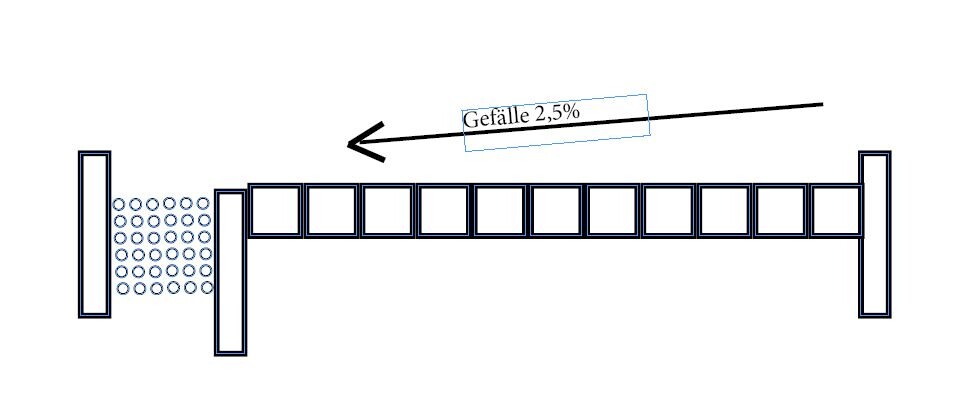
So, what should I do? Would the solution in picture 2 work? Or do you have a better idea?
Below are 2 pictures:
Picture 1 shows the parcels: our house will be built on 331, our neighbors own 332, the access road is parcel 337, and the adjoining street is parcel 339.
Picture 2 shows my idea for drainage: a cross-section of our road (from right to left): curbs, permeable paving, a lowered curb, a gravel pit, curb

Best regards,
Simon
I hope this is the right subforum (or would landscaping have been better?).
Since our building plot is set back from the main road (parcel 331), we bought a second parcel together with our neighbors (332) to use as an access road (parcel 337). It is about 30 meters (98 feet) long and about 3 meters (10 feet) wide. Until now, I thought we would simply pave it and direct the rainwater into the sewage system (of course with a drainage permit).
Yesterday, I called the local water authority. They told me that we are not allowed to discharge the water there because parcel 337 has no sewer connection. We are not permitted to use the sewer line of our residential building. Instead, we should use permeable paving and avoid any slope.
Avoiding a slope doesn’t make sense to me, because I don’t want to be walking through puddles.
So, what should I do? Would the solution in picture 2 work? Or do you have a better idea?
Below are 2 pictures:
Picture 1 shows the parcels: our house will be built on 331, our neighbors own 332, the access road is parcel 337, and the adjoining street is parcel 339.
Picture 2 shows my idea for drainage: a cross-section of our road (from right to left): curbs, permeable paving, a lowered curb, a gravel pit, curb
Best regards,
Simon

Hello,
permeable paving definitely works. We installed a product called Rinn Hydropor Padio Splittfuge (from Rinn Beton- und Naturstein GmbH) because we could only achieve a slope of 1% (0.4 inches per foot). It works great—even during heavy downpours, no puddles form. Also, the city cannot charge drainage fees for this area. Of course, the subsoil must be suitable. It doesn’t work on clay soil…
Best regards,
Andreas
permeable paving definitely works. We installed a product called Rinn Hydropor Padio Splittfuge (from Rinn Beton- und Naturstein GmbH) because we could only achieve a slope of 1% (0.4 inches per foot). It works great—even during heavy downpours, no puddles form. Also, the city cannot charge drainage fees for this area. Of course, the subsoil must be suitable. It doesn’t work on clay soil…
Best regards,
Andreas
Similar topics