
S
Sockeldichtung18 Jan 2026 23:38Good evening,
Our landscaper paved our driveway up to the garage with a gravel joint about 3 - 4 cm (1.2 - 1.6 inches) wide, as shown in the picture. This is not really ideal because some gravel keeps coming out of the joint. Also, the loose gravel probably won’t create enough lateral pressure in the long term, which may cause the stones to shift.
How can this be improved? The joint should remain permeable because the pavement is approximately level with the garage floor. Our idea is to remove about 2 - 3 cm (0.8 - 1.2 inches) of gravel from the joint and fill it with drainable concrete. What do you think?
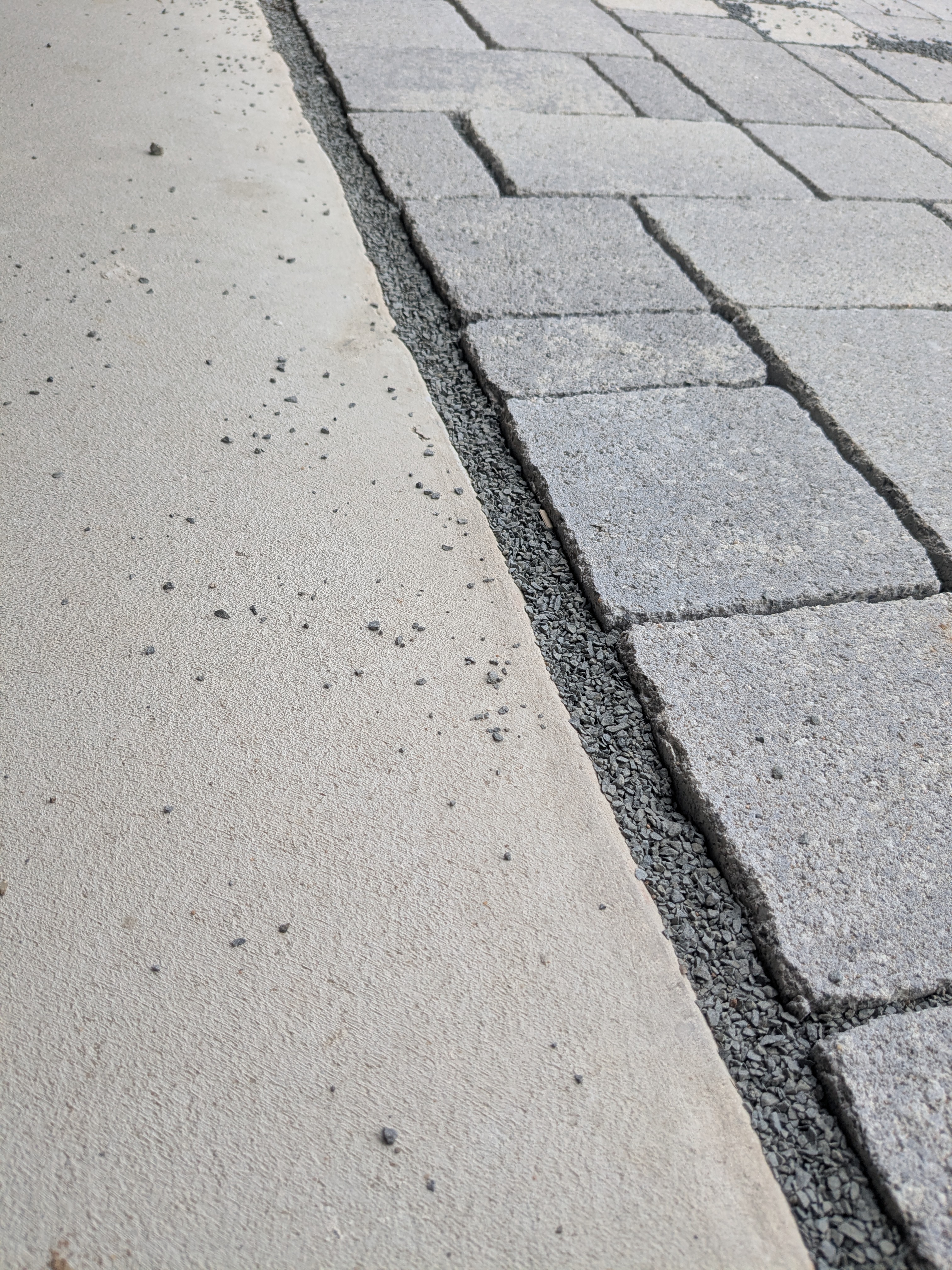
Our landscaper paved our driveway up to the garage with a gravel joint about 3 - 4 cm (1.2 - 1.6 inches) wide, as shown in the picture. This is not really ideal because some gravel keeps coming out of the joint. Also, the loose gravel probably won’t create enough lateral pressure in the long term, which may cause the stones to shift.
How can this be improved? The joint should remain permeable because the pavement is approximately level with the garage floor. Our idea is to remove about 2 - 3 cm (0.8 - 1.2 inches) of gravel from the joint and fill it with drainable concrete. What do you think?
S
Sockeldichtung1 Feb 2026 21:15Does nobody have an opinion on this idea or an alternative suggestion?
M
MachsSelbst1 Feb 2026 23:19What is supposed to drain away there? If the paving next to the garage has a slope of at least 2%, then you don’t need that strip. In that case, lift the stones and lay the paving up to the garage with joint width. Otherwise, a drainage channel is required there, and the paving should be laid normally with joint spacing along it.
At this spot, an epoxy resin joint filler was used. It is significantly more expensive than regular grouting, but since it is only this joint (the rest of the surface has standard joints), it has held up very well for about 10 years without crumbling. Ours is approximately 2cm (0.8 inches) wide.
S
Sockeldichtung9 Feb 2026 00:54The top edge of the pavement is approximately level with the garage floor and then slopes downward at a 2 - 3% gradient. In heavy rain with wind blowing towards the garage, water would probably still be forced into the garage if the joint were completely sealed. Therefore, in my case, epoxy resin is probably not ideal, but I will keep it in mind.
Installing a channel drain now would be quite labor-intensive. Is there any reason not to consider drainage mortar?
Installing a channel drain now would be quite labor-intensive. Is there any reason not to consider drainage mortar?

The mortar will not lift.
This should have been planned in advance. If it couldn’t be done differently, the joint could have been brought forward or simply larger paving stones could have been placed exactly at the edge.
What you can try is using gravel stabilizer to seal the joint.
This should have been planned in advance. If it couldn’t be done differently, the joint could have been brought forward or simply larger paving stones could have been placed exactly at the edge.
What you can try is using gravel stabilizer to seal the joint.
Similar topics