
Hello everyone,
This concerns a house built in 1965, where we have so far removed a laminate floor in one room on the ground floor. Beneath it, we found a suspected vinyl/PVC flooring. Since we would like to convert the house to underfloor heating, this flooring is also planned to be removed.
A contractor had previously told us (without a thorough inspection) that the flooring did not contain asbestos. Trusting that, we have already lifted the flooring at one corner and detached it from the underlying screed (naively and unfortunately without any protective equipment). However, due to the construction of the flooring, we have become doubtful whether asbestos might be present.
To clarify in advance, we have already ordered a test kit for laboratory analysis. However, it will still take several days until the kit arrives, the sample is sent in, and the lab results are available. Because of the potential fiber release, we are now very concerned about our health and the consequences for our renovation project, so we would greatly appreciate an initial professional assessment.
Unfortunately, we did not take any pictures and currently do not dare to enter the house again, so I will try to describe the situation as precisely as possible:
The suspected vinyl/PVC flooring consists of two layers: a foamed decorative layer with a wood pattern (similar to mosaic parquet imitation) and a thin white backing layer. We do not have reliable information on this, but the flooring was likely (not necessarily) installed around the time the building was constructed in 1965. The flooring was laid as one continuous sheet covering the entire room (about 4 x 4 m (13 x 13 ft)).
It is a flexible flooring that can be folded back over the walking surface without breaking. When peeling the flooring off the adhesive, no pieces broke off from the backing layer and remained stuck to the adhesive. The backing layer does not have a paper/cardboard-like or brittle structure but rather a smooth surface. When lifting the corner, the flooring tore slightly from the corner due to adhesion to the adhesive (it can tear but does not snap).
Additionally, there is a print on the backing layer, presumably the manufacturer’s name or logo. Because only one piece of flooring was lifted, it is difficult to read clearly. What is clearly visible is the word “Guarantee” printed in several languages.
The flooring is firmly glued to the underlying screed with a light brown adhesive. Considerable force is required to detach the flooring. The adhesive is somewhat matte and also not brittle or crumbly. It has a slight solvent smell (as far as I can tell) and still sticks a little bit to shoes when standing on it. However, it is less sticky than, for example, walking over dried lemonade on the floor (anyone with children may be familiar with that).
Based on recommendations from other threads, we would especially appreciate a professional assessment from @KlaRa.
Thank you very much and best regards
This concerns a house built in 1965, where we have so far removed a laminate floor in one room on the ground floor. Beneath it, we found a suspected vinyl/PVC flooring. Since we would like to convert the house to underfloor heating, this flooring is also planned to be removed.
A contractor had previously told us (without a thorough inspection) that the flooring did not contain asbestos. Trusting that, we have already lifted the flooring at one corner and detached it from the underlying screed (naively and unfortunately without any protective equipment). However, due to the construction of the flooring, we have become doubtful whether asbestos might be present.
To clarify in advance, we have already ordered a test kit for laboratory analysis. However, it will still take several days until the kit arrives, the sample is sent in, and the lab results are available. Because of the potential fiber release, we are now very concerned about our health and the consequences for our renovation project, so we would greatly appreciate an initial professional assessment.
Unfortunately, we did not take any pictures and currently do not dare to enter the house again, so I will try to describe the situation as precisely as possible:
The suspected vinyl/PVC flooring consists of two layers: a foamed decorative layer with a wood pattern (similar to mosaic parquet imitation) and a thin white backing layer. We do not have reliable information on this, but the flooring was likely (not necessarily) installed around the time the building was constructed in 1965. The flooring was laid as one continuous sheet covering the entire room (about 4 x 4 m (13 x 13 ft)).
It is a flexible flooring that can be folded back over the walking surface without breaking. When peeling the flooring off the adhesive, no pieces broke off from the backing layer and remained stuck to the adhesive. The backing layer does not have a paper/cardboard-like or brittle structure but rather a smooth surface. When lifting the corner, the flooring tore slightly from the corner due to adhesion to the adhesive (it can tear but does not snap).
Additionally, there is a print on the backing layer, presumably the manufacturer’s name or logo. Because only one piece of flooring was lifted, it is difficult to read clearly. What is clearly visible is the word “Guarantee” printed in several languages.
The flooring is firmly glued to the underlying screed with a light brown adhesive. Considerable force is required to detach the flooring. The adhesive is somewhat matte and also not brittle or crumbly. It has a slight solvent smell (as far as I can tell) and still sticks a little bit to shoes when standing on it. However, it is less sticky than, for example, walking over dried lemonade on the floor (anyone with children may be familiar with that).
Based on recommendations from other threads, we would especially appreciate a professional assessment from @KlaRa.
Thank you very much and best regards
robinrd schrieb:
Unfortunately, we didn’t take any pictures and we’re currently too afraid to go into the house,That’s quite unreasonable. You should know that asbestos is only dangerous if the material is disturbed and the fibers become airborne. Go inside and take photos instead of describing something that you haven’t seen yourself.Thank you for the quick reply!
The issue of fiber release is, of course, well known. As described, the covering is unfortunately already torn in one spot and has detached from the adhesive. So if asbestos is present, the fibers are very likely to be in the room.
Best regards
The issue of fiber release is, of course, well known. As described, the covering is unfortunately already torn in one spot and has detached from the adhesive. So if asbestos is present, the fibers are very likely to be in the room.
Best regards
A
Asbestosteron12 Jul 2025 15:03robinrd schrieb:
The issue of fiber release is, of course, well known. As described, the covering has unfortunately already torn in one spot and detached from the adhesive. So, if it contains asbestos, the fibers are very likely present in the room. Your question is similar to asking, "Can you get lung cancer from smoking just one cigarette in your life?"
If we told you that your current and future time spent in the house would result in a loss of 0.023% of your lung capacity, what would you do?
Sorry, it seems I was not clear enough in my original post.
My question was not about the possible consequences in case of fiber release. Instead, based on the extensive expertise and experience in this forum, I was hoping for an initial professional assessment of whether the described flooring and adhesive might contain asbestos at all (of course, hoping for some reassurance).
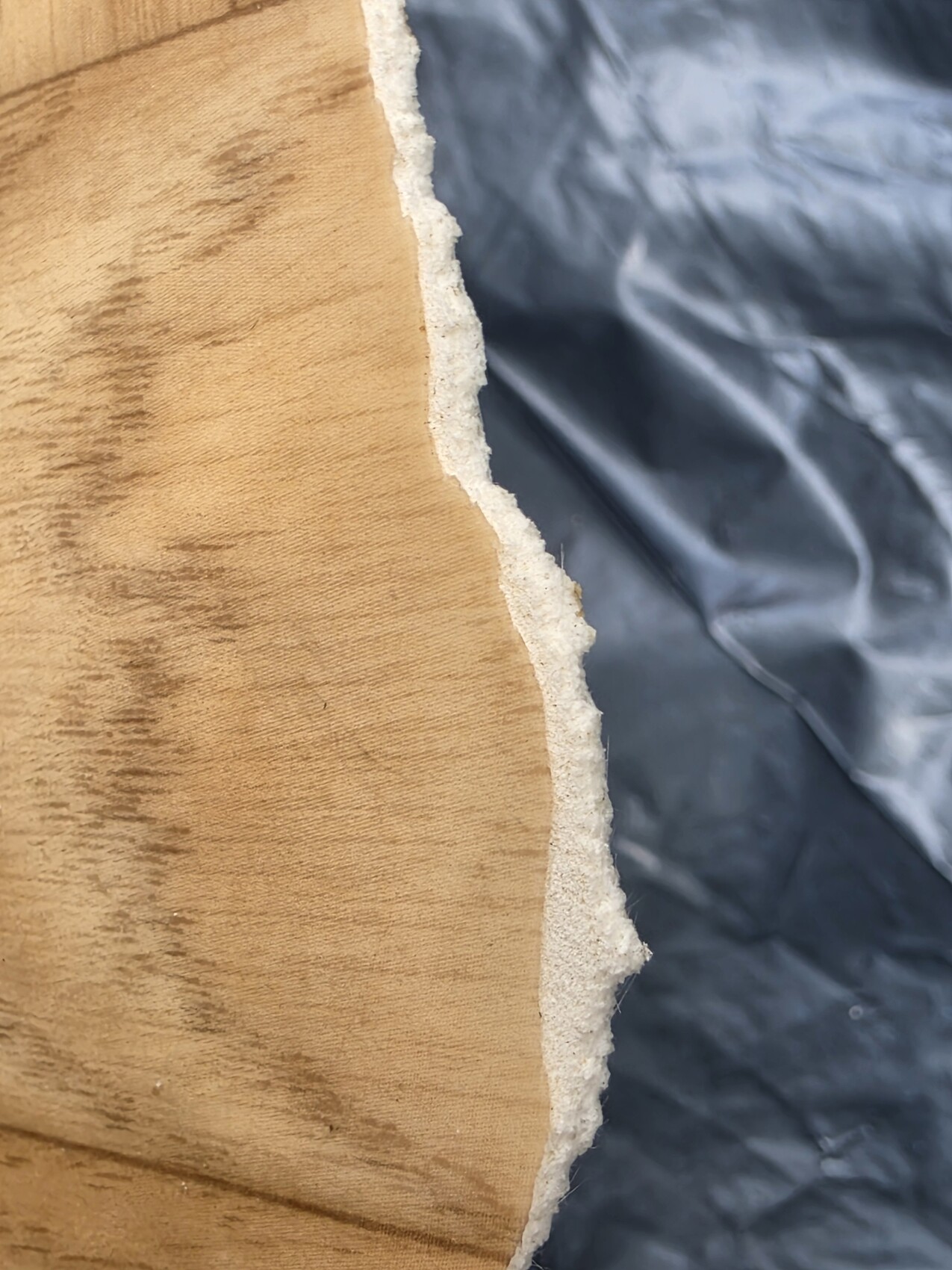
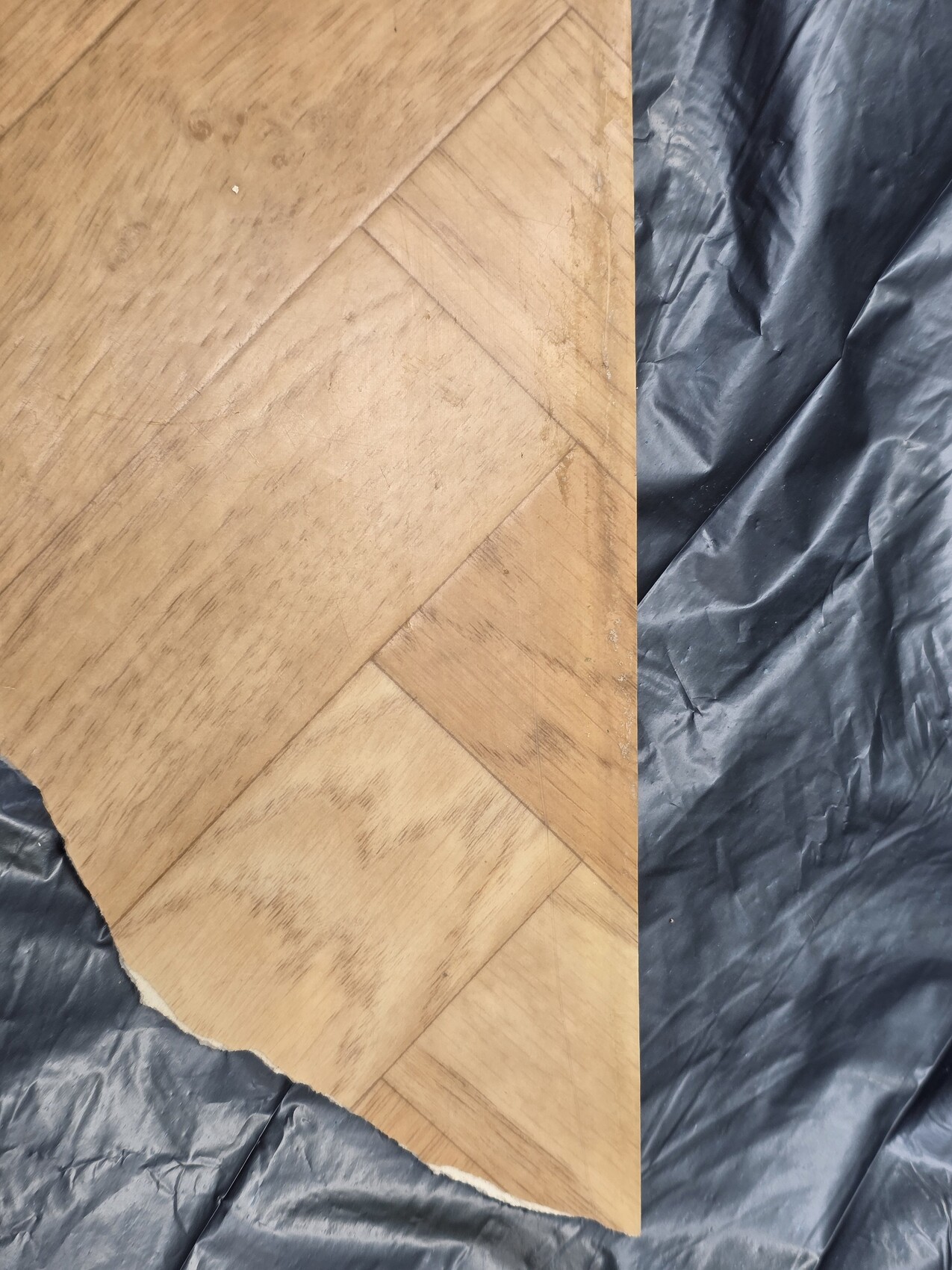
I visited the site again today to take samples, this time with the appropriate protective equipment. I carefully detached the piece that was already separated from the underlying screed in the corner and also took some photos (the black background is a foil and is only used to improve contrast). What you can see is:
- Two-layer construction (Image 1)
- Thin, long fibers at the torn edge, either in the lower layer or possibly between the two layers (Image 2)
- Decorative layer with wood pattern (Image 3)
- Printed underside and light brown adhesive (Image 4)
- Both the flooring and the adhesive are very flexible and can be bent or folded without breaking or tearing (without breaking or tearing) (Image 5)
It is also interesting that although the flooring was fully glued to the screed, it was not glued “edge to edge” as I know it, for example, from the installation of modern parquet flooring.
Thank you very much for your support and best regards



My question was not about the possible consequences in case of fiber release. Instead, based on the extensive expertise and experience in this forum, I was hoping for an initial professional assessment of whether the described flooring and adhesive might contain asbestos at all (of course, hoping for some reassurance).
I visited the site again today to take samples, this time with the appropriate protective equipment. I carefully detached the piece that was already separated from the underlying screed in the corner and also took some photos (the black background is a foil and is only used to improve contrast). What you can see is:
- Two-layer construction (Image 1)
- Thin, long fibers at the torn edge, either in the lower layer or possibly between the two layers (Image 2)
- Decorative layer with wood pattern (Image 3)
- Printed underside and light brown adhesive (Image 4)
- Both the flooring and the adhesive are very flexible and can be bent or folded without breaking or tearing (without breaking or tearing) (Image 5)
It is also interesting that although the flooring was fully glued to the screed, it was not glued “edge to edge” as I know it, for example, from the installation of modern parquet flooring.
Thank you very much for your support and best regards
robinrd schrieb:
Based on the extensive expertise and experience in this forum, a first professional assessment was hoped for,But that is contradictory: expertise according to description. robinrd schrieb:
of course with appropriate protective equipmentI hope you disposed of it properly!Then just wait and see what the lab tells you. How long will that take?
Similar topics