
R
Reavon12328 May 2024 22:43Hello dear forum members!
Last year, we had the opportunity to build a house in Berlin, and now we want to work on the exterior landscaping. First, we want to complete the splash guard / eaves edge around the house. Due to the high costs for landscaping and civil engineering contractors, we have decided to try the project ourselves initially.
We have already thoroughly researched the type of eaves edge, know how wide it needs to be, how to build the different layers, and which edging stones we want.
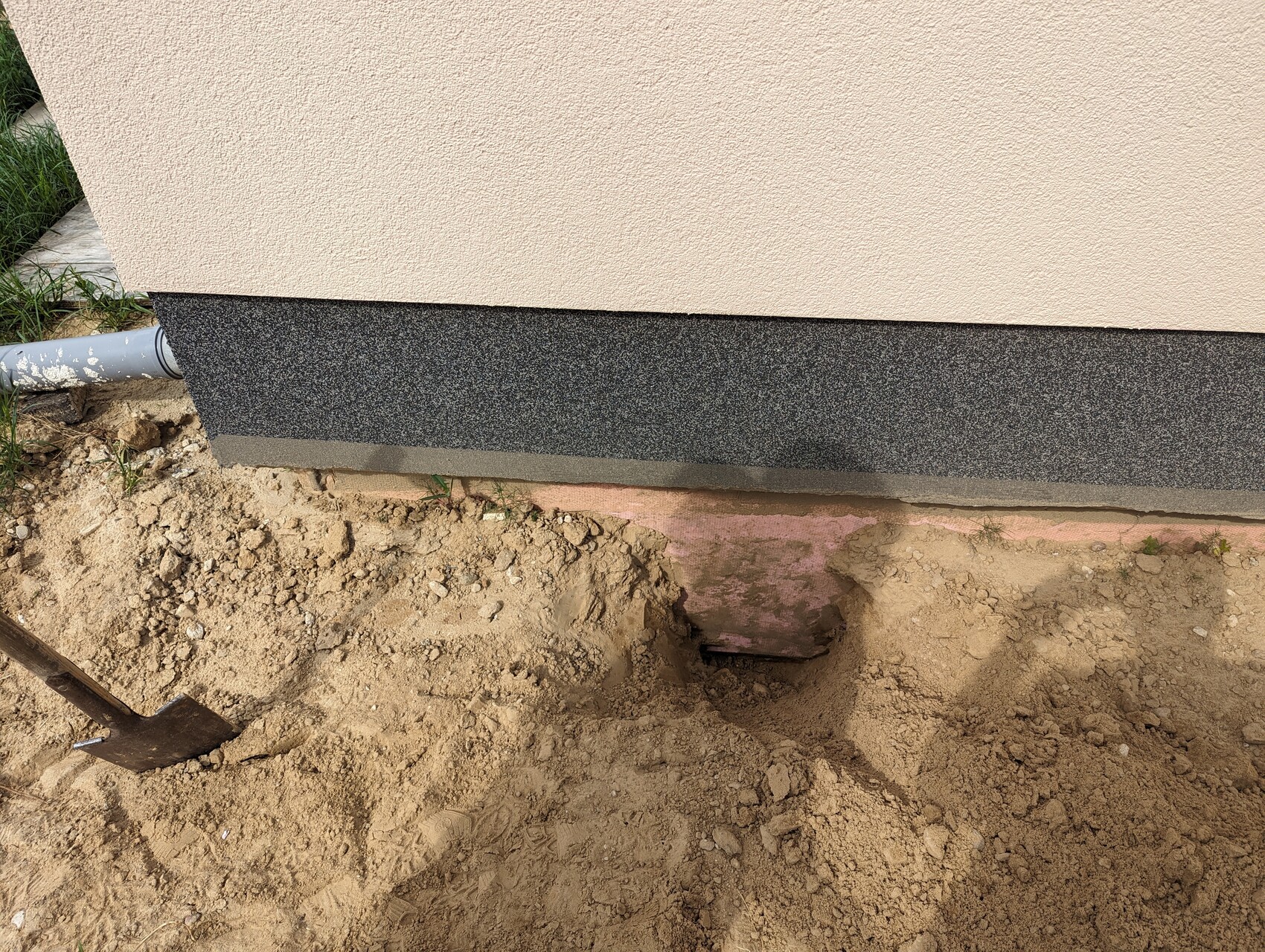
What is still unclear to us is the question of the preparatory work on the base of the building. According to my research, the base (plinth) should be coated with bitumen. The question is, how far “down” should it be coated? I did a test excavation and found that the pink insulation extends about 75cm (30 inches) into the ground. Does the entire part need to be coated?
I will upload some photos to help make it clearer.
Best regards and many thanks in advance for your help!

Last year, we had the opportunity to build a house in Berlin, and now we want to work on the exterior landscaping. First, we want to complete the splash guard / eaves edge around the house. Due to the high costs for landscaping and civil engineering contractors, we have decided to try the project ourselves initially.
We have already thoroughly researched the type of eaves edge, know how wide it needs to be, how to build the different layers, and which edging stones we want.
What is still unclear to us is the question of the preparatory work on the base of the building. According to my research, the base (plinth) should be coated with bitumen. The question is, how far “down” should it be coated? I did a test excavation and found that the pink insulation extends about 75cm (30 inches) into the ground. Does the entire part need to be coated?
I will upload some photos to help make it clearer.
Best regards and many thanks in advance for your help!
N
nordanney28 May 2024 22:48Nothing is sealed down there anymore. Instead, you place sealing between the house wall/basement wall/foundation and the insulation. You don’t need to apply additional waterproofing.
The base is already finished with waterproof slurry and colored pebble dash plaster. Now you just need to install the splash guard. Although normally you would also put a dimpled membrane between the pink insulation and the earth slab.
The base is already finished with waterproof slurry and colored pebble dash plaster. Now you just need to install the splash guard. Although normally you would also put a dimpled membrane between the pink insulation and the earth slab.
nordanney schrieb:
No more painting will be done down there. I completely agree.
Reavon123 schrieb:
According to my research, the base should still be coated with bitumen. That work is already done. There is a dimpled membrane in front of it, and that’s sufficient.
Reavon123 schrieb:
We have thoroughly studied the design of the eaves edge and know how wide it needs to be, how to build up the relevant layers, and which edging stones we want. Just don’t make it too narrow and use gravel so that water can drain properly into the ground. Then apply a visible finish layer of your choice.
“Sufficient layers” might be overstating it.
R
Reavon12329 May 2024 09:37Thank you very much in advance for your quick help! How deep should I install the dimpled membrane? Up to the bottom edge of the pink insulation? Should it go a little higher than the level of the waterproofing slurry – right?

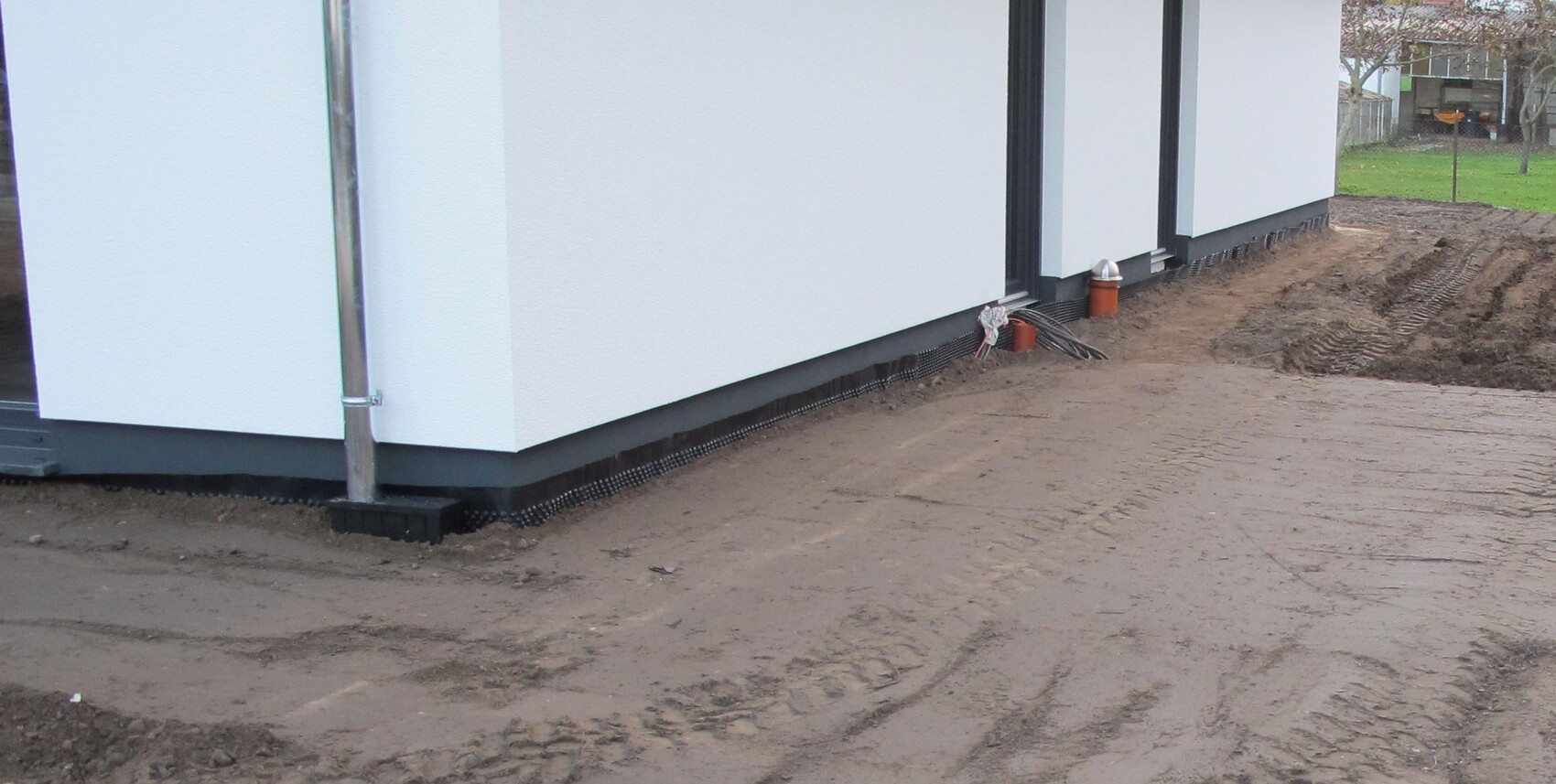
We installed the dimple membrane down to the bottom (end of your insulation) and then upwards to the point where the eaves edge ends. Then we laid a row of edge stones. Between the house and the edge stones, we spread gravel, covered it with a dark geotextile fabric, and finally added large dark stones on top.
M
MachsSelbst29 May 2024 21:57Well, if the 5cm (2 inches) bitumen coating at the bottom is enough for you. The site manager told me that where soil, crushed stone, or gravel comes into contact, the bitumen coating should be extended up to the top edge of the layer and then a dimpled membrane installed against it. The dimpled membrane is not a waterproofing layer but purely mechanical protection...
But go ahead with the colored stone plaster, that will probably work great too.
But go ahead with the colored stone plaster, that will probably work great too.
Similar topics