
ᐅ Is it advisable to start painting while the screed is still drying?
Created on: 21 Aug 2023 15:28
J
jrth2151Our screed has now been in the house for almost 4 weeks, and of course, we have been ventilating properly all along. Starting soon, hopefully at the beginning of September, we will begin the functional and readiness heating, which will release a significant amount of moisture.
According to our site manager, we can already start with the filling and sanding work so that only wallpaper and paint will be needed afterwards. Do you agree with this, or should we wait at least 3-4 weeks of heating? We are a bit worried that the plaster might come off the ceiling during heating if we do all the filling now.
The kitchen installer is scheduled for November 2nd. By then, the painting and flooring work must be completed. After that, we can move in. Therefore, we would like to use the drying time productively so that the final phase is not too stressful.
According to our site manager, we can already start with the filling and sanding work so that only wallpaper and paint will be needed afterwards. Do you agree with this, or should we wait at least 3-4 weeks of heating? We are a bit worried that the plaster might come off the ceiling during heating if we do all the filling now.
The kitchen installer is scheduled for November 2nd. By then, the painting and flooring work must be completed. After that, we can move in. Therefore, we would like to use the drying time productively so that the final phase is not too stressful.
K
KarstenausNRW21 Aug 2023 15:48After four weeks, the (assuming cement screed) is already dry enough to safely carry out all other work. There is no longer a significant amount of moisture coming out. It is said that, under normal conditions and average thickness, cement screed is often dry enough for floor covering after two months.
Simply place a 1x1 meter (3x3 feet) sheet of plastic on the floor, tape down the edges, and check after one day how dry or damp the underside of the sheet is. This is a rough test to assess readiness for floor covering – it will help you get a sense of the moisture level in the screed.
Simply place a 1x1 meter (3x3 feet) sheet of plastic on the floor, tape down the edges, and check after one day how dry or damp the underside of the sheet is. This is a rough test to assess readiness for floor covering – it will help you get a sense of the moisture level in the screed.
KarstenausNRW schrieb:
After four weeks, the (I assume cement screed) is already dry enough for you to safely carry out all other work. There won’t be any significant moisture coming out anymore. It is said that under normal conditions and average thickness, cement screed is often dry enough for floor covering after two months.
Simply place a 1x1 m (3x3 ft) sheet of plastic on the floor, seal the edges, and check after one day how dry or damp the plastic is underneath. This is a rough test for readiness for covering – but it helps you get a feel for the moisture in the screed. Yes, cement screed. Until now, I thought most of the moisture is only released during heating. Otherwise, why heat it for so long? Currently, the indoor humidity after 24 hours with closed windows is around 80-90%, depending on the floor level. By ventilating, we reduce it to about 60%, which mostly matches the outdoor humidity shown on the weather app on most days. And yes, the temperature inside and outside is almost the same right now, with about ±1° Celsius (approximately 2°F) difference. So, we can’t ventilate more effectively than that.
K
KarstenausNRW21 Aug 2023 16:17jrth2151 schrieb:
Why else would you heat for so long? There are two reasons.
1. Initially, a functional heating phase is carried out. According to DIN standards, this tests the correct operation of the heating system with screed (including thermal expansion, etc.), ensuring that everything works properly during normal use. This also provides proof for the heating installer that the system was correctly commissioned and handed over. In the past, before heat pumps operated with supply temperatures as low as 30°C (86°F), most heating protocols specified 50-55°C (122-131°F) supply temperature because this matched the maximum temperature for underfloor heating. Today, it is often enough to heat only up to around 35°C (95°F) or the system’s maximum design temperature, which makes sense if higher temperatures are not used. You should check what is required in your case.
This process takes a few days.
2. After that, there is the drying heating phase, which drives out the last residual moisture from the nearly dry screed. This step is especially important for bonded floorings like parquet since the parquet adhesive acts almost like a moisture barrier. Tiles are less sensitive in this regard.
For clarification from online sources:
The issue is that screed may appear dry after four weeks, but you can’t be certain that everything is fine. Even very small amounts of moisture can still cause serious damage. That’s why professionals always err on the safe side, whether it is strictly necessary or not.
In my own properties with heat pumps, I have only heated up to the supply temperature and then checked the moisture myself as described in point 2. For safety, I then ran the system for two more days, and that was sufficient – but of course, you do this at your own risk and only if you manage the work yourself.
Alternatively, you can simply pay a bit more at the start for fast-drying screed. This allows parquet installation after just one week, and all other trades can proceed as usual. With good coordination or if you do some work yourself, this can be a worthwhile investment, especially if it means moving in up to two months earlier.
KarstenausNRW schrieb:
For two reasons.
1. Initially, a functional heating phase takes place. According to DIN standards, this is to thoroughly check the correct operation of the heating system with the screed (including longitudinal expansion etc.) to ensure that nothing is wrong during normal use. It also serves as proof for the heating installer that everything is working properly and that the trade has been completed correctly. In the past, before heat pumps with 30°C (86°F) flow temperature were common, most heating-up protocols specified a flow temperature of 50-55°C (122-131°F), as this matches the maximum temperature in underfloor heating systems. Nowadays, however, it is often heated only up to 35°C (95°F) or to the maximum design temperature of the heating system, which also makes sense if higher temperatures are not used. You’ll have to check what is required in your case.
This process takes a few days.
2. Afterwards, there is the drying heating phase to drive out the last residual moisture from the almost dry screed. This is especially important for glued floors such as parquet, since the parquet adhesive essentially acts as a moisture barrier. Tiles are less sensitive in this regard.
Explanation from the internet:
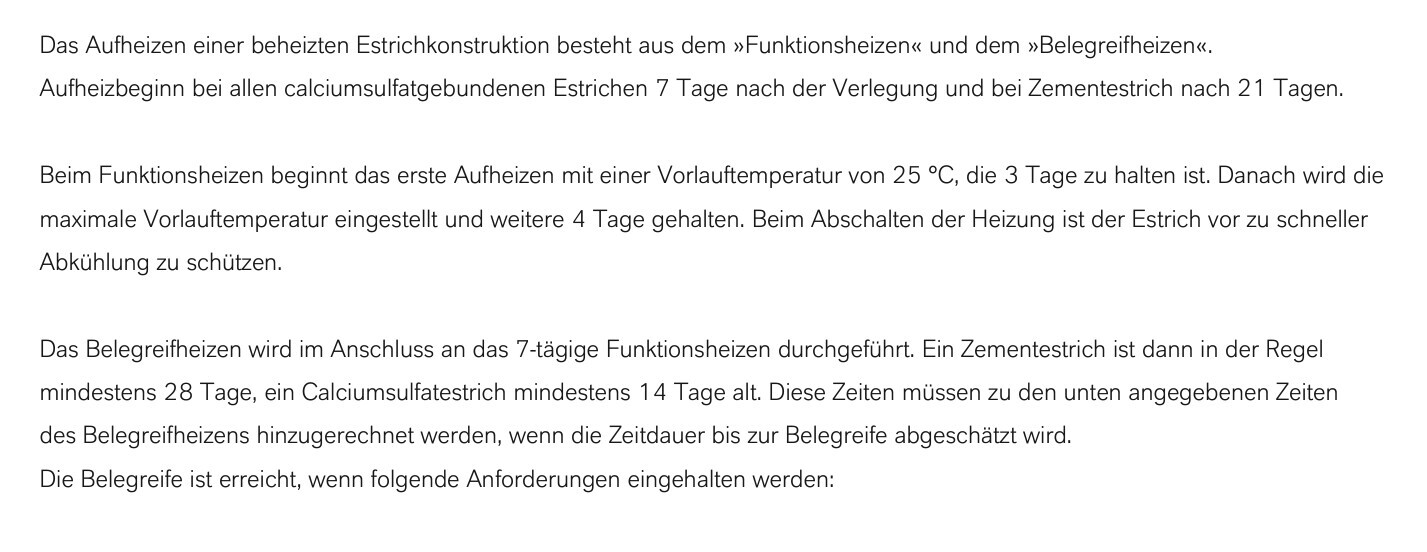
The problem is that the screed seems dry after four weeks. But you do not actually know if everything is okay or not. Even very low moisture can still cause significant damage. That’s why craftsmen always play it safe, whether necessary or not.
In my own properties with heat pumps, I have so far only heated up according to the flow temperature and then checked the moisture myself as described in #2. Then, as a precaution, I let it run for two more days and that was that – but you can only do this at your own risk and if you do the work yourself.
Alternatively, you can invest a few euros at the beginning in fast-drying screed. This allows parquet flooring to be installed after just one week – all other work is possible anyway. With good coordination or if you do the work yourself again, this can be money well spent if it means you can move into the house up to two months earlier. Thanks for all the information. To summarize:
Most of the moisture is probably already out, but the remaining moisture will be removed by heating. We plan to install click vinyl flooring, so we should get down to about 2% moisture content measured by CM (calcium chloride test), if I’ve researched correctly. The tiler will also come by and do a CM measurement, so we’ll have an interim report then.
I wouldn’t want to start wallpapering yet, but applying filler and things like that should be okay.
What surprises me is that the inside of our house was never really wet. Although we had 99% humidity, our neighbors in the development told us about wet, dripping ceilings etc. However, they all dried during winter/spring at low temperatures. This year, spring went straight from 10°C (50°F) to 30°C (86°F) in May/June. We only had windows very slightly wet from the inside, but even that wasn’t much.
K
KarstenausNRW21 Aug 2023 16:51jrth2151 schrieb:
Although we had 99% humidity, our neighbors in the development were talking about wet, dripping ceilings, etc. That’s understandable. Moisture condenses on cold surfaces. That will be challenging in summer ;-)
Similar topics