
ᐅ Which paint is suitable for a damp basement room – can I use modern dispersion paint?
Created on: 28 Apr 2023 09:42
J
jx7We want to convert a basement room into a pool room. Currently, the walls and ceiling consist of plastered sand-lime brick and concrete, painted with dispersion paint.
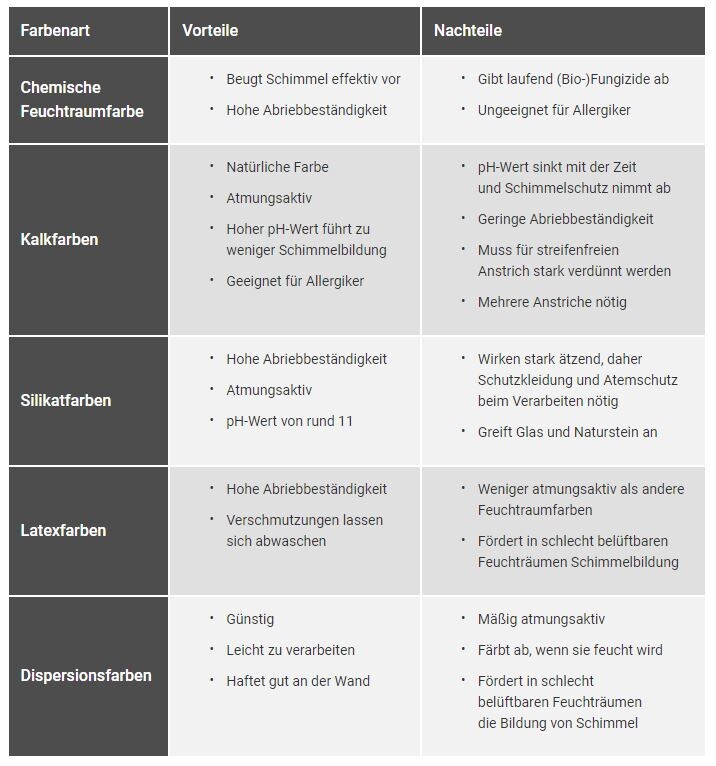
- Chemical moisture-resistant paint: doesn’t sound very appealing.
- Lime paint: good moisture and mold protection but not abrasion-resistant.
- Silicate paint: best properties but only works on a mineral substrate, so not over dispersion paint.
- Latex paint: moderate mold protection, moderately breathable.
- Dispersion paint: generally unsuitable for damp rooms.
Silicate paint sounds like the best option.
1) Is there a primer that can be used if you want to paint over dispersion paint?
2) Is it better to have genuine silicate paint mixed and applied by a professional painter? Or is dispersion-silicate paint also acceptable? It has a maximum of 5% organic content. Its properties are somewhat inferior to genuine silicate paint, but it is easier to apply.
3) Or should the dispersion paint be removed beforehand? But that sounds very labor-intensive.
- Chemical moisture-resistant paint: doesn’t sound very appealing.
- Lime paint: good moisture and mold protection but not abrasion-resistant.
- Silicate paint: best properties but only works on a mineral substrate, so not over dispersion paint.
- Latex paint: moderate mold protection, moderately breathable.
- Dispersion paint: generally unsuitable for damp rooms.
Silicate paint sounds like the best option.
1) Is there a primer that can be used if you want to paint over dispersion paint?
2) Is it better to have genuine silicate paint mixed and applied by a professional painter? Or is dispersion-silicate paint also acceptable? It has a maximum of 5% organic content. Its properties are somewhat inferior to genuine silicate paint, but it is easier to apply.
3) Or should the dispersion paint be removed beforehand? But that sounds very labor-intensive.

Tolentino schrieb:
So, how well can you ventilate there?A pool dehumidification system will be installed, which can extract 1.5 liters (1.6 quarts) of water per hour from the air at 25°C (77°F) and 60% humidity. (Meaco Wall 53).
K
KarstenausNRW28 Apr 2023 10:33jx7 schrieb:
Plastered calcium silicate brick and concrete painted with dispersion paint. Dispersion paint is already a disqualifying factor for silicate paint, as it does not adhere to it. You need a mineral-based substrate because silicate paint doesn’t just dry; it chemically bonds with the surface. Pure silicate paint is also quite difficult to apply.
It’s better to use sol-silicate paint, although I consider that (as well as dispersion silicate paint) rather pointless since the whole idea is to achieve the silification effect.
Now I’d rather ask what exactly you mean by “converting into a pool room.” Are you still excavating the basement for a pool? How large will the pool be? How will ventilation and exhaust be handled? What does the pool builder say?
KarstenausNRW schrieb:
But I think (just like dispersion silicate paint) it is nonsense because you actually want the silicification effect. Not necessarily. While silicification does provide excellent color durability and resistance, even without it, you still have a highly alkaline, diffusion-open paint (which reduces mold) that is much easier to apply than lime paint or "true" silicate paint.
I think it’s a bit of the best of both worlds.
The silicification is just the finishing touch, if you can afford it (professional painter) or don’t mind the extra effort (DIY).
Similar topics