
ᐅ Which paint is suitable for a damp basement room – can I use modern dispersion paint?
Created on: 28 Apr 2023 09:42
J
jx7
We want to convert a basement room into a pool room. Currently, the walls and ceiling consist of plastered sand-lime brick and concrete, painted with dispersion paint.
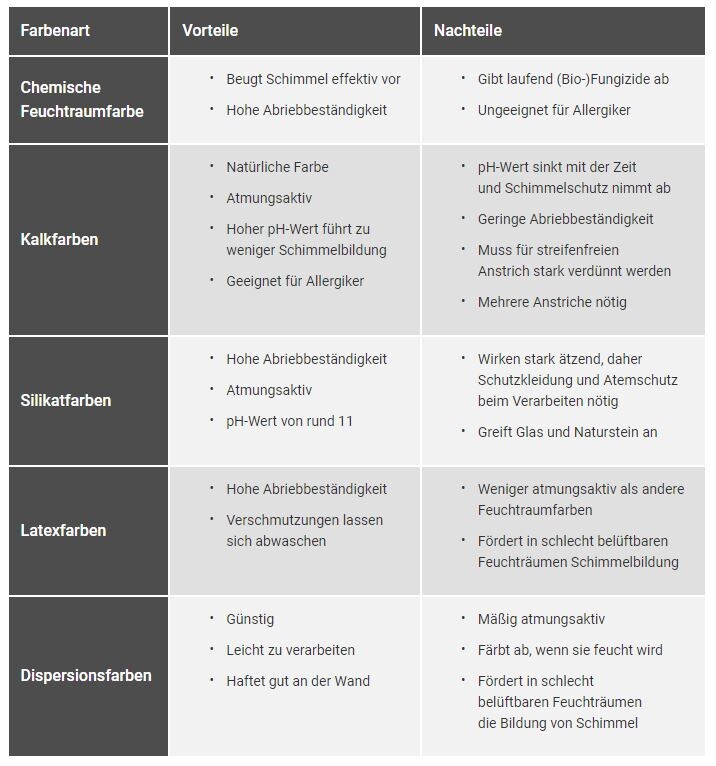
- Chemical moisture-resistant paint: doesn’t sound very appealing.
- Lime paint: good moisture and mold protection but not abrasion-resistant.
- Silicate paint: best properties but only works on a mineral substrate, so not over dispersion paint.
- Latex paint: moderate mold protection, moderately breathable.
- Dispersion paint: generally unsuitable for damp rooms.
Silicate paint sounds like the best option.
1) Is there a primer that can be used if you want to paint over dispersion paint?
2) Is it better to have genuine silicate paint mixed and applied by a professional painter? Or is dispersion-silicate paint also acceptable? It has a maximum of 5% organic content. Its properties are somewhat inferior to genuine silicate paint, but it is easier to apply.
3) Or should the dispersion paint be removed beforehand? But that sounds very labor-intensive.
- Chemical moisture-resistant paint: doesn’t sound very appealing.
- Lime paint: good moisture and mold protection but not abrasion-resistant.
- Silicate paint: best properties but only works on a mineral substrate, so not over dispersion paint.
- Latex paint: moderate mold protection, moderately breathable.
- Dispersion paint: generally unsuitable for damp rooms.
Silicate paint sounds like the best option.
1) Is there a primer that can be used if you want to paint over dispersion paint?
2) Is it better to have genuine silicate paint mixed and applied by a professional painter? Or is dispersion-silicate paint also acceptable? It has a maximum of 5% organic content. Its properties are somewhat inferior to genuine silicate paint, but it is easier to apply.
3) Or should the dispersion paint be removed beforehand? But that sounds very labor-intensive.
KarstenausNRW schrieb:
I'm more curious about what exactly you mean by "converting into a pool room"? Are you still excavating the basement for a pool? How large will the pool be? How will ventilation and air extraction be handled? What does the pool installer say? The screed and impact sound insulation will be removed where the pool is located. The pool will then sit on the 25 cm (10 inch) concrete slab. (Basically set 13 cm (5 inches) into the floor.)
Dimensions
Room: 5.08 m x 4.65 m x 2.31 m (16.7 ft x 15.3 ft x 7.6 ft)
Pool size: 2.46 m (width) x 4.60 m (length) – exterior / 2.13 m (width) x 4.27 m (length) – interior / 122 cm (48 inches) height
A pool dehumidifier will be installed, which can extract 1.5 liters (1.6 quarts) of water per hour from the air at 25° C (77°F) and 60% humidity. (Meaco Wall 53).
Unfortunately, there is no professional pool builder designing an overall concept. The pool is supplied by Endless Pool. In hindsight, I also see it as a significant disadvantage that the pool is only delivered and assembled without a complete concept developed by a professional. The assembly is modular. The parts are sized so they can be carried down the basement stairs. You can find a video on YouTube called "Installing an Endless Pool" to see how it’s done.
Tolentino schrieb:
Not necessarily. The silicification process definitely adds excellent color fastness and durability, but even without it, you still have a highly alkaline, vapor-permeable paint (which helps reduce mold) that is much easier to work with than lime paint or “true” silicate paint.
I think it’s a bit of the best of both worlds.
The silicification is just the finishing touch if you can afford a professional painter or don’t mind the extra effort if doing it yourself. That sounds good. But is there a way to apply a sol silicate or dispersion silicate paint without having to sand off the dispersion paint?
At the moment, I see three options:
a) Stick with the dispersion paint (since there is a dehumidifier that keeps the humidity at 60-70%)
b) Sand off the dispersion paint and use silicate paint (or sol silicate or dispersion silicate paint)
c) Apply a primer and then use sol silicate or dispersion silicate paint (Is that possible?)
I have found something else, see the attachment.
So the options now look like this:
1) Stay with dispersion paint (since there is a dehumidifier that keeps the humidity between 60-70 %)
2) Sand down the dispersion paint and use silicate paint
3) Apply primer and then use dispersion-silicate paint
4) Use sol-silicate paint (without primer)
I now see option 4) as having the best cost-benefit ratio.

So the options now look like this:
1) Stay with dispersion paint (since there is a dehumidifier that keeps the humidity between 60-70 %)
2) Sand down the dispersion paint and use silicate paint
3) Apply primer and then use dispersion-silicate paint
4) Use sol-silicate paint (without primer)
I now see option 4) as having the best cost-benefit ratio.
K
KarstenausNRW28 Apr 2023 11:06jx7 schrieb:
That sounds good. But is there a way to apply a sol-silicate paint or a silicate dispersion paint without sanding off the dispersion paint? You can apply sol-silicate paint directly over dispersion paint.
However, if it were my pool and I already had to put in considerable effort, I would consider two options:
1. Simply sand off the dispersion paint. It’s not a big task with the right sander and dust extraction, then apply the silicate paint.
2. Create a nice pool room with a separate shower, proper wall waterproofing, and on most walls NO paint at all, but instead use attractive tiles or seamless wall coatings (such as beton ciré, tadelakt, or similar) or decorative panels.
KarstenausNRW schrieb:
You can also apply the sol-silicate paint over the dispersion paint.
However, if it were my pool and I was already planning a significant effort, I would consider two options:
1. Just lightly sand the dispersion paint. It’s not a big job with the right sander and dust extraction, then apply the silicate paint.
2. Create a nice pool area with a separate shower, proper waterproofing on the walls, and on most walls NO paint, but rather attractive tiles or seamless wall coatings (such as Beton Ciré, Tadelakt, or similar) or decorative panels. The walls around the pool will be waterproofed and tiled, but not the entire room.
X
xMisterDx29 Apr 2023 18:37What type of plaster was used? If it’s gypsum plaster, then you can forget about using pure silicate paint because it does not chemically bond with gypsum.
If you want to benefit from the vapor permeability of silicate paint, any dispersive coatings must be removed first.
Simply applying 1mm of sol-silicate paint and hoping it won’t cause mold is not reliable.
Tiles, yes. But not everywhere, right? It’s supposed to be a pool, not a slaughterhouse.
If you want to benefit from the vapor permeability of silicate paint, any dispersive coatings must be removed first.
Simply applying 1mm of sol-silicate paint and hoping it won’t cause mold is not reliable.
Tiles, yes. But not everywhere, right? It’s supposed to be a pool, not a slaughterhouse.
Similar topics