
ᐅ Drainage from retention tank into higher-level stormwater sewer
Created on: 2 Nov 2022 20:03
M
mutzbratemM
mutzbratem2 Nov 2022 20:03Hello everyone 🙂
I’m new to the forum and have an interesting question right away. We are currently building a single-family house near Chemnitz and need to provide 3 cubic meters of retention volume per 100 sqm (1076 sq ft) of sealed surface area, as well as a discharge rate of 1 l/s (0.26 gal/s). In our case, that means 6000 liters (1585 gallons) of retention volume plus 4000 liters (1057 gallons) for own use, totaling a 10,000-liter (2642 gallons) monolithic concrete cistern (drive-over capable beneath the driveway).
Since the road is 50cm (20 inches) above the plot level and I want to drain freely by gravity into the cistern, it has to be installed relatively deep underground.
Problem: The retention throttle valve is located below the street’s sewer invert level, so a lift pump is required for drainage. The overflow is positioned just above the sewer, so that does not cause any issues.
The cistern installer suggested building a lift shaft next to the cistern where the throttle valve could discharge at 1 l/s (0.26 gal/s), and to install a submersible pump with a float switch there to pump the water into the sewer. Honestly… that sounds nonsense to me. The pump would keep switching on and off frequently, pumping a small amount at a rate above 1 l/s into the sewer, then shutting off… on and off again, and so on.
My idea was to install a submersible pump with a throttle valve directly in the cistern, draining through a hose into the sewer. I would fix the pump at the level between retention volume and storage volume. This way, no expensive retention throttle valve is needed, no hole in the wall is required, there’s no risk of leaks, and so on… only advantages, in my opinion.
What do you think? Would the wastewater utility have any objections here? How would you have solved or have you solved such a problem? I hope I have explained myself clearly and that someone can share their thoughts. 🙂
Best regards from the Erzgebirge
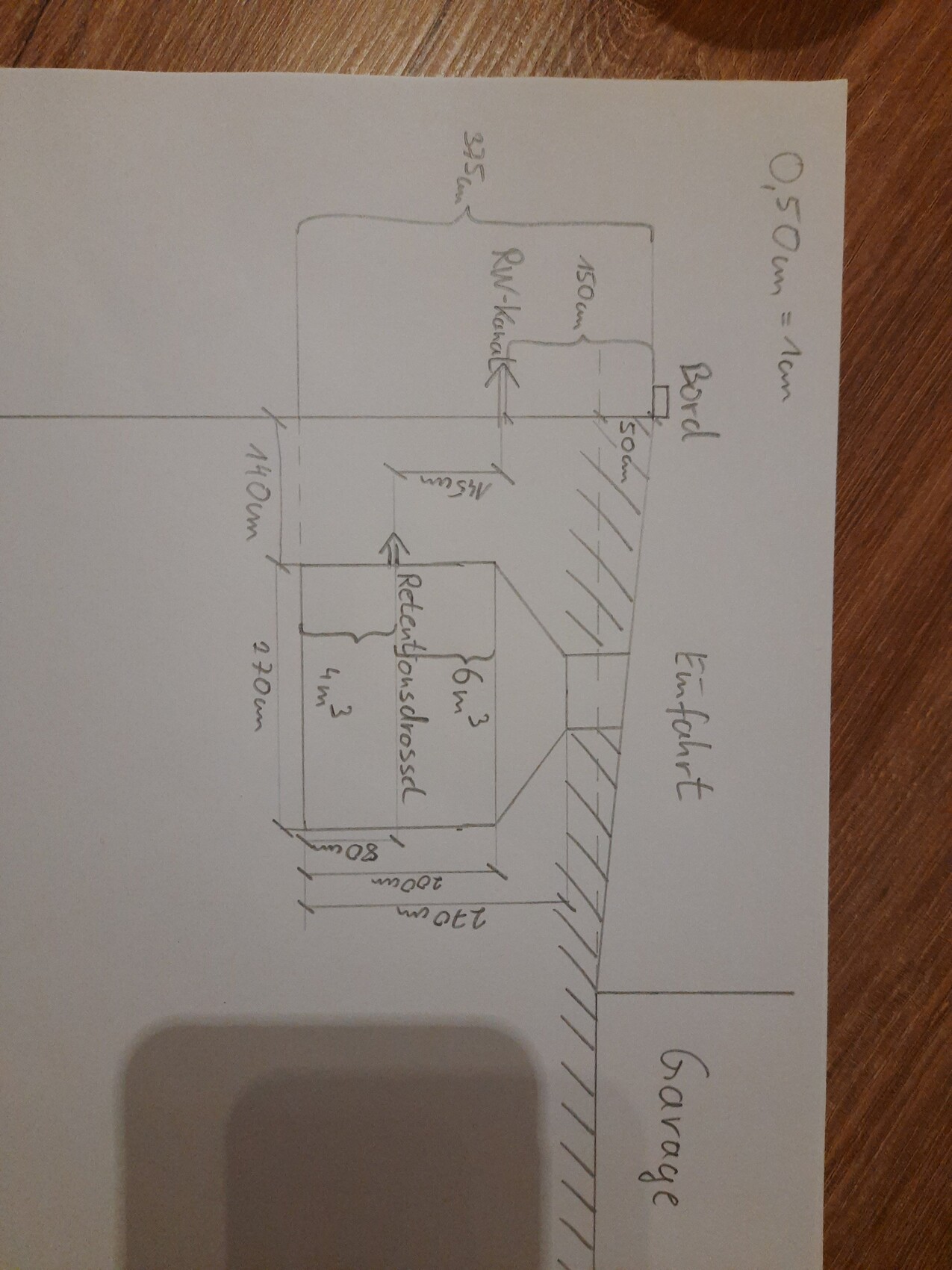
I’m new to the forum and have an interesting question right away. We are currently building a single-family house near Chemnitz and need to provide 3 cubic meters of retention volume per 100 sqm (1076 sq ft) of sealed surface area, as well as a discharge rate of 1 l/s (0.26 gal/s). In our case, that means 6000 liters (1585 gallons) of retention volume plus 4000 liters (1057 gallons) for own use, totaling a 10,000-liter (2642 gallons) monolithic concrete cistern (drive-over capable beneath the driveway).
Since the road is 50cm (20 inches) above the plot level and I want to drain freely by gravity into the cistern, it has to be installed relatively deep underground.
Problem: The retention throttle valve is located below the street’s sewer invert level, so a lift pump is required for drainage. The overflow is positioned just above the sewer, so that does not cause any issues.
The cistern installer suggested building a lift shaft next to the cistern where the throttle valve could discharge at 1 l/s (0.26 gal/s), and to install a submersible pump with a float switch there to pump the water into the sewer. Honestly… that sounds nonsense to me. The pump would keep switching on and off frequently, pumping a small amount at a rate above 1 l/s into the sewer, then shutting off… on and off again, and so on.
My idea was to install a submersible pump with a throttle valve directly in the cistern, draining through a hose into the sewer. I would fix the pump at the level between retention volume and storage volume. This way, no expensive retention throttle valve is needed, no hole in the wall is required, there’s no risk of leaks, and so on… only advantages, in my opinion.
What do you think? Would the wastewater utility have any objections here? How would you have solved or have you solved such a problem? I hope I have explained myself clearly and that someone can share their thoughts. 🙂
Best regards from the Erzgebirge
G
Gartenfreund3 Nov 2022 02:34Why don't you use 100% of the water for your garden?
Is the soil not suitable for that?
This is how I did it here.
When the cistern reaches a certain fill level, a wastewater pump (with a float switch) starts and directs the excess water into an above-ground slotted PVC pipe, which then distributes the water over several meters throughout the garden.
This way, I was able to avoid connecting to the sewer system and no longer have to pay any fees for it.
Is the soil not suitable for that?
This is how I did it here.
When the cistern reaches a certain fill level, a wastewater pump (with a float switch) starts and directs the excess water into an above-ground slotted PVC pipe, which then distributes the water over several meters throughout the garden.
This way, I was able to avoid connecting to the sewer system and no longer have to pay any fees for it.
M
mutzbratem3 Nov 2022 05:55In principle, a good idea. However, we have many regulations in the development plan from the wastewater association. We are building relatively high up on a mountain, and the soil is mainly clay on a slope. This means infiltration is not possible, and to reduce the load on the stormwater system, we are required to discharge stormwater at 1 l/s (0.26 gal/s). According to the development plan, a retention volume of 3000 l (792 gal) per 100 m² (1,076 sq ft) of impermeable surface is mandatory. The circumstances leave us no other choice.
Therefore, my question is whether, instead of a retention throttle with a sump pit, I can adequately drain the retention volume using a throttled submersible pump? Or will the utility authority object because it may be considered too susceptible to manipulation?
Therefore, my question is whether, instead of a retention throttle with a sump pit, I can adequately drain the retention volume using a throttled submersible pump? Or will the utility authority object because it may be considered too susceptible to manipulation?
B
borderpuschl3 Nov 2022 08:27Unfortunately, I can't think of a solution here either. However, keep in mind that the cistern also has an emergency overflow with a diameter of 100mm (4 inches). This must also lead directly into the stormwater drain. How do you plan to solve the problem if the cistern fills up during extended rain and the pumping capacity to the subsequent system is not sufficient?
W
WilderSueden3 Nov 2022 09:38Gartenfreund schrieb:
Why don’t you use the water 100% for your garden?If retention is required, the volume cannot be used effectively and air has to be buried. We have the same situation.Is there a way to install the cistern higher so that the overflow and retention can drain by gravity? Or raise the cistern using another cistern, for example, a flat tank?
M
mutzbratem3 Nov 2022 13:19Thank you for the responses and suggestions. Today, I finally spoke with a helpful colleague from the ZWA. He sent me some forms that clarify how I can manage the drainage.
Type 4 applies to my situation. That has cleared everything up. I will discuss the rest with the plumber, as they will design and supply the retention pump.
Nevertheless, many thanks to all of you!
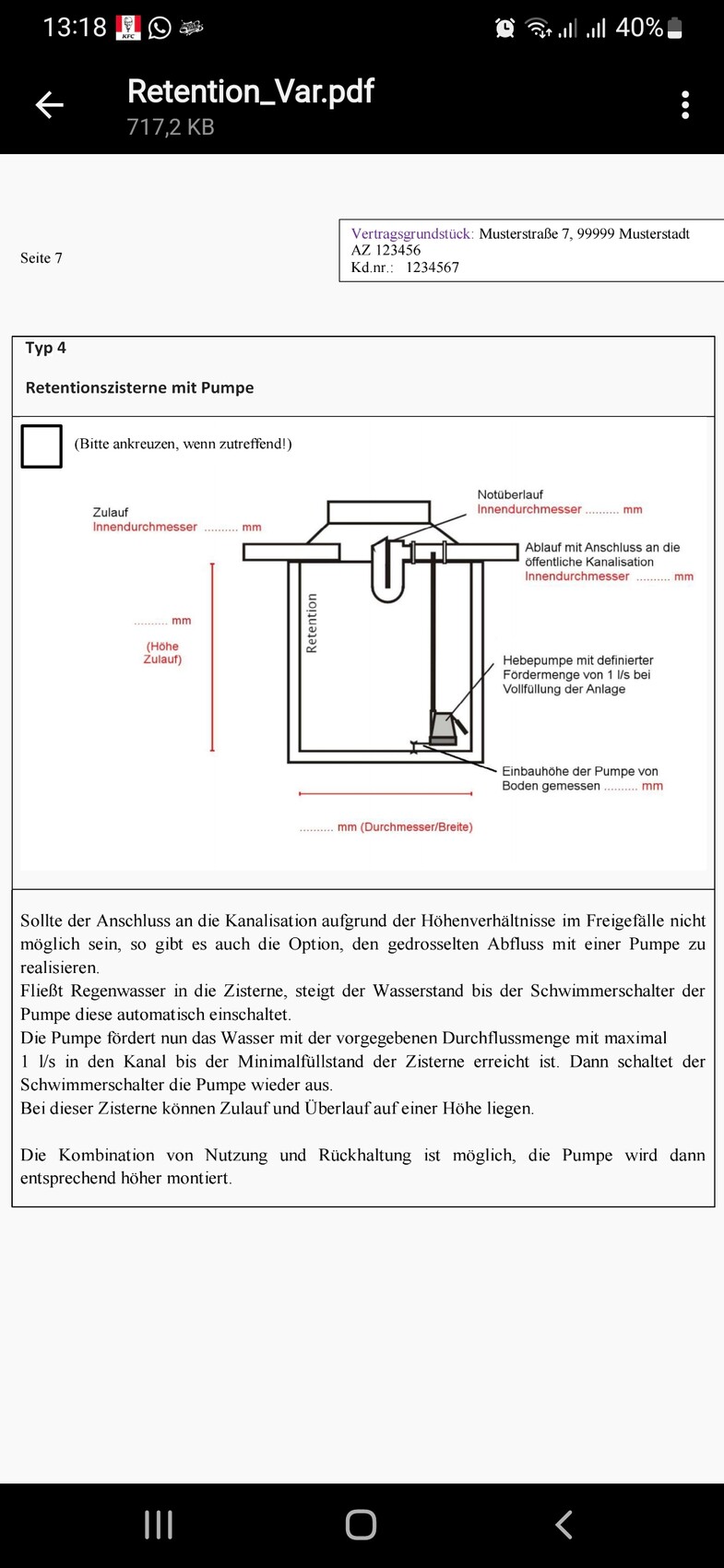
Type 4 applies to my situation. That has cleared everything up. I will discuss the rest with the plumber, as they will design and supply the retention pump.
Nevertheless, many thanks to all of you!
Similar topics