
ᐅ Cistern! I don’t want one, but I am being forced to have it – experiences
Created on: 15 Jan 2023 20:05
W
wesson76
Hello everyone,
According to our development plan, installing a cistern is mandatory. From an economic perspective, it doesn’t seem worthwhile; if I had the choice, I would skip it.
I have received the following all-inclusive offers (excavation, pump, etc., everything included):
1. 5200-liter (1375-gallon) cistern, €7,000
2. 2600-liter (686-gallon) cistern, €6,000
There is also the option of installing only the cistern without a usage system to meet the development plan’s requirements. For both offers, I would save about €1,000 on the pump and related equipment. However, this would mean burying something in the ground for €6,000–7,000 without any actual benefit, which is hard for me to accept.
Either way, I would use the cistern only for garden irrigation, with a maximum watering area of 220m² (2370 ft²). A garden water meter will definitely be installed; the fees are about €2 per cubic meter.
For me, only the economic aspect matters. Which option is the most cost-effective? I’m leaning toward the 2600-liter (686-gallon) cistern. Or would it be better to just bury the cistern without any usage?
Thank you in advance.
According to our development plan, installing a cistern is mandatory. From an economic perspective, it doesn’t seem worthwhile; if I had the choice, I would skip it.
I have received the following all-inclusive offers (excavation, pump, etc., everything included):
1. 5200-liter (1375-gallon) cistern, €7,000
2. 2600-liter (686-gallon) cistern, €6,000
There is also the option of installing only the cistern without a usage system to meet the development plan’s requirements. For both offers, I would save about €1,000 on the pump and related equipment. However, this would mean burying something in the ground for €6,000–7,000 without any actual benefit, which is hard for me to accept.
Either way, I would use the cistern only for garden irrigation, with a maximum watering area of 220m² (2370 ft²). A garden water meter will definitely be installed; the fees are about €2 per cubic meter.
For me, only the economic aspect matters. Which option is the most cost-effective? I’m leaning toward the 2600-liter (686-gallon) cistern. Or would it be better to just bury the cistern without any usage?
Thank you in advance.
I have decided to go with the 5200L (1375 gal) option. Where would you place the cistern in the garden?
So far, the plan was to position the cistern at the lower left, as close to the house as possible. However, since this would require dragging a 10m (33 ft) hose into the garden for watering, we are now considering placing the cistern directly in the garden, as shown by the red rectangle. It would be about 80cm (31 inches) from the neighboring property, as we plan to plant a hedge there.
According to the builder, this should not pose any technical issues.
Any thoughts?
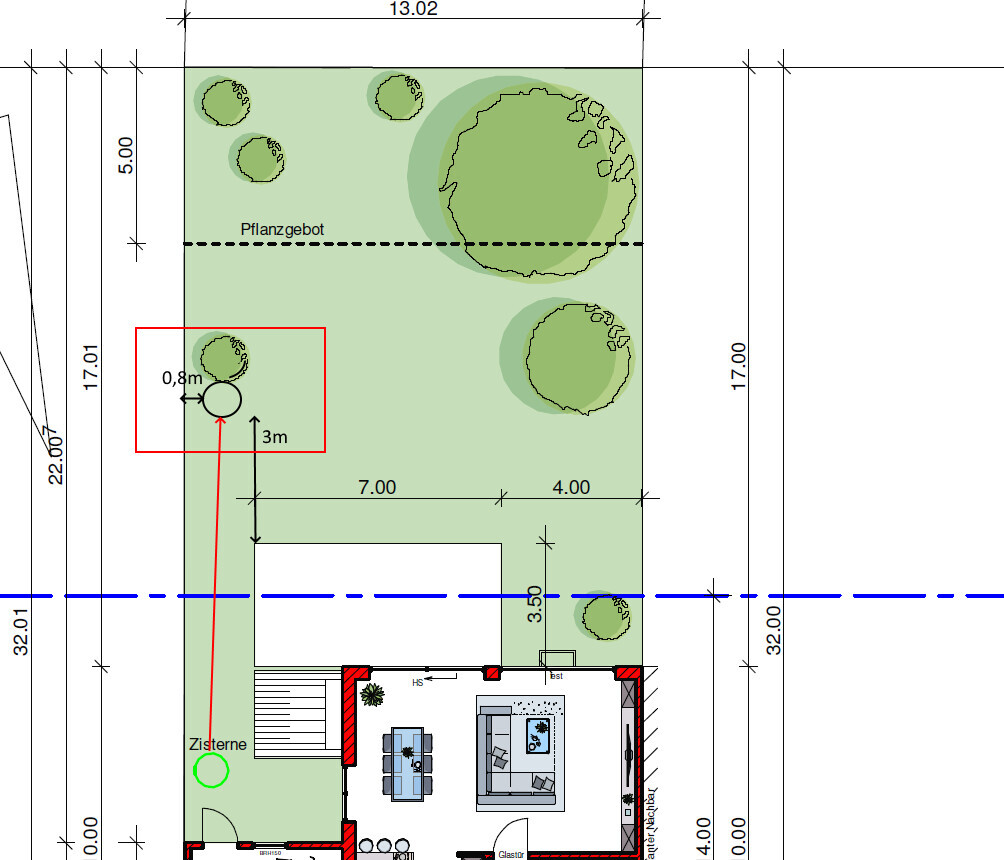
So far, the plan was to position the cistern at the lower left, as close to the house as possible. However, since this would require dragging a 10m (33 ft) hose into the garden for watering, we are now considering placing the cistern directly in the garden, as shown by the red rectangle. It would be about 80cm (31 inches) from the neighboring property, as we plan to plant a hedge there.
According to the builder, this should not pose any technical issues.
Any thoughts?

W
WilderSueden19 Jan 2023 08:54Keep in mind that a cistern is more than just the access cover. You need to excavate a larger area and then refill it. As far as I know, you are allowed to install cisterns within a 3-meter (10-foot) distance. I had considered this for our place as well. The cistern also needs to be positioned so that the truck can pull up directly to the excavation site.
When planning, you should also consider garden sheds, which will likely need to drain into the cistern. Generally, I would place the cistern to keep pathways as short as possible. For garden irrigation, you can then install a pipeline system with an additional tap point in the garden. This is something that can also be done as a DIY project.
When planning, you should also consider garden sheds, which will likely need to drain into the cistern. Generally, I would place the cistern to keep pathways as short as possible. For garden irrigation, you can then install a pipeline system with an additional tap point in the garden. This is something that can also be done as a DIY project.
X
xMisterDx25 Jan 2023 18:50For around 150 EUR, you can get a Gardena wall-mounted hose reel L with a 30m (98 feet) hose. No need to carry anything around.
Better to hide the ugly concrete cover than have it right in the middle of the garden.
Especially since the cistern will be full in winter and empty in summer.
In summer, you’ll easily need 4,000 liters (1,057 gallons) for a 200m² (2,153 square feet) garden with a lot of lawn, so about 16,000 liters (4,227 gallons) per month.
In my old home in the heart of Lower Saxony, it rains 84mm (3.3 inches) in July. With a 100m² (1,076 square feet) roof, you can collect 8,400 liters (2,220 gallons).
This is important to consider if you store or infiltrate rainwater on your own property. No rainwater fees apply. For an average single-family house, these fees can easily amount to 200 or 250 EUR per year.
Ultimately, municipalities save on costly rainwater drainage systems… what can you do.
Better to hide the ugly concrete cover than have it right in the middle of the garden.
Especially since the cistern will be full in winter and empty in summer.
In summer, you’ll easily need 4,000 liters (1,057 gallons) for a 200m² (2,153 square feet) garden with a lot of lawn, so about 16,000 liters (4,227 gallons) per month.
In my old home in the heart of Lower Saxony, it rains 84mm (3.3 inches) in July. With a 100m² (1,076 square feet) roof, you can collect 8,400 liters (2,220 gallons).
This is important to consider if you store or infiltrate rainwater on your own property. No rainwater fees apply. For an average single-family house, these fees can easily amount to 200 or 250 EUR per year.
Ultimately, municipalities save on costly rainwater drainage systems… what can you do.
W
WilderSueden26 Jan 2023 09:06xMisterDx schrieb:
No stormwater fees apply. This is not entirely correct. Depending on the municipality, the relevant areas are calculated at a reduced rate. For example, in our case, a factor of 0.5 applies if there is an overflow. Both paved surfaces and gravel areas are also included.
Similar topics