
ᐅ Lighting Design for a Single-Family Home with LED Recessed Spotlights – Number and Placement
Created on: 30 Jan 2022 22:58
S
Samantheus
Hello everyone,
I am currently working on the lighting plan for our single-family house construction project, as the ceiling order is coming up soon. The general floor plan planning thread was here: https://www.hausbau-forum.de/threads/grundriss-planung-und-platzierung-efh-ca-200qm-auf-900qm-Grundstück.39104/
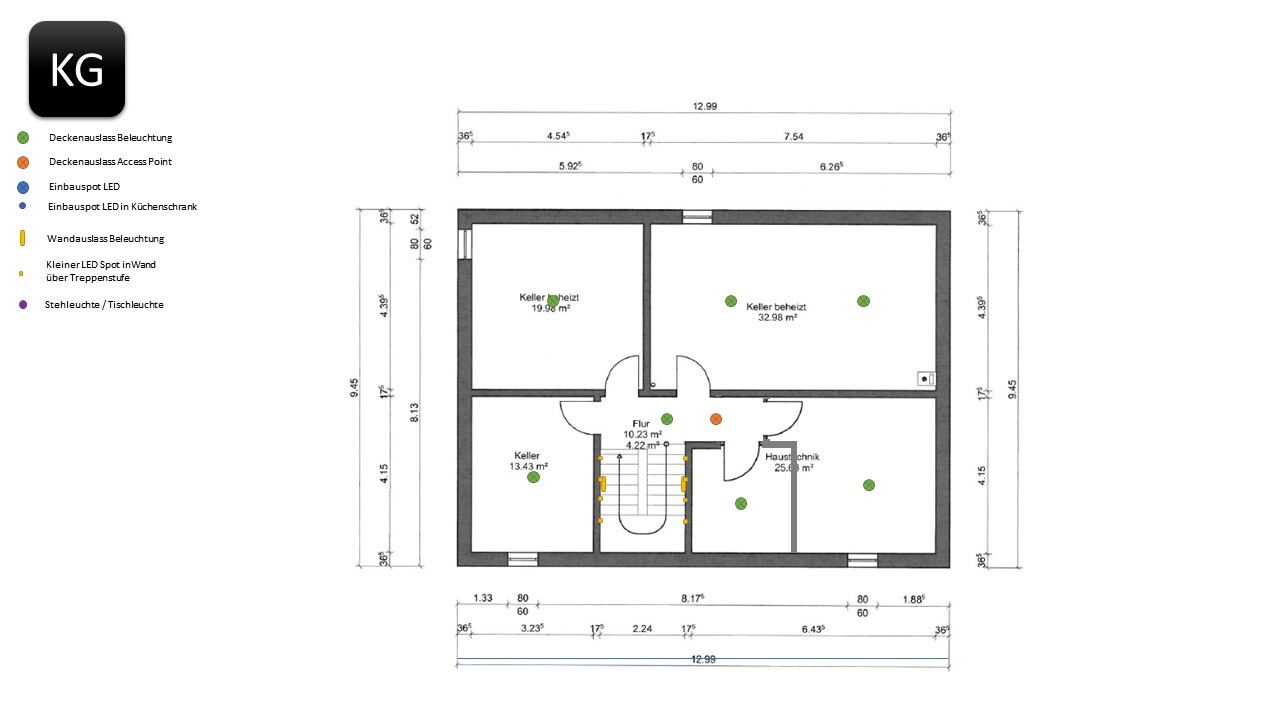
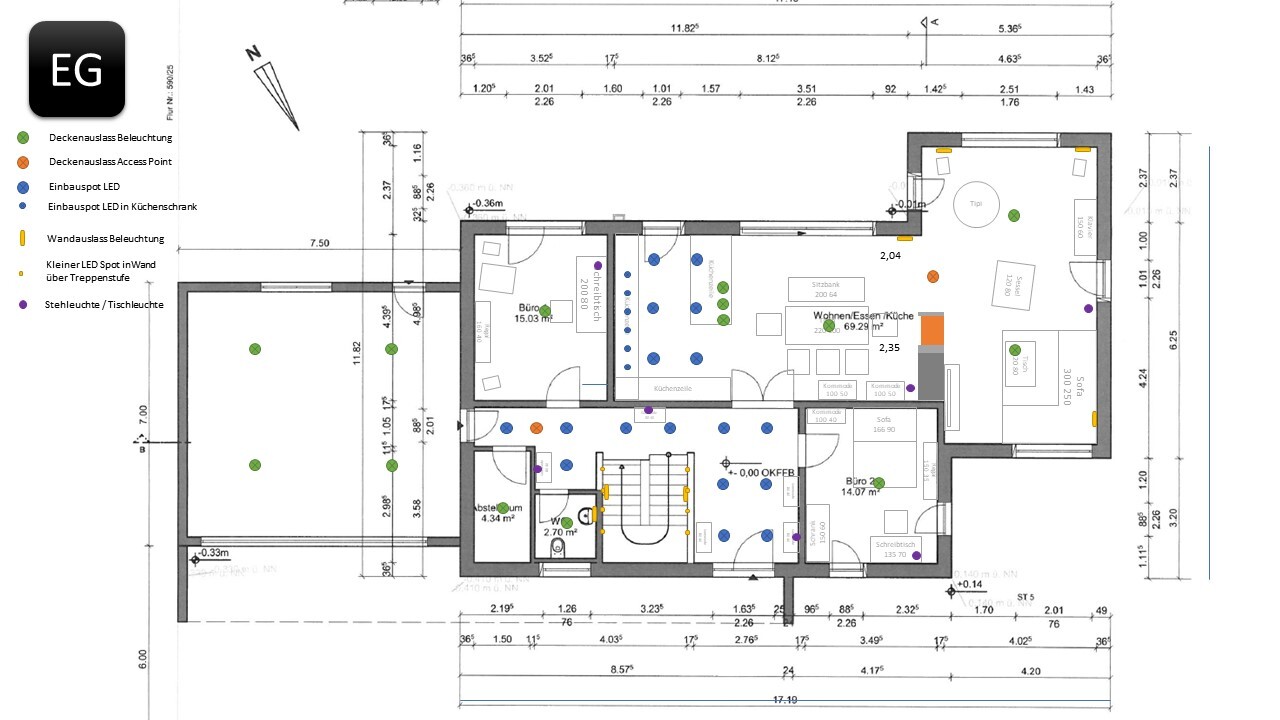
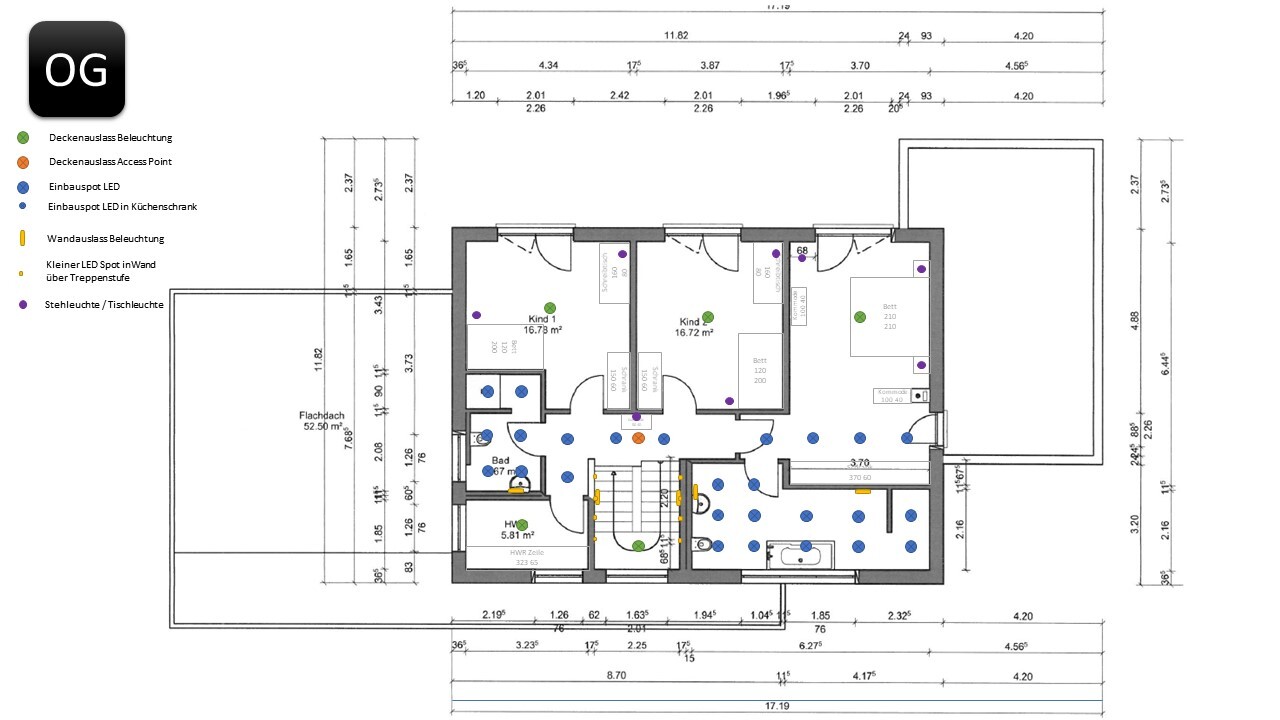
Attached are 3 images showing the planned lighting, which should hopefully be self-explanatory.
First, some general information: We prefer brighter lighting than some others might. I often find rooms too dark; I have never experienced a room as being too bright. Additionally, my wife strongly dislikes LED panels, LED strips, and anything along those lines. Smart home systems, motion sensors, etc., are not planned.
Our basic approach is that each room should have a "primary lighting" suited in brightness according to the room’s use:
Work areas (bathroom, kitchen, hallway, office, basement, garage): very bright
Living, dining, sleeping: "cozy"
Children’s rooms: somewhere in between
In addition, we plan a "secondary lighting" for a cozy atmosphere when less brightness is desired.
The number and positioning of the recessed LED downlights have been roughly discussed with our electrician.
Brief explanations of the more complex rooms:
Master Bathroom: Spots for primary lighting when bright light is needed. Mood lighting opposite the bathtub for relaxing in the tub or for quick nighttime bathroom visits without much light. Light outlet at the mirror for mirror illumination.
Children’s Bathroom: Same as master bathroom, but without mood lighting.
Bedroom: Bedside lamp/reading lamp at the bed, a small table lamp or floor lamp in the corner, and a cozy ceiling light. A few spots in front of the wardrobe to illuminate the closet well so clothes can be seen clearly when choosing and dressing.
Hallways: Ceiling spots for when very bright light is needed (e.g. dressing, carrying groceries, transporting items), table lamps on sideboards as continuous lighting in the evening when just passing through.
Upper Floor Hallway: The gap in the spots is because there is a loft pull-down staircase there.
Stairs: Small mini LEDs in the walls above every second or third step for accent lighting, which stays on in the evening. If bright light is needed, a wall light on each side. Alternatively, on the upper floor, a ceiling outlet above the landing for a long pendant light.
Living / Dining / Kitchen: 6 recessed spotlights are installed under the wall cabinets in the kitchen. Then 6 LED spots to illuminate the countertop and the stove (peninsula) well. At 3 ceiling outlets there is a bar, where 3 small pendant lights will be installed. Above the dining table, a large pendant light. In the corner between the fireplace wall and the dining table is a larger floor lamp. Opposite the fireplace wall, to the right of the sliding door, is a wall lamp, as well as to the left and right of the window in the right section (living area). The window is a seating window. Above the sofa is a wall-mounted reading lamp, and next to the sofa possibly a floor lamp with a shade and a small reading lamp so you can read well in the armchair too.
This summarizes our considerations so far. I am hoping for some creative feedback on the following points:
1. Does the number and arrangement of the LED spots in hallways and bathrooms seem appropriate to you?
2. I noticed that in hallways, LED spots are sometimes not centered but placed closer to one wall, casting stronger light on that wall. Does anyone have experience with this? Is it good or bad?
3. Would you omit the first row of LED spots in the bathrooms near the washbasin if a mirror with integrated lighting is planned, or would you still keep them?
4. Do you think the upper floor stairs could be well lit with a pendant light at the ceiling outlet and that wall lights could then be omitted?
5. Does the wardrobe lighting in the bedroom seem appropriate? Or is there a risk of too many shadows making the wardrobe not bright enough?
6. Does anything stand out in general? Any room with too much or too little lighting planned?
Thank you in advance for all feedback!
I am currently working on the lighting plan for our single-family house construction project, as the ceiling order is coming up soon. The general floor plan planning thread was here: https://www.hausbau-forum.de/threads/grundriss-planung-und-platzierung-efh-ca-200qm-auf-900qm-Grundstück.39104/
Attached are 3 images showing the planned lighting, which should hopefully be self-explanatory.
First, some general information: We prefer brighter lighting than some others might. I often find rooms too dark; I have never experienced a room as being too bright. Additionally, my wife strongly dislikes LED panels, LED strips, and anything along those lines. Smart home systems, motion sensors, etc., are not planned.
Our basic approach is that each room should have a "primary lighting" suited in brightness according to the room’s use:
Work areas (bathroom, kitchen, hallway, office, basement, garage): very bright
Living, dining, sleeping: "cozy"
Children’s rooms: somewhere in between
In addition, we plan a "secondary lighting" for a cozy atmosphere when less brightness is desired.
The number and positioning of the recessed LED downlights have been roughly discussed with our electrician.
Brief explanations of the more complex rooms:
Master Bathroom: Spots for primary lighting when bright light is needed. Mood lighting opposite the bathtub for relaxing in the tub or for quick nighttime bathroom visits without much light. Light outlet at the mirror for mirror illumination.
Children’s Bathroom: Same as master bathroom, but without mood lighting.
Bedroom: Bedside lamp/reading lamp at the bed, a small table lamp or floor lamp in the corner, and a cozy ceiling light. A few spots in front of the wardrobe to illuminate the closet well so clothes can be seen clearly when choosing and dressing.
Hallways: Ceiling spots for when very bright light is needed (e.g. dressing, carrying groceries, transporting items), table lamps on sideboards as continuous lighting in the evening when just passing through.
Upper Floor Hallway: The gap in the spots is because there is a loft pull-down staircase there.
Stairs: Small mini LEDs in the walls above every second or third step for accent lighting, which stays on in the evening. If bright light is needed, a wall light on each side. Alternatively, on the upper floor, a ceiling outlet above the landing for a long pendant light.
Living / Dining / Kitchen: 6 recessed spotlights are installed under the wall cabinets in the kitchen. Then 6 LED spots to illuminate the countertop and the stove (peninsula) well. At 3 ceiling outlets there is a bar, where 3 small pendant lights will be installed. Above the dining table, a large pendant light. In the corner between the fireplace wall and the dining table is a larger floor lamp. Opposite the fireplace wall, to the right of the sliding door, is a wall lamp, as well as to the left and right of the window in the right section (living area). The window is a seating window. Above the sofa is a wall-mounted reading lamp, and next to the sofa possibly a floor lamp with a shade and a small reading lamp so you can read well in the armchair too.
This summarizes our considerations so far. I am hoping for some creative feedback on the following points:
1. Does the number and arrangement of the LED spots in hallways and bathrooms seem appropriate to you?
2. I noticed that in hallways, LED spots are sometimes not centered but placed closer to one wall, casting stronger light on that wall. Does anyone have experience with this? Is it good or bad?
3. Would you omit the first row of LED spots in the bathrooms near the washbasin if a mirror with integrated lighting is planned, or would you still keep them?
4. Do you think the upper floor stairs could be well lit with a pendant light at the ceiling outlet and that wall lights could then be omitted?
5. Does the wardrobe lighting in the bedroom seem appropriate? Or is there a risk of too many shadows making the wardrobe not bright enough?
6. Does anything stand out in general? Any room with too much or too little lighting planned?
Thank you in advance for all feedback!
Stephan— schrieb:
They were 180mm (7 inches) in diameter. 🙂
Make sure everyone marks exactly where they want them and double-check—during revision 04 of the ceiling plan, one was missed, and I didn’t notice it in THAT revision. (I will have to core drill afterwards)
S
Samantheus31 Jan 2022 14:30I just asked the construction company about the diameter, so I can’t say offhand. I think it’s a good idea to save a few there. The price is 155 EUR per spot (including ceiling outlet, wiring, light bulb, transformer, etc.). That really adds up, so I would definitely like to save there.
C
Chris251131 Jan 2022 14:40I would generally recommend first gaining some basic knowledge about lighting and the related planning. There should also be some lighting designers locally who can help "shed light" on the subject.
When I planned my lighting, I initially cluttered everything with those strange spotlights... In the final plan, only a few made it into the kitchen and stairwell.
A small tip: take a look at wall-mounted uplights (e.g., Artemide Surf, also dimmable). They provide shadow-free general lighting and create an amazing atmosphere in your living spaces. I wouldn’t have believed it myself before, but after a demonstration by the local lighting designer and the explanation of how light works and unfolds, it all became very clear and convincing 🙂
When I planned my lighting, I initially cluttered everything with those strange spotlights... In the final plan, only a few made it into the kitchen and stairwell.
A small tip: take a look at wall-mounted uplights (e.g., Artemide Surf, also dimmable). They provide shadow-free general lighting and create an amazing atmosphere in your living spaces. I wouldn’t have believed it myself before, but after a demonstration by the local lighting designer and the explanation of how light works and unfolds, it all became very clear and convincing 🙂

Samantheus schrieb:
The price is 155 EUR per spot (including ceiling outlet, wiring, light bulb, transformer, etc.). That’s rather expensive now, but what can you do? The light bulb plus mounting ring probably cost well under 10 EUR, and the wiring shouldn’t be more than 40 to 50 EUR (charged by the electrician).
S
Samantheus1 Feb 2022 00:28Chris2511 schrieb:
I would generally recommend first learning some basic knowledge about lighting and the related planning. There should also be some lighting designers locally who can help to "shed some light on the subject." I have actually already read quite a bit about it online. I’ve considered hiring a lighting designer, but on one hand they are quite expensive, and on the other hand, time is tight right now. The ceilings have to be ordered next week, so the schedule is a bit tight.
Chris2511 schrieb:
During my planning, I initially cluttered everything up with those weird spotlights… In the final plan, only a few made it—mainly in the kitchen and stairwell. I’m currently trimming down quite a bit as well… What did you do instead in the bathroom? I find there are pretty few luminaires in the relevant protection rating that aren’t recessed but still don’t look boring or ugly. Especially inside the shower itself, I can hardly find alternatives.
Chris2511 schrieb:
A small tip: check out wall washers (e.g., Artemide Surf, also dimmable). They provide shadow-free general lighting and an incredibly nice atmosphere in your living spaces. I wouldn’t have believed it myself before, but after a demonstration with the local lighting designer and an explanation of how light works and unfolds, it all became very clear. They do look really nice, at least in pictures. Do you use them in the living room, or where exactly? Are they enough on their own to provide the room’s general lighting, or do you also have ceiling lights?
C
Chris25111 Feb 2022 18:55Samantheus schrieb:
I have actually done quite a bit of research online. I’ve also considered hiring a lighting designer, but on one hand that seems quite expensive, and on the other hand, I’m short on time right now. The ceilings need to be ordered next week, so the schedule is getting tight. There are also books to read… The internet isn’t always the best source.
At least with our lighting designer, the on-site consultation and a demonstration of various lights and their effects in the showroom were free.
The planning cost us about 300€ (around $320), which was money very well spent. You currently have about 34 ceiling spots planned at 155€ (around $165) each (and after a quick glance, I’d say roughly half of those are unnecessary), if I saw that correctly. You can do the math yourself…
On a sunny day, daylight can reach up to 100,000 lux, while on a dark winter day it might drop to just 3,000.
Normal lighting levels in living spaces are around 500 lux.
You can easily damage your retina in the evening with 50,000 lux. Tell that to your designer—they will surely come up with a solution.
Lighting design is not only about electric lights, but starts with the architecture, which—at least during the day—lets natural light into the house.
Samantheus schrieb:
I’m currently cutting back quite a bit… what did you do in the bathroom instead? I find there are very few luminaires in the relevant protection class that are not recessed but still don’t look boring or ugly. Especially in the shower, I find hardly any alternatives. In the large bathroom, we have a ceiling light and a mirror light. Another connection point is installed in the wall above the toilet for a wall light. The ceiling light provides enough brightness for the shower, is dimmable in three steps, and is more than sufficient.
Samantheus schrieb:
At least in the pictures, it looks really nice. Do you use it in your living room, or where do you have it? Is it able to provide the general lighting for the room alone, or do you still have ceiling lights as well? We have two wall uplights in the living room (not the original Surf model), which create a similar effect. Each contains 2x 6-watt G9 warm white LEDs.
Over the dining table, we have a pendant lamp, and in the living room there is a ceiling light.
In the kitchen we use larger ceiling spots with white diffusers that spread the light nicely and avoid the harsh spotlight effect from above.
Similar topics