
Hello everyone!
I bought a house with land on which a gas pipeline already runs (see image, blue line). Since the pipeline crosses the seller’s property and, for whatever reasons, they do not want this, a contract was made to relocate the gas pipeline. The old pipeline is to be cut off on my property and rerouted southwards to the street (see image, red line).
On the NBB Netzgesellschaft website, tiered flat rates for gas connection and piping can be found; for 60 meters that would be 2,600€ gross.
In my case, only a new pipeline is to be installed from the existing house connection across the property to the sidewalk. For this, I am supposed to pay almost double (5,100€ and 3,300€ without excavation work), even though less work is involved. According to an NBB employee, this is because my case is considered a relocation. Unlike a new connection, relocations receive less subsidy. This subsidy seems quite unclear and hard to understand to me, as the price is considerably higher and also differs from the estimate given by an employee. She previously said the price wouldn’t differ much from the information on their website. Has anyone had similar experience? If this cannot be changed, are there other, cheaper alternatives? Since NBB is the only company authorized to install pipelines, I cannot go to another provider. Possibly I could have someone else do the excavation work, but whether I would save much with 60 meters is uncertain. Thanks in advance.
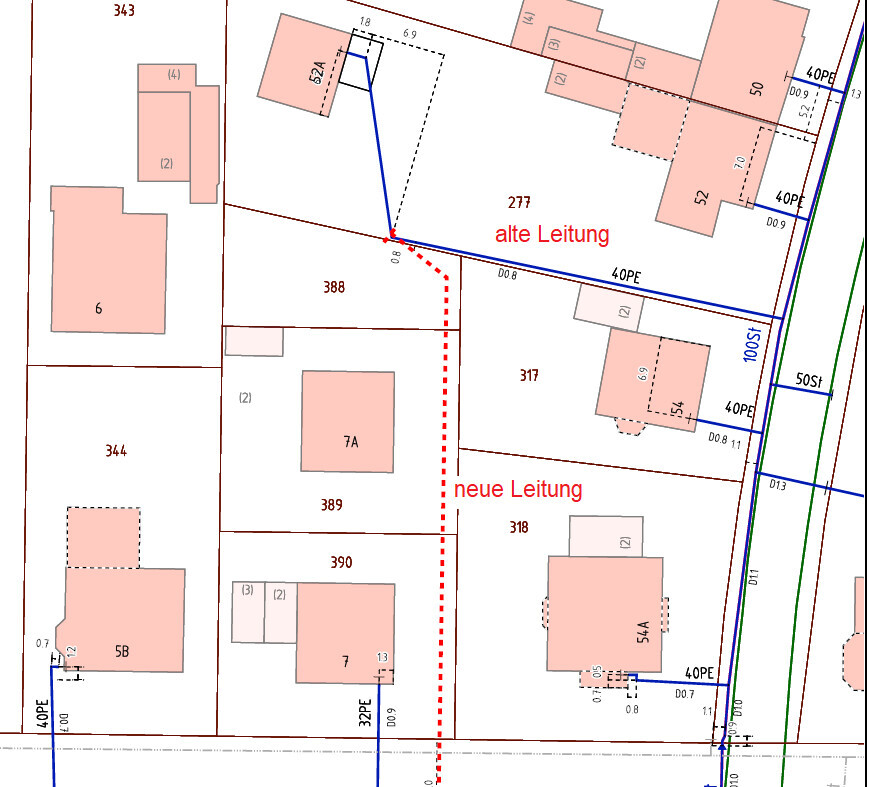
I bought a house with land on which a gas pipeline already runs (see image, blue line). Since the pipeline crosses the seller’s property and, for whatever reasons, they do not want this, a contract was made to relocate the gas pipeline. The old pipeline is to be cut off on my property and rerouted southwards to the street (see image, red line).
On the NBB Netzgesellschaft website, tiered flat rates for gas connection and piping can be found; for 60 meters that would be 2,600€ gross.
In my case, only a new pipeline is to be installed from the existing house connection across the property to the sidewalk. For this, I am supposed to pay almost double (5,100€ and 3,300€ without excavation work), even though less work is involved. According to an NBB employee, this is because my case is considered a relocation. Unlike a new connection, relocations receive less subsidy. This subsidy seems quite unclear and hard to understand to me, as the price is considerably higher and also differs from the estimate given by an employee. She previously said the price wouldn’t differ much from the information on their website. Has anyone had similar experience? If this cannot be changed, are there other, cheaper alternatives? Since NBB is the only company authorized to install pipelines, I cannot go to another provider. Possibly I could have someone else do the excavation work, but whether I would save much with 60 meters is uncertain. Thanks in advance.
There is still gas in the ground for thousands of years, and it can be burned relatively cleanly.
Pretending now that the train has left the station and electricity (which also has to be generated somehow) is the ultimate solution is, in my opinion, nonsense.
I don’t believe that electricity prices will significantly detach from the price increases of other energy sources.
Generating your own energy is nice and all, but naturally it can only cover a limited portion of the demand. In older buildings, gas remains economically more sensible than an air-to-water heat pump for a long time.
Pretending now that the train has left the station and electricity (which also has to be generated somehow) is the ultimate solution is, in my opinion, nonsense.
I don’t believe that electricity prices will significantly detach from the price increases of other energy sources.
Generating your own energy is nice and all, but naturally it can only cover a limited portion of the demand. In older buildings, gas remains economically more sensible than an air-to-water heat pump for a long time.

apokolok schrieb:
There will be natural gas available underground for thousands of yearsSource please... I am reading estimates between 40 and 67 years
Tolentino schrieb:
Source, please...
I am reading something between 40 and 67 years Well, that might have been a bit optimistic and speculative.
Apparently, there are no really reliable figures available because there are constantly new developments.
Your numbers are based on currently tapped gas sources.
Other sources (which I naturally cannot link) estimate reserves from 'unconventional sources' to last over 700 years...
The truth is probably somewhere in between.
From an economic perspective, when choosing a heating system today, there is definitely no need to worry about the availability of gas during the expected lifespan of the heating unit.
Similar topics