
Hello everyone,
I would appreciate your feedback on the floor plans.
Development Plan / Restrictions:
· Plot size: 1,200 m² (18 m (59 inches) wide)
· Slope: south-facing hill, street to the north
· Site coverage ratio: 0.3
· Floor area ratio: 0.6
· Building envelope, building line, and boundary: see "enlarged building envelope" 12 x 14 m (39 x 46 feet)
· Edge development: garages
· Number of parking spaces: 3 required according to building authority
· Construction type: open building layout
· Building setback: 3 m (10 feet)
· Roof type: pitched roofs 15-30°, hipped roofs to be avoided, see regulations
· Orientation: ridge direction of the buildings parallel to each other
· Exterior design: see section 6 of the regulations
Homeowners’ Requirements
Preliminary: The homeowners (born 1982 male, 1988 female, and two children born 2014 female, 2016 male) want to live on two floors (basement and ground floor). A third children’s bedroom should also be included. The third floor (attic) should be accessible barrier-free.
· Style: Bauhaus (optionally exposed concrete)
· Roof design: large south-facing side (for solar panels, photovoltaics)
· Building type: two-family house
· Basement and floors: basement, ground floor, attic
· Number of occupants and ages as above: (2 + 3 in basement and ground floor, 2 + 1 in attic)
o Space requirements attic: 2 bedrooms, 1 flexible floor plan bathroom, open living/dining/kitchen area, utility room
o Space requirements ground floor: 1 master bedroom, walk-in closet, master bathroom, large open living/dining/kitchen area, wardrobe, storage room
o Space requirements basement: 3 children’s bedrooms, children’s bathroom, optional play corridor, boiler room, cellar, utility room
· Open or closed architecture: open
· Conservative or modern construction: modern
· Kitchen: open kitchen with island (at least on ground floor)
· Balcony, roof terrace: likely sensible on all three floors considering exposed concrete
· Parking spaces: carports if possible, which can later be converted into garages (initial cost saving)
· Heating/thermal technology: air-to-water heat pump (underfloor heating), optional photovoltaics
· Windows: large window areas on the south side, optionally wide, low windows above the kitchen worktop on the ground floor
· Energy efficiency: KfW 55 standard
· High sound insulation (especially for the ceiling of the attic, separate residential unit)
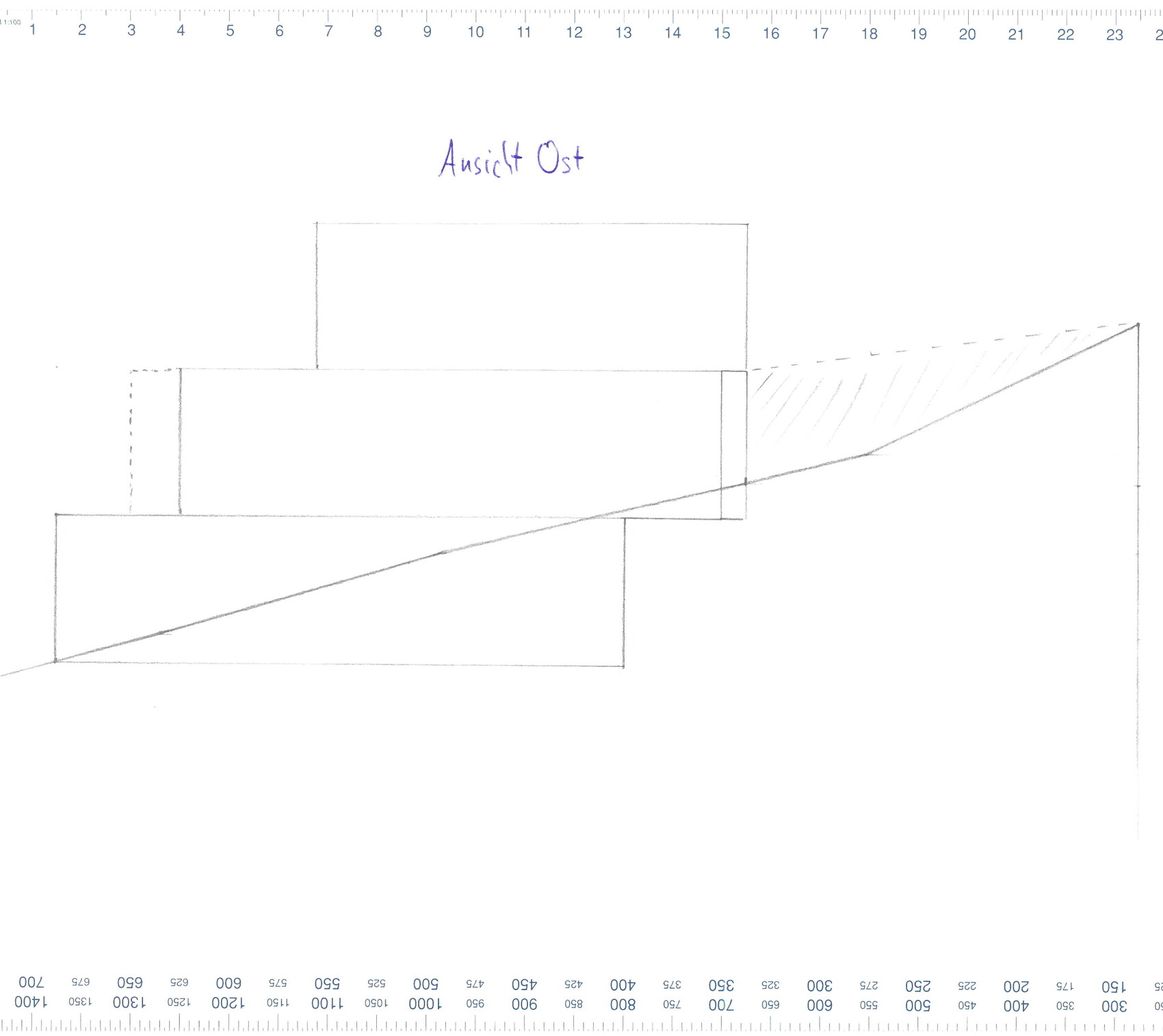
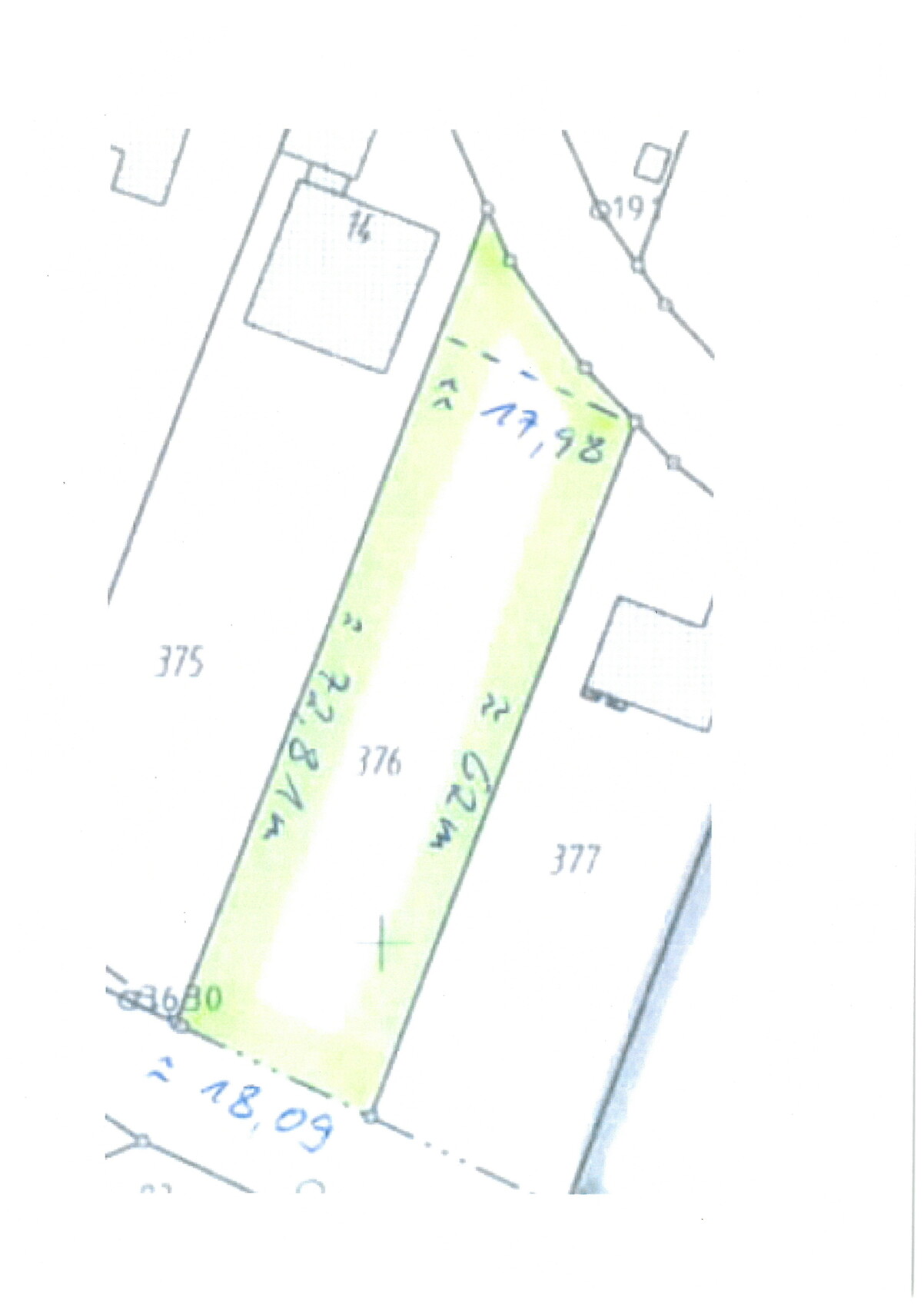
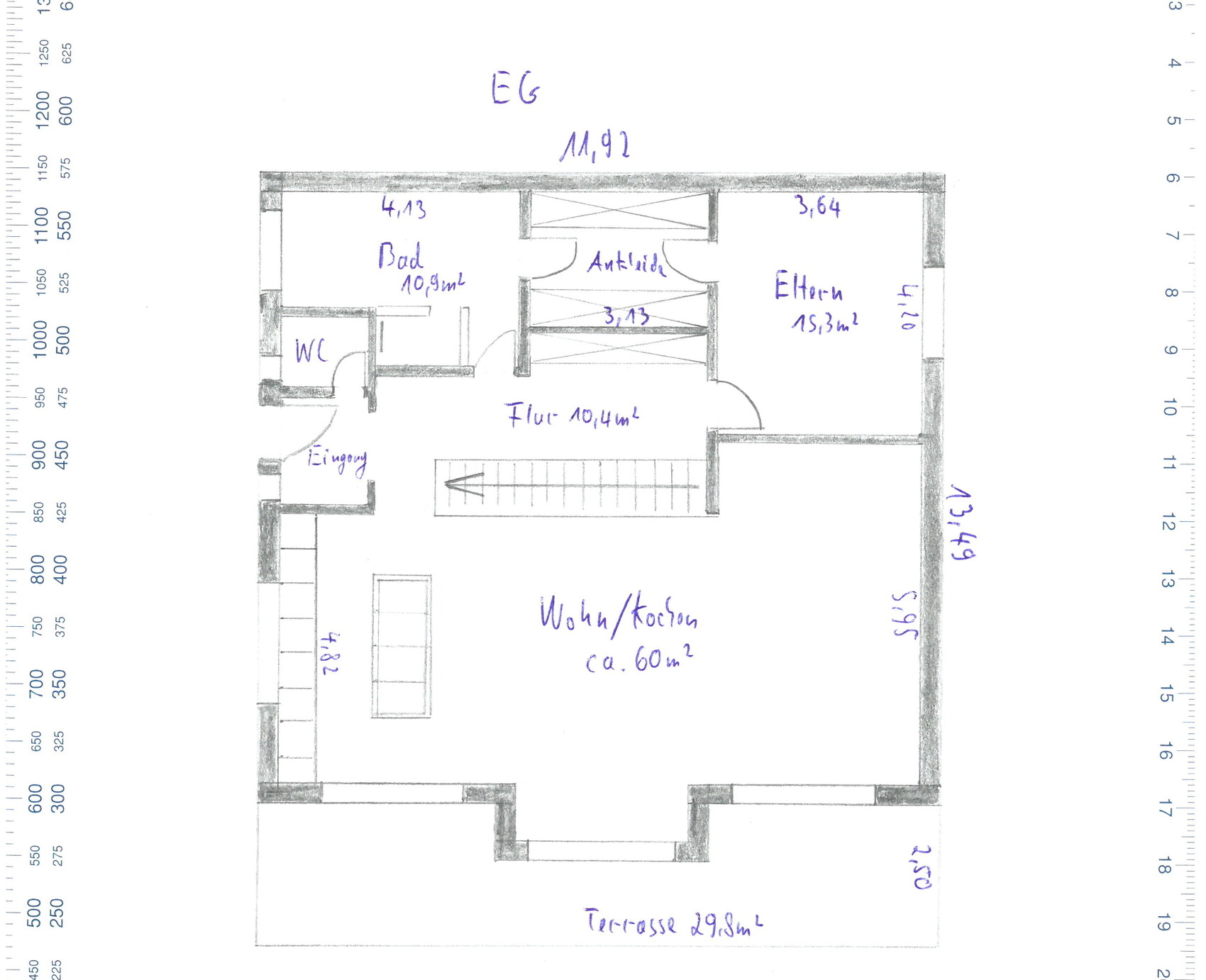
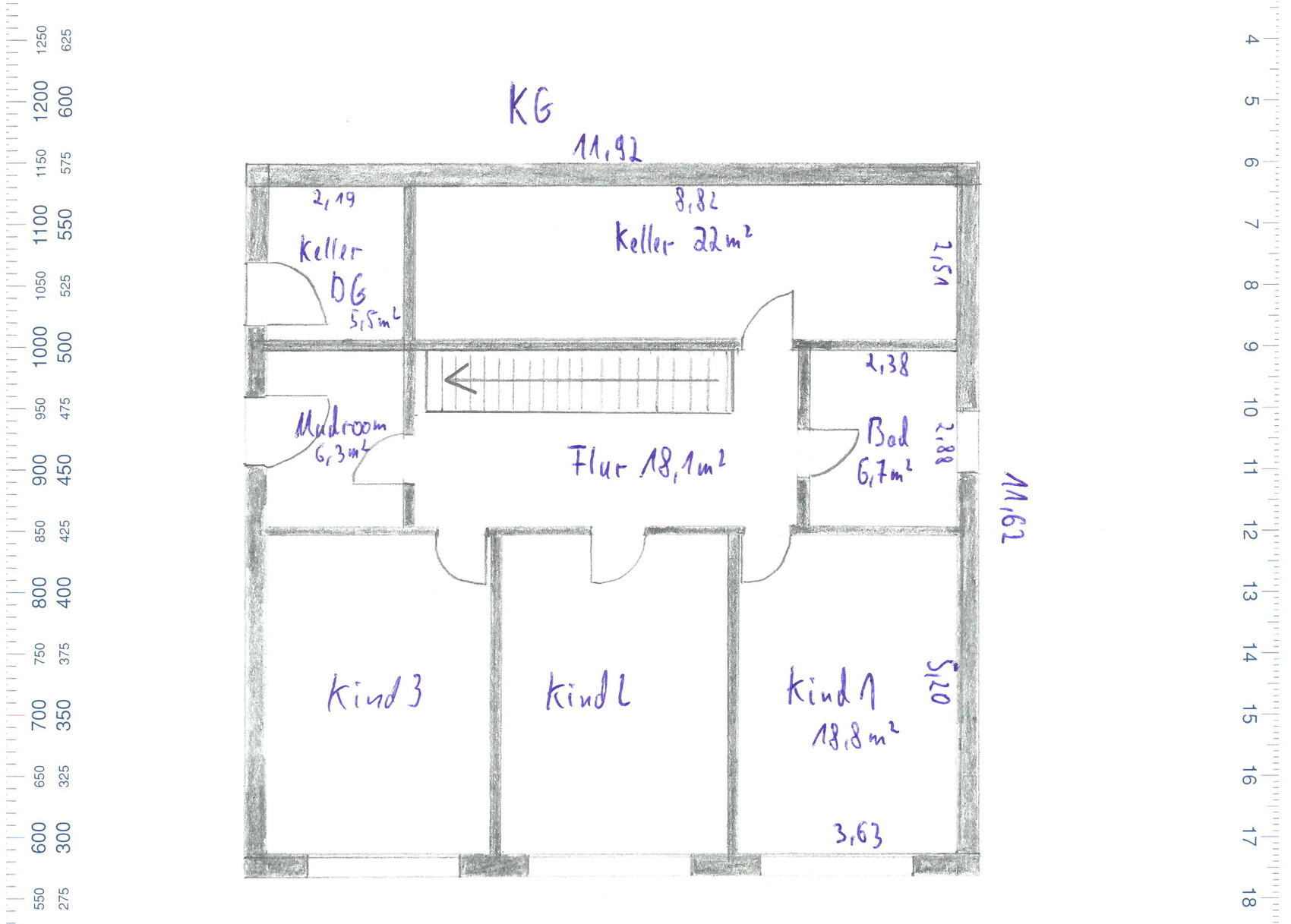
I would appreciate your feedback on the floor plans.
Development Plan / Restrictions:
· Plot size: 1,200 m² (18 m (59 inches) wide)
· Slope: south-facing hill, street to the north
· Site coverage ratio: 0.3
· Floor area ratio: 0.6
· Building envelope, building line, and boundary: see "enlarged building envelope" 12 x 14 m (39 x 46 feet)
· Edge development: garages
· Number of parking spaces: 3 required according to building authority
· Construction type: open building layout
· Building setback: 3 m (10 feet)
· Roof type: pitched roofs 15-30°, hipped roofs to be avoided, see regulations
· Orientation: ridge direction of the buildings parallel to each other
· Exterior design: see section 6 of the regulations
Homeowners’ Requirements
Preliminary: The homeowners (born 1982 male, 1988 female, and two children born 2014 female, 2016 male) want to live on two floors (basement and ground floor). A third children’s bedroom should also be included. The third floor (attic) should be accessible barrier-free.
· Style: Bauhaus (optionally exposed concrete)
· Roof design: large south-facing side (for solar panels, photovoltaics)
· Building type: two-family house
· Basement and floors: basement, ground floor, attic
· Number of occupants and ages as above: (2 + 3 in basement and ground floor, 2 + 1 in attic)
o Space requirements attic: 2 bedrooms, 1 flexible floor plan bathroom, open living/dining/kitchen area, utility room
o Space requirements ground floor: 1 master bedroom, walk-in closet, master bathroom, large open living/dining/kitchen area, wardrobe, storage room
o Space requirements basement: 3 children’s bedrooms, children’s bathroom, optional play corridor, boiler room, cellar, utility room
· Open or closed architecture: open
· Conservative or modern construction: modern
· Kitchen: open kitchen with island (at least on ground floor)
· Balcony, roof terrace: likely sensible on all three floors considering exposed concrete
· Parking spaces: carports if possible, which can later be converted into garages (initial cost saving)
· Heating/thermal technology: air-to-water heat pump (underfloor heating), optional photovoltaics
· Windows: large window areas on the south side, optionally wide, low windows above the kitchen worktop on the ground floor
· Energy efficiency: KfW 55 standard
· High sound insulation (especially for the ceiling of the attic, separate residential unit)

sichtbeton82 schrieb:
The summer phase (terraces) was especially wonderful!Yes, and it’s a pity that you now have to rely on this strength :-(https://www.instagram.com/11antgmxde/
https://www.linkedin.com/company/bauen-jetzt/
11ant schrieb:
Yes, and it's unfortunate that you now have to rely on this energy :-(I see empathy here, keep it up!!
tumaa schrieb:
I see empathy here,I always have it; it just works differently than in neurotypical people.https://www.instagram.com/11antgmxde/
https://www.linkedin.com/company/bauen-jetzt/
S
sichtbeton8228 Feb 2020 11:22I haven’t posted here for a while, but it’s incredible how much incompetence and/or arrogance one encounters during such a construction project...
The good news first: the basement and ground floor are almost finished. Not without defects, but completed. Tomorrow the painters and plasterers will come to finalize the work.
On the other hand, the main bathroom in the attic floor was not completed by the tile installer. I terminated his contract extraordinarily. Subsequently, a termination agreement was reached. So far, so good. The reason for this still makes me angry. The belief that an invoice marked “3% discount if paid within 7 days” would become due after 8 days.
Here is an excerpt:
The contractor was already absent from the construction site on 11.02.2020 and informed the client’s architect on 13.02.2020 that he had stopped work due to the unpaid invoice 4388 dated 31.01.2020. The architect explained to the contractor on 13.02.2020 that stopping work was not justified. The contractor was also informed of the consequences of his behavior, including termination by the client with claim for damages.
My further statement on this, as no other solution was possible:
You are entitled to stop work if we do not pay interim payments or pay them incompletely. Accordingly, you stopped work on 11.02.2020, [13.02.2020], 18.02.2020, and today, 19.02.2020, [and as known today, also on 20.02.2020]. However, this is contingent on you issuing a prior deadline. You missed this deadline and were not entitled to stop work. If you do so anyway and thereby endanger the completion date (21.02.2020), we are entitled to terminate the contract for cause, which in turn obliges you to pay damages. […]
It is clear that stopping work poses a significant risk for the contractor. If the contractor makes a legal error in assessing his claim and it is unfounded or not yet due, then stopping work constitutes a serious and definitive refusal to perform, entitling the client to immediately terminate the construction contract for cause and claim damages instead of performance. The contractor is therefore well advised to carefully check as a first step whether the respective interim invoice is actually due and based on a justified claim. Then, as a second step, a written reminder with notice of stopping work must be issued to the client. The contractor must ensure that proof can be provided that the reminder with the set deadline was received by the client after the due date. If these requirements are met, the contractor should generally be on the safe side when stopping work.
Review of Step 1 (Due date):
You issued an invoice dated 31.01.2020 with payment terms stating “3% discount if paid within 7 days.” A discount period is always a voluntary mutual payment term! This means that if the discount is not taken, the legal payment deadline of 30 days applies (or 21 days under VOB/B). Therefore, at the time the work was stopped (11.02.2020, 18.02.2020, and 19.02.2020), no payment default had occurred. According to the payment terms, the invoice was not yet due.
You must attach to the interim invoices an auditable statement of your contractually performed services that allows for a quick and reliable assessment of the work. Since this was not provided, no due date occurs on this basis.
Representation of the work progress including interim measurement
According to § 632a paragraph 1 sentence 2 of the German Civil Code and § 16 paragraph 1 number 1 sentence 2 VOB/B, the services to be invoiced by interim invoice must be substantiated by a statement that “enables a quick and reliable evaluation of the work.” Only after this is the interim invoice due for payment. The verifiable statement with measurements must refer to the scope of work. Clients must be able to verify before payment that the agreed construction progress has been demonstrably and defect-free performed and thus the interim invoice is due.
In practice, this means including an interim measurement. The vague term “on account” with a lump sum of, for example, 5,000.00 EUR is by no means sufficient. There are basically no major differences in verifiability between interim invoices and final invoices. If the contractor wants to avoid comprehensive measurement evidence in interim invoices for speed reasons, possible simplifications for interim invoices must be clearly defined in the contract beforehand. In case of doubt, the requirements for traceability and verifiability of interim invoices must be specified in detail, e.g., that approximate measurements or approximate work progress are allowed. If such “simplification provisions” are missing, a correct and complete interim measurement including all sketches, tables, etc. is indispensable.
An interim invoice is not due until the contractor has demonstrated the actual work progress based on a verifiable interim invoice.
Review of Step 2 (Written reminder):
In short: It was not done.
Further note regarding tax requirements for the format of interim invoices. The following point 6 may also be insufficient on the invoice:
Every issued invoice must contain the following information according to § 14 para. 4 German VAT Act:
1. Full name and address of the service provider and the recipient
2. Tax number or VAT identification number of the provider
3. Date of issue
4. A unique, sequential invoice number
5. Scope and nature of the service
6. Date of service
7. The fee for the service as well as any pre-agreed price reductions (e.g., discount), if not already included
8. The applicable tax rate and the tax amount applied to the fee
***********************************************************
Regarding your “notification of obstruction”:
Content:
The first paragraph contradicts itself with respect to the timing factor since other work could be carried out. Additionally, it should be noted that we agreed to begin tiling the basement and utility room regardless of unfinished work in other trades, since the move-in date was scheduled for 31.12.2019.
Work resumed on 06.01.2020. According to your letter, since 06.01.2020 there has been a “somewhat revised schedule” due to delayed sanitary installations.
You worked two weeks in December. You intended to finish within four weeks. Presumably also because you wanted to work with two people simultaneously. Thus, from 06.01.2020 you would still have two weeks left and a completion date of 17.01.2020. If you now finish as agreed on 21.02.2020, this is a delay of five weeks. This certainly does not justify a “somewhat revised schedule.”
Form:
To protect their entitlement to an extension of construction time, the contractor must notify the client in writing of any obstruction (notification of hindrance). Since notice to the site architect usually only suffices in exceptional cases, the contractor should take the safe route and send the notice directly to the client. The contractor loses any entitlement to consideration of obstructing circumstances if this notification obligation is not fulfilled.
A notification of obstruction is also considered present if the hindrance is recorded in the site meeting minutes or daily site report and is received or countersigned by the client.
During the execution of a construction project, obstructions in construction work may occur. In a VOB/B contract, detailed rules are set out in § 6 of VOB/B. The contractor must notify the client immediately in writing of any hindrance according to § 6 para. 1 VOB/B. This should similarly be done when dealing with an owner or consumer. It is not necessary that the obstruction has already occurred; the notice should be made at the earliest sign of concern by the contractor. Essentially, it is a contractual ancillary duty.
When drafting such a notification, one should always keep in mind its purpose. The aim of the obstruction notice is to protect the client. The client should be comprehensively and in detail informed about existing disruptions and their expected impact on work progress, so they can take timely measures and provide appropriate remedies. Therefore, the notice serves an informational, protective, and warning function.
A vague statement that obstructions have occurred is by no means sufficient. The contractor must specify as precisely as possible which specific tasks cannot be carried out as planned due to which circumstances, what effects this has on construction time and further measures, and why no alternative solutions exist. If work is not entirely impossible but only made more difficult by the obstructions, the contractor must indicate exactly what additional efforts arise due to the necessary change in construction sequence.
The contractor has the duty to reasonably do everything possible to continue construction after the obstruction is removed and to resume work. He must protect already completed construction work from damage and actively promote continuation of the construction process.
In conclusion, the content of the “notification of obstruction” is debatable, and the form is insufficient. The originally contractual completion date, within four working weeks (excluding Christmas and company holidays) after the start of work, i.e., 17.01.2020, still applies. We have generally and cooperatively waived any claims for damages on our part from this date until today.
***********************************************************
The subject here is the fourth interim invoice. The first three interim payments were made on time and in full, although we could have already applied minor defect withholdings. So far, xx,xxx.xx EUR (gross) have been paid on time. The disputed amount is a discount deduction of 124.95 EUR (gross). You are only endangering yourself with your actions over this amount. As explained above, this is also legally completely incomprehensible.
It should be noted that the contractor is not entitled to stop work if the outstanding payment is so small that it is disproportionate to the remaining work to be performed. For a minor outstanding payment, the contractor does not have the right to refuse performance according to the general principle of good faith.
The good news first: the basement and ground floor are almost finished. Not without defects, but completed. Tomorrow the painters and plasterers will come to finalize the work.
On the other hand, the main bathroom in the attic floor was not completed by the tile installer. I terminated his contract extraordinarily. Subsequently, a termination agreement was reached. So far, so good. The reason for this still makes me angry. The belief that an invoice marked “3% discount if paid within 7 days” would become due after 8 days.
Here is an excerpt:
The contractor was already absent from the construction site on 11.02.2020 and informed the client’s architect on 13.02.2020 that he had stopped work due to the unpaid invoice 4388 dated 31.01.2020. The architect explained to the contractor on 13.02.2020 that stopping work was not justified. The contractor was also informed of the consequences of his behavior, including termination by the client with claim for damages.
My further statement on this, as no other solution was possible:
You are entitled to stop work if we do not pay interim payments or pay them incompletely. Accordingly, you stopped work on 11.02.2020, [13.02.2020], 18.02.2020, and today, 19.02.2020, [and as known today, also on 20.02.2020]. However, this is contingent on you issuing a prior deadline. You missed this deadline and were not entitled to stop work. If you do so anyway and thereby endanger the completion date (21.02.2020), we are entitled to terminate the contract for cause, which in turn obliges you to pay damages. […]
It is clear that stopping work poses a significant risk for the contractor. If the contractor makes a legal error in assessing his claim and it is unfounded or not yet due, then stopping work constitutes a serious and definitive refusal to perform, entitling the client to immediately terminate the construction contract for cause and claim damages instead of performance. The contractor is therefore well advised to carefully check as a first step whether the respective interim invoice is actually due and based on a justified claim. Then, as a second step, a written reminder with notice of stopping work must be issued to the client. The contractor must ensure that proof can be provided that the reminder with the set deadline was received by the client after the due date. If these requirements are met, the contractor should generally be on the safe side when stopping work.
Review of Step 1 (Due date):
You issued an invoice dated 31.01.2020 with payment terms stating “3% discount if paid within 7 days.” A discount period is always a voluntary mutual payment term! This means that if the discount is not taken, the legal payment deadline of 30 days applies (or 21 days under VOB/B). Therefore, at the time the work was stopped (11.02.2020, 18.02.2020, and 19.02.2020), no payment default had occurred. According to the payment terms, the invoice was not yet due.
You must attach to the interim invoices an auditable statement of your contractually performed services that allows for a quick and reliable assessment of the work. Since this was not provided, no due date occurs on this basis.
Representation of the work progress including interim measurement
According to § 632a paragraph 1 sentence 2 of the German Civil Code and § 16 paragraph 1 number 1 sentence 2 VOB/B, the services to be invoiced by interim invoice must be substantiated by a statement that “enables a quick and reliable evaluation of the work.” Only after this is the interim invoice due for payment. The verifiable statement with measurements must refer to the scope of work. Clients must be able to verify before payment that the agreed construction progress has been demonstrably and defect-free performed and thus the interim invoice is due.
In practice, this means including an interim measurement. The vague term “on account” with a lump sum of, for example, 5,000.00 EUR is by no means sufficient. There are basically no major differences in verifiability between interim invoices and final invoices. If the contractor wants to avoid comprehensive measurement evidence in interim invoices for speed reasons, possible simplifications for interim invoices must be clearly defined in the contract beforehand. In case of doubt, the requirements for traceability and verifiability of interim invoices must be specified in detail, e.g., that approximate measurements or approximate work progress are allowed. If such “simplification provisions” are missing, a correct and complete interim measurement including all sketches, tables, etc. is indispensable.
An interim invoice is not due until the contractor has demonstrated the actual work progress based on a verifiable interim invoice.
Review of Step 2 (Written reminder):
In short: It was not done.
Further note regarding tax requirements for the format of interim invoices. The following point 6 may also be insufficient on the invoice:
Every issued invoice must contain the following information according to § 14 para. 4 German VAT Act:
1. Full name and address of the service provider and the recipient
2. Tax number or VAT identification number of the provider
3. Date of issue
4. A unique, sequential invoice number
5. Scope and nature of the service
6. Date of service
7. The fee for the service as well as any pre-agreed price reductions (e.g., discount), if not already included
8. The applicable tax rate and the tax amount applied to the fee
***********************************************************
Regarding your “notification of obstruction”:
Content:
The first paragraph contradicts itself with respect to the timing factor since other work could be carried out. Additionally, it should be noted that we agreed to begin tiling the basement and utility room regardless of unfinished work in other trades, since the move-in date was scheduled for 31.12.2019.
Work resumed on 06.01.2020. According to your letter, since 06.01.2020 there has been a “somewhat revised schedule” due to delayed sanitary installations.
You worked two weeks in December. You intended to finish within four weeks. Presumably also because you wanted to work with two people simultaneously. Thus, from 06.01.2020 you would still have two weeks left and a completion date of 17.01.2020. If you now finish as agreed on 21.02.2020, this is a delay of five weeks. This certainly does not justify a “somewhat revised schedule.”
Form:
To protect their entitlement to an extension of construction time, the contractor must notify the client in writing of any obstruction (notification of hindrance). Since notice to the site architect usually only suffices in exceptional cases, the contractor should take the safe route and send the notice directly to the client. The contractor loses any entitlement to consideration of obstructing circumstances if this notification obligation is not fulfilled.
A notification of obstruction is also considered present if the hindrance is recorded in the site meeting minutes or daily site report and is received or countersigned by the client.
During the execution of a construction project, obstructions in construction work may occur. In a VOB/B contract, detailed rules are set out in § 6 of VOB/B. The contractor must notify the client immediately in writing of any hindrance according to § 6 para. 1 VOB/B. This should similarly be done when dealing with an owner or consumer. It is not necessary that the obstruction has already occurred; the notice should be made at the earliest sign of concern by the contractor. Essentially, it is a contractual ancillary duty.
When drafting such a notification, one should always keep in mind its purpose. The aim of the obstruction notice is to protect the client. The client should be comprehensively and in detail informed about existing disruptions and their expected impact on work progress, so they can take timely measures and provide appropriate remedies. Therefore, the notice serves an informational, protective, and warning function.
A vague statement that obstructions have occurred is by no means sufficient. The contractor must specify as precisely as possible which specific tasks cannot be carried out as planned due to which circumstances, what effects this has on construction time and further measures, and why no alternative solutions exist. If work is not entirely impossible but only made more difficult by the obstructions, the contractor must indicate exactly what additional efforts arise due to the necessary change in construction sequence.
The contractor has the duty to reasonably do everything possible to continue construction after the obstruction is removed and to resume work. He must protect already completed construction work from damage and actively promote continuation of the construction process.
In conclusion, the content of the “notification of obstruction” is debatable, and the form is insufficient. The originally contractual completion date, within four working weeks (excluding Christmas and company holidays) after the start of work, i.e., 17.01.2020, still applies. We have generally and cooperatively waived any claims for damages on our part from this date until today.
***********************************************************
The subject here is the fourth interim invoice. The first three interim payments were made on time and in full, although we could have already applied minor defect withholdings. So far, xx,xxx.xx EUR (gross) have been paid on time. The disputed amount is a discount deduction of 124.95 EUR (gross). You are only endangering yourself with your actions over this amount. As explained above, this is also legally completely incomprehensible.
It should be noted that the contractor is not entitled to stop work if the outstanding payment is so small that it is disproportionate to the remaining work to be performed. For a minor outstanding payment, the contractor does not have the right to refuse performance according to the general principle of good faith.
M
Matthew0328 Feb 2020 12:42ops: Have you received any response to this yet?
S
sichtbeton8229 Feb 2020 05:06The termination agreement has been countersigned. However, it is also very favorable to AN. I waived my right to compensation in exchange for a small amount. Firstly, because I do not want any further contact with that person, and secondly, to save my nerves and bring closure.
But once again, we were too fair, too kind, too trusting. It was agreed in the termination agreement that the remaining tiles for the still to be completed main bathroom in the attic would be delivered by yesterday. Now there are excuses that the tiles were stolen... Frankly, I don’t care what happened. The deadline was yesterday. Should I now declare the termination agreement invalid and, as the butcher says, “make them pay”?
By the way, if he had intended to fulfill his contract, the tiles would have been delivered a long time ago.
But once again, we were too fair, too kind, too trusting. It was agreed in the termination agreement that the remaining tiles for the still to be completed main bathroom in the attic would be delivered by yesterday. Now there are excuses that the tiles were stolen... Frankly, I don’t care what happened. The deadline was yesterday. Should I now declare the termination agreement invalid and, as the butcher says, “make them pay”?
By the way, if he had intended to fulfill his contract, the tiles would have been delivered a long time ago.