
Hello everyone,
I would appreciate your feedback on the floor plans.
Development Plan / Restrictions:
· Plot size: 1,200 m² (18 m (59 inches) wide)
· Slope: south-facing hill, street to the north
· Site coverage ratio: 0.3
· Floor area ratio: 0.6
· Building envelope, building line, and boundary: see "enlarged building envelope" 12 x 14 m (39 x 46 feet)
· Edge development: garages
· Number of parking spaces: 3 required according to building authority
· Construction type: open building layout
· Building setback: 3 m (10 feet)
· Roof type: pitched roofs 15-30°, hipped roofs to be avoided, see regulations
· Orientation: ridge direction of the buildings parallel to each other
· Exterior design: see section 6 of the regulations
Homeowners’ Requirements
Preliminary: The homeowners (born 1982 male, 1988 female, and two children born 2014 female, 2016 male) want to live on two floors (basement and ground floor). A third children’s bedroom should also be included. The third floor (attic) should be accessible barrier-free.
· Style: Bauhaus (optionally exposed concrete)
· Roof design: large south-facing side (for solar panels, photovoltaics)
· Building type: two-family house
· Basement and floors: basement, ground floor, attic
· Number of occupants and ages as above: (2 + 3 in basement and ground floor, 2 + 1 in attic)
o Space requirements attic: 2 bedrooms, 1 flexible floor plan bathroom, open living/dining/kitchen area, utility room
o Space requirements ground floor: 1 master bedroom, walk-in closet, master bathroom, large open living/dining/kitchen area, wardrobe, storage room
o Space requirements basement: 3 children’s bedrooms, children’s bathroom, optional play corridor, boiler room, cellar, utility room
· Open or closed architecture: open
· Conservative or modern construction: modern
· Kitchen: open kitchen with island (at least on ground floor)
· Balcony, roof terrace: likely sensible on all three floors considering exposed concrete
· Parking spaces: carports if possible, which can later be converted into garages (initial cost saving)
· Heating/thermal technology: air-to-water heat pump (underfloor heating), optional photovoltaics
· Windows: large window areas on the south side, optionally wide, low windows above the kitchen worktop on the ground floor
· Energy efficiency: KfW 55 standard
· High sound insulation (especially for the ceiling of the attic, separate residential unit)
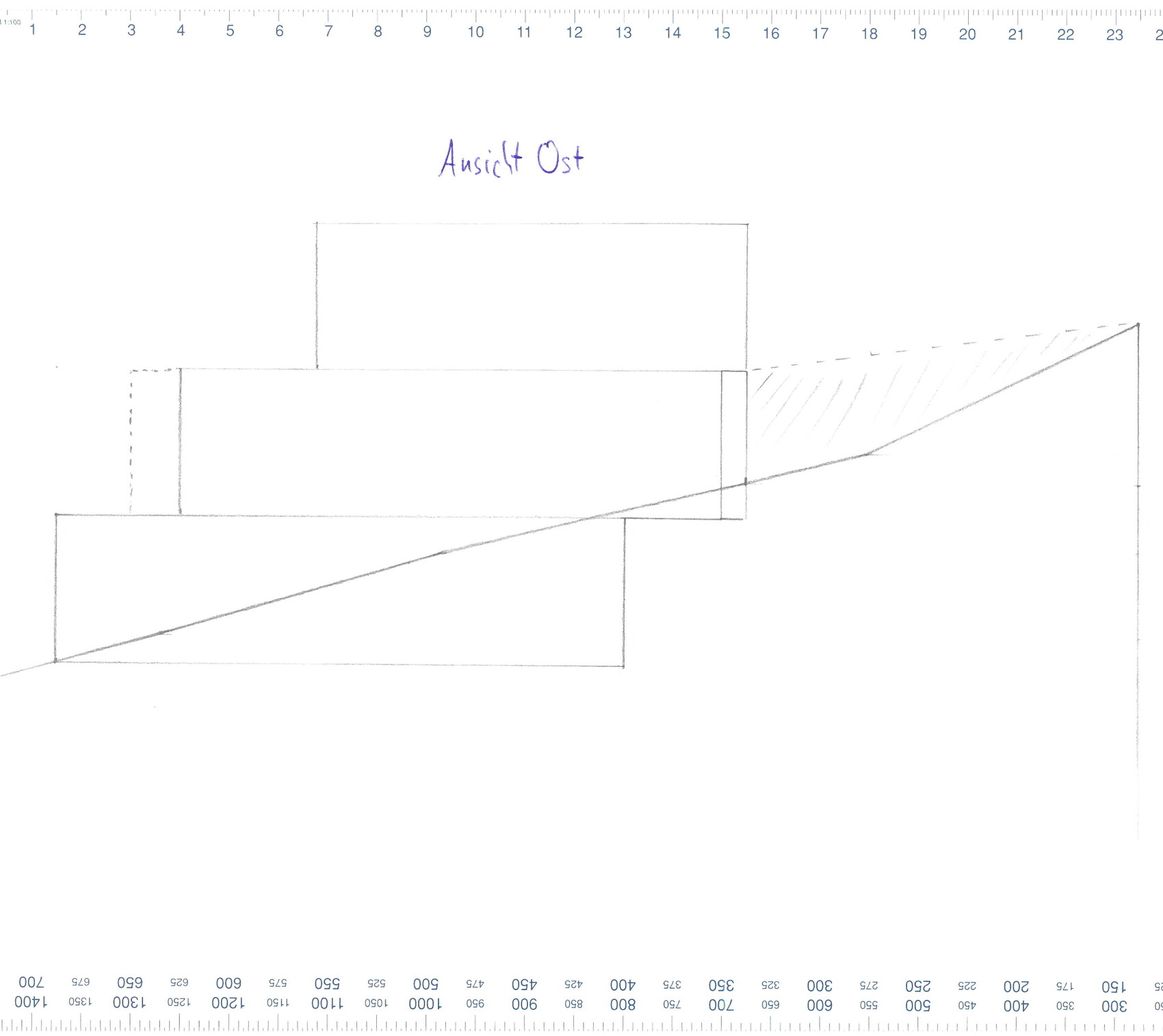
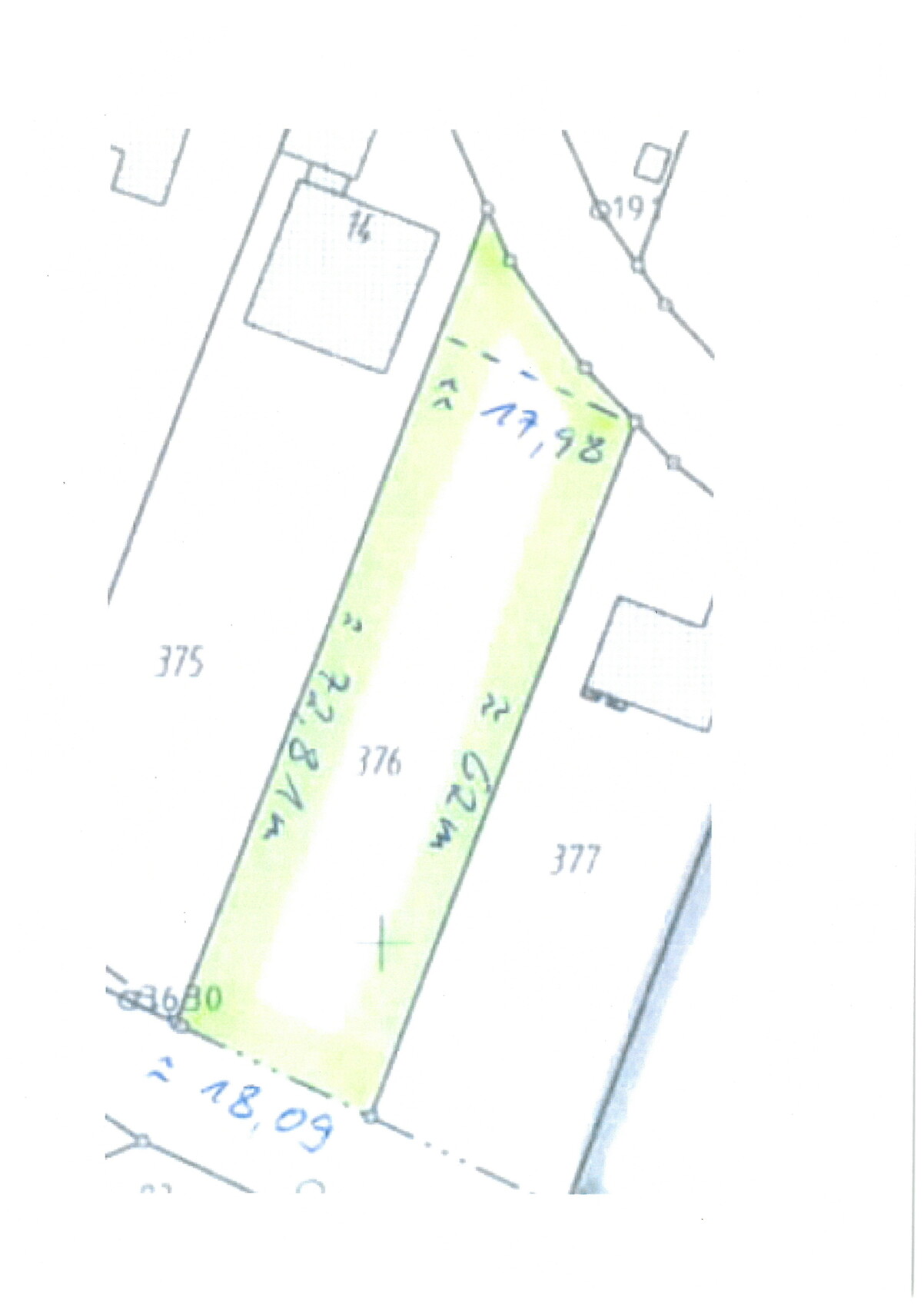
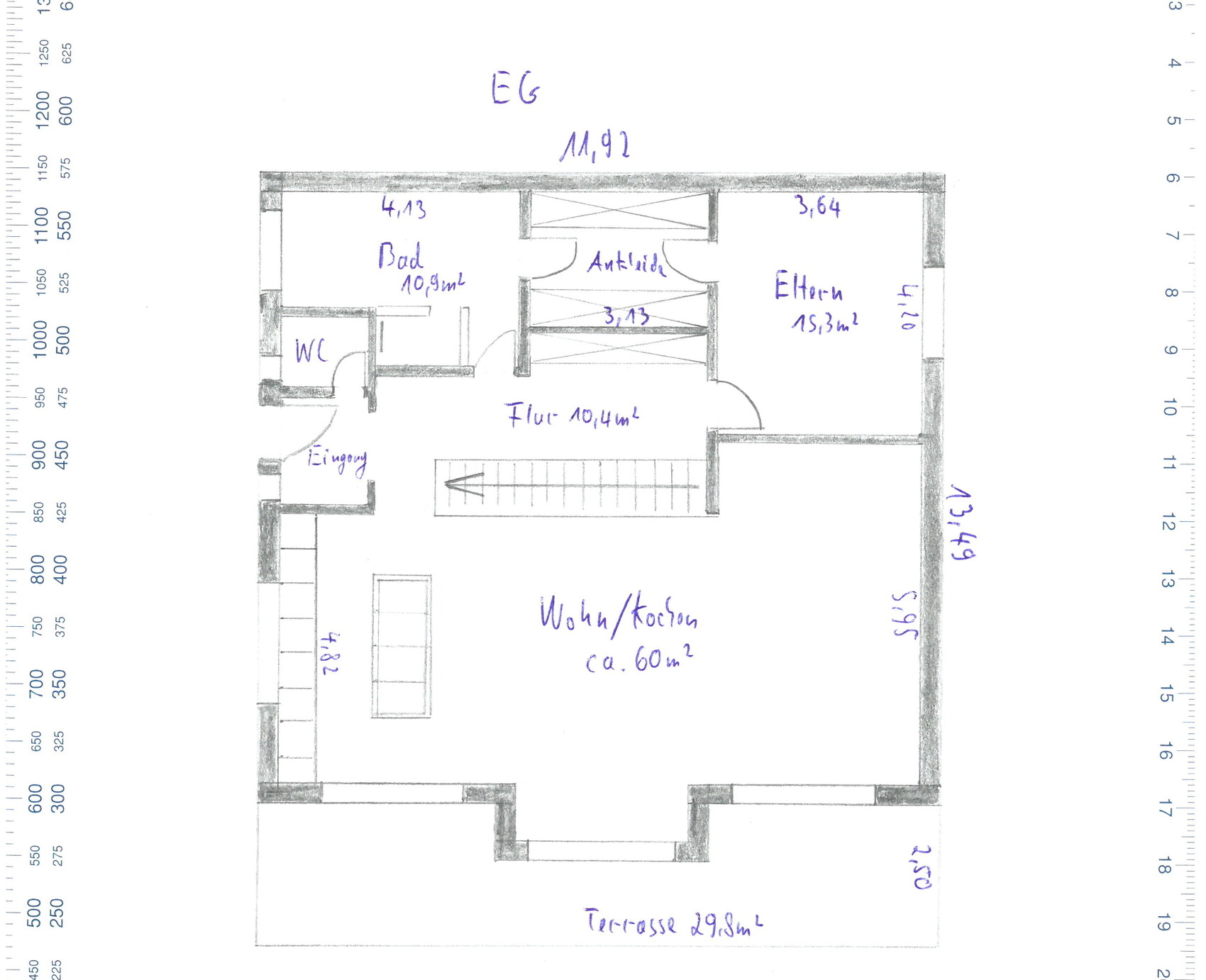
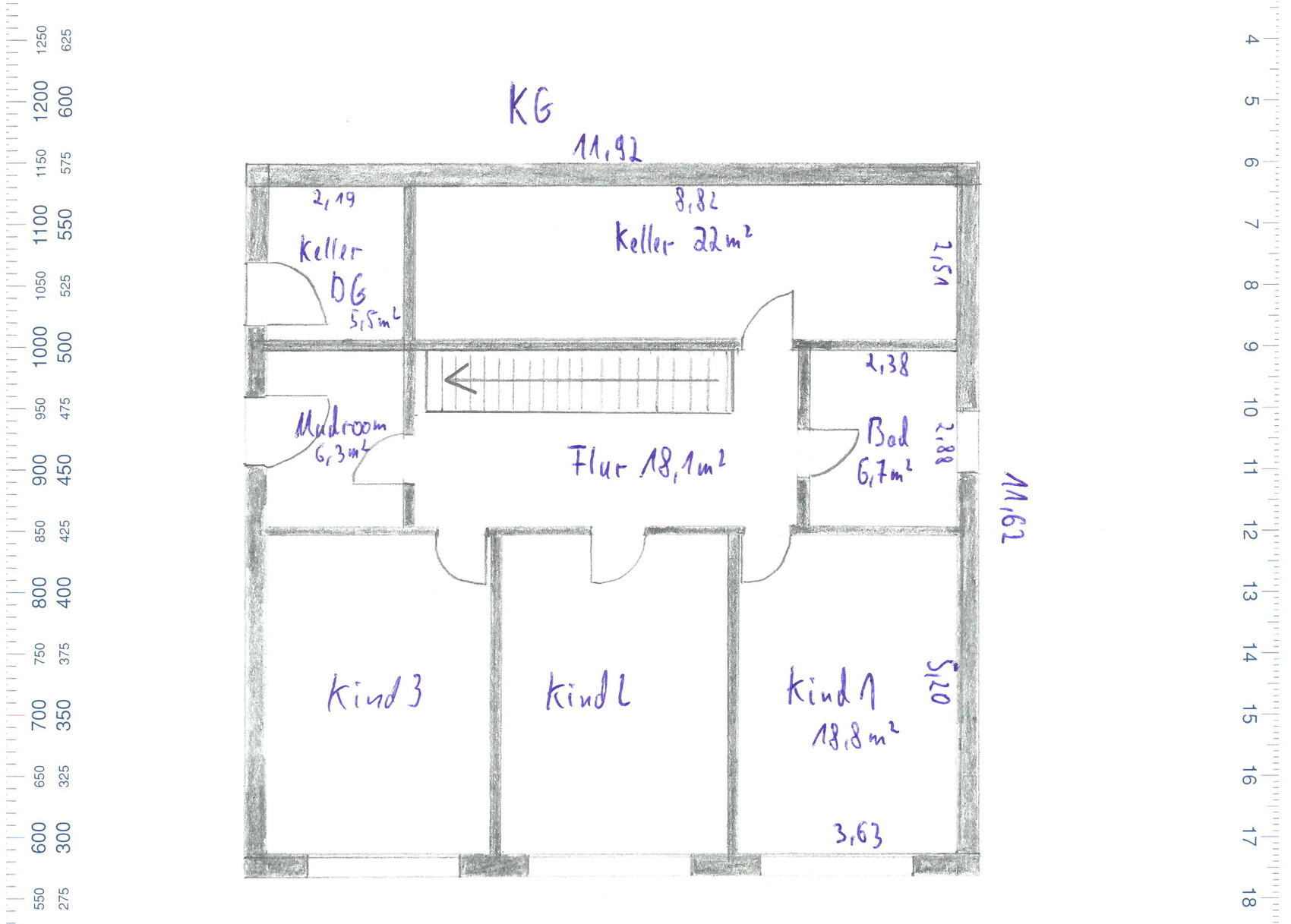
I would appreciate your feedback on the floor plans.
Development Plan / Restrictions:
· Plot size: 1,200 m² (18 m (59 inches) wide)
· Slope: south-facing hill, street to the north
· Site coverage ratio: 0.3
· Floor area ratio: 0.6
· Building envelope, building line, and boundary: see "enlarged building envelope" 12 x 14 m (39 x 46 feet)
· Edge development: garages
· Number of parking spaces: 3 required according to building authority
· Construction type: open building layout
· Building setback: 3 m (10 feet)
· Roof type: pitched roofs 15-30°, hipped roofs to be avoided, see regulations
· Orientation: ridge direction of the buildings parallel to each other
· Exterior design: see section 6 of the regulations
Homeowners’ Requirements
Preliminary: The homeowners (born 1982 male, 1988 female, and two children born 2014 female, 2016 male) want to live on two floors (basement and ground floor). A third children’s bedroom should also be included. The third floor (attic) should be accessible barrier-free.
· Style: Bauhaus (optionally exposed concrete)
· Roof design: large south-facing side (for solar panels, photovoltaics)
· Building type: two-family house
· Basement and floors: basement, ground floor, attic
· Number of occupants and ages as above: (2 + 3 in basement and ground floor, 2 + 1 in attic)
o Space requirements attic: 2 bedrooms, 1 flexible floor plan bathroom, open living/dining/kitchen area, utility room
o Space requirements ground floor: 1 master bedroom, walk-in closet, master bathroom, large open living/dining/kitchen area, wardrobe, storage room
o Space requirements basement: 3 children’s bedrooms, children’s bathroom, optional play corridor, boiler room, cellar, utility room
· Open or closed architecture: open
· Conservative or modern construction: modern
· Kitchen: open kitchen with island (at least on ground floor)
· Balcony, roof terrace: likely sensible on all three floors considering exposed concrete
· Parking spaces: carports if possible, which can later be converted into garages (initial cost saving)
· Heating/thermal technology: air-to-water heat pump (underfloor heating), optional photovoltaics
· Windows: large window areas on the south side, optionally wide, low windows above the kitchen worktop on the ground floor
· Energy efficiency: KfW 55 standard
· High sound insulation (especially for the ceiling of the attic, separate residential unit)

S
sichtbeton8229 Feb 2020 05:23But there are also legal issues elsewhere. Here is an excerpt regarding the architect’s invoice verification. There are also other legal irregularities...
My note:
... I observe the following regarding the "invoice verification."
One of your primary obligations is to verify invoices. This includes progress, partial final, and final invoices. You are, among other things, required to check:
a. whether the invoiced services have been performed
b. whether the invoiced services were agreed upon
c. whether the separate billing of the invoiced services was agreed (e.g., whether services billed separately as "additional orders" were already included in the main contract)
d. whether the prices used correspond to those agreed and whether the quantities used match the measurements
e. the arithmetic accuracy of the invoice
f. whether discounts, rebates, and other special conditions have been applied
g. whether agreed guarantees were provided
h. whether previously made advance payments have been considered and whether there is any overpayment
i. whether the claim is due
j. whether the client has any rights of retention or counterclaims that can be offset
k. the architect is not authorized to adjust the invoice to the client’s disadvantage.
Below are three recent cases which, from my point of view, violate these verification obligations:
1. Invoice 4388 from company XXX dated 31.01.2020 (31 January 2020), your approval dated 03.02.2020 (3 February 2020) (also concerning invoices 4377 dated 11.12.2019 and 4383 dated 13.01.2020):
In my email dated 13.02.2020, I already pointed out: “…Mr. XXX must attach a verifiable list of his contractually performed services to the progress invoices, enabling us to assess the services quickly and reliably. Since this has not been done, no maturity occurs based on this…” In your same-day reply, you wrote: “…I know that and I tried to explain it exactly like that to him.” Consequently, I assume that despite knowing this, you violated above point i. In addition, a possible violation of point a. may exist.
2. Invoice 20001 from company XXX dated 16.01.2020 (16 January 2020), your approval dated 24.01.2019 (meant to be 2020):
The invoice totals a gross amount of 6,265.35 EUR (arithmetically correct). Your approval amounts to 7,098.35 EUR. From my perspective, this contravenes point k. To avoid claims for damages against you due to overpayment, we settled the invoice based on the gross amount of 6,265.35 EUR.
3. Final invoice 2019098 from company XXX dated 16.12.2019 (16 December 2019), your approval dated 07.01.2020 (7 January 2020):
From my point of view, points i and j above are violated. In my opinion, no formal acceptance has taken place so far. (Note: With your approval on 07.01.2020, the deadline under §12 VOB/B has expired.) As is known to all involved parties, since October water has been penetrating through at least two floor slabs (attic to ground floor and ground floor to basement) at the drill holes for the lamp power cables. At the time of issuing/finalizing the final invoice, the responsible party (roofer, window installer, electrician, etc.) was unclear in my view. Were any defects reserved by you towards the contractor? Are we at risk of losing rights arising from these defects? Please note that the organization of the acceptance of construction works and the acceptance recommendation to the client are your responsibility.
I now ask that, for future invoices, special care be taken regarding the points mentioned above.
My note:
... I observe the following regarding the "invoice verification."
One of your primary obligations is to verify invoices. This includes progress, partial final, and final invoices. You are, among other things, required to check:
a. whether the invoiced services have been performed
b. whether the invoiced services were agreed upon
c. whether the separate billing of the invoiced services was agreed (e.g., whether services billed separately as "additional orders" were already included in the main contract)
d. whether the prices used correspond to those agreed and whether the quantities used match the measurements
e. the arithmetic accuracy of the invoice
f. whether discounts, rebates, and other special conditions have been applied
g. whether agreed guarantees were provided
h. whether previously made advance payments have been considered and whether there is any overpayment
i. whether the claim is due
j. whether the client has any rights of retention or counterclaims that can be offset
k. the architect is not authorized to adjust the invoice to the client’s disadvantage.
Below are three recent cases which, from my point of view, violate these verification obligations:
1. Invoice 4388 from company XXX dated 31.01.2020 (31 January 2020), your approval dated 03.02.2020 (3 February 2020) (also concerning invoices 4377 dated 11.12.2019 and 4383 dated 13.01.2020):
In my email dated 13.02.2020, I already pointed out: “…Mr. XXX must attach a verifiable list of his contractually performed services to the progress invoices, enabling us to assess the services quickly and reliably. Since this has not been done, no maturity occurs based on this…” In your same-day reply, you wrote: “…I know that and I tried to explain it exactly like that to him.” Consequently, I assume that despite knowing this, you violated above point i. In addition, a possible violation of point a. may exist.
2. Invoice 20001 from company XXX dated 16.01.2020 (16 January 2020), your approval dated 24.01.2019 (meant to be 2020):
The invoice totals a gross amount of 6,265.35 EUR (arithmetically correct). Your approval amounts to 7,098.35 EUR. From my perspective, this contravenes point k. To avoid claims for damages against you due to overpayment, we settled the invoice based on the gross amount of 6,265.35 EUR.
3. Final invoice 2019098 from company XXX dated 16.12.2019 (16 December 2019), your approval dated 07.01.2020 (7 January 2020):
From my point of view, points i and j above are violated. In my opinion, no formal acceptance has taken place so far. (Note: With your approval on 07.01.2020, the deadline under §12 VOB/B has expired.) As is known to all involved parties, since October water has been penetrating through at least two floor slabs (attic to ground floor and ground floor to basement) at the drill holes for the lamp power cables. At the time of issuing/finalizing the final invoice, the responsible party (roofer, window installer, electrician, etc.) was unclear in my view. Were any defects reserved by you towards the contractor? Are we at risk of losing rights arising from these defects? Please note that the organization of the acceptance of construction works and the acceptance recommendation to the client are your responsibility.
I now ask that, for future invoices, special care be taken regarding the points mentioned above.
S
sichtbeton8229 Feb 2020 05:24Architect’s Response:
...
I don’t know where you got this information from, but it only partially relates to my work.
Regarding points a. to j.: Point k. contradicts point e., and it is not my role to assist you in any form of fraud. I verify the mathematical and factual accuracy of the invoices.
Ultimately, it is up to the client to decide what, when, and to whom payments are made. That is your responsibility.
Concerning 1: Any tradesperson can issue progress invoices at reasonable intervals according to building regulations. This is also agreed upon in the contracts.
My task is to compare the appropriateness of the requested amount with the level of work completed. I have done this and certified it by releasing the payment to you.
If you require a detailed breakdown of the work, in my opinion, this must also be agreed upon in the contract with the tradesperson. I do not have these contracts.
Regarding 2: It is your decision what you pay; however, I am required to verify the invoice for content and mathematical accuracy based on the level of work completed, the offers, and the contracts. I do not understand how you arrive at point k. Neither the VOB (Construction Contract Procedures) nor the Building Code mandates the architect to carry out a one-sided invoice review to the detriment of the tradesperson.
Regarding 3: The final invoice from Mr. XXX was only issued after the rework I requested and the elimination of known or suspected defects. As has become clear, water is obviously penetrating through the apparently improperly installed windows. A clear proof, in my opinion, is your father’s attempt in my presence and that of your wife; the process was documented and is also available to you.
If any defects still exist in the roofing work, these are not visible, and therefore the tradesperson’s 5-year warranty liability applies. The tradesperson is aware of this and has now immediately begun possible defect remediation.
I will continue to act neither as an accomplice to the tradespeople nor on behalf of the client. If I make any errors during invoice verification, it is your duty to report them to me, and I have the right to correct them.
...
I don’t know where you got this information from, but it only partially relates to my work.
Regarding points a. to j.: Point k. contradicts point e., and it is not my role to assist you in any form of fraud. I verify the mathematical and factual accuracy of the invoices.
Ultimately, it is up to the client to decide what, when, and to whom payments are made. That is your responsibility.
Concerning 1: Any tradesperson can issue progress invoices at reasonable intervals according to building regulations. This is also agreed upon in the contracts.
My task is to compare the appropriateness of the requested amount with the level of work completed. I have done this and certified it by releasing the payment to you.
If you require a detailed breakdown of the work, in my opinion, this must also be agreed upon in the contract with the tradesperson. I do not have these contracts.
Regarding 2: It is your decision what you pay; however, I am required to verify the invoice for content and mathematical accuracy based on the level of work completed, the offers, and the contracts. I do not understand how you arrive at point k. Neither the VOB (Construction Contract Procedures) nor the Building Code mandates the architect to carry out a one-sided invoice review to the detriment of the tradesperson.
Regarding 3: The final invoice from Mr. XXX was only issued after the rework I requested and the elimination of known or suspected defects. As has become clear, water is obviously penetrating through the apparently improperly installed windows. A clear proof, in my opinion, is your father’s attempt in my presence and that of your wife; the process was documented and is also available to you.
If any defects still exist in the roofing work, these are not visible, and therefore the tradesperson’s 5-year warranty liability applies. The tradesperson is aware of this and has now immediately begun possible defect remediation.
I will continue to act neither as an accomplice to the tradespeople nor on behalf of the client. If I make any errors during invoice verification, it is your duty to report them to me, and I have the right to correct them.
S
sichtbeton8229 Feb 2020 05:28Finally, my response:
... it seems to me that there is uncertainty on your part regarding the exact scope of the inspection obligations and the significance of the results of this inspection. This lack of clarity is often, at least in my experience, due to the approach of only reading and citing laws (building law, general conditions of contract for construction works, fee regulations for architects, etc.). Much more important at this point, and providing an almost exhaustive understanding, are the related commentaries. These make clear the considerations and intentions behind often concise legal texts.
The term "compensation for damages" appears several times below. Please do not view this, as company XXX suspects on your part, as a threat, but simply as a legal fact.
Your remark: "In principle, it is up to the client to decide what, when, and to whom they pay, and how much. That is your matter."
That is initially completely correct. However, if the architect fails to fulfill their inspection obligation, they may be liable to pay damages:
A payment recommendation issued by the architect carries significant weight because the client can regularly rely on it. Therefore, the Higher Regional Court (OLG) Frankfurt am Main, in a legally binding decision of March 31, 2016 (Case No.: 6 U 36/15), ordered an architect to pay damages.
This corresponds to the case law of the Federal Court of Justice, which ruled on April 4, 2002, that the client may trust a payment recommendation from their architect unless the architect informs the client that they should examine certain points themselves as well (Case No.: VII ZR 295/00). According to the OLG Frankfurt, the client’s obligation to re-check the recommendation arises only if there are clear indications that the architect may have relied on incorrect assumptions...
… If there are uncertainties regarding the payment status in individual cases, the architect is therefore well advised to clarify these with the client, or at least to point out that the payment recommendation is made subject to the client’s own verification. Even if the architect is uncertain about the fulfillment of conditions, for example for a cash discount or retention of security, they must disclose this.
Observing the corresponding duty of care is also absolutely advisable because architects risk jeopardizing their professional liability insurance coverage if they neglect or perform an overly superficial invoice review. This was also decided by the OLG Cologne on June 2, 1996 (Case No.: 9 U 14/96).
Invoice verification is part of the basic services to be provided in service phase 8 and a primary contractual obligation. The architect must first check whether the invoiced prices match the agreed prices, whether the invoiced quantities correspond to the measured quantities, whether services are wrongly charged as additional services, whether agreed cash discounts, rebates, retention of security, and advance or partial payments have been correctly accounted for, and whether the invoiced services were fully and properly provided (Werner/Pastor, The Construction Process, 15th edition, para. 2026). This inspection obligation extends to all invoices submitted to the architect, not only final invoices but especially partial invoices (cf. OLG Cologne, ruling of July 2, 1996, Case No.: 9 U 14/96).
Your remark "Regarding points a. to j.: Point k. contradicts point e., and it is not my task to assist you with fraud. I check the mathematical and substantive accuracy of the invoices."
Please use caution and a careful approach with the word "fraud."
I also cannot understand where you see a contradiction. Point e states that the mathematical accuracy of the invoice must be checked. The inspection results can then be:
- The inspection result corresponds to the invoice.
- The inspection result is lower than the invoice.
- The inspection result is higher than the invoice.
Point k states how to proceed in the third case. Even if this might be morally debatable, the law here is clear. Further explanation follows.
Regarding point 1:
Side note: In my opinion, there is a contradiction here. On the one hand, you know what has been agreed in the contract (sentence 2); on the other hand, you do not know it, as the contract is not available (sentences 5+6). I will disregard this for now.
Formal requirements for partial invoices
Tax requirements
Each issued invoice must, according to Section 14 (4) of the German Value Added Tax Act, contain the following details:
1. The full name and full address of the supplier and the recipient of the service
2. The tax identification number or VAT identification number of the supplier
3. The date of issue
4. A unique, sequential invoice number
5. Scope and type of service
6. Date of the service (side note: this may sometimes be insufficiently detailed on the invoice)
7. The remuneration for the service and any agreed reductions (e.g., cash discounts), unless already included in the remuneration
8. The applicable tax rate and the tax amount attributable to the remuneration
Representation of the progress of work including interim measurement
According to Section 632a (1) sentence 2 of the German Civil Code and Section 16 (1) No. 1 sentence 2 of the German Construction Contract Procedures (VOB/B), the services billed with the partial invoice must be proven by a statement that “must allow a quick and reliable assessment of the work performed.”
Only after this is the partial invoice due for payment. The verifiable statement with the measured quantities must relate to the service description.
Clients must be able to verify before payment whether the agreed construction progress has demonstrably been completed without defects and thus whether the partial invoice is due.
A partial invoice is not due until the contractor has proven the actual progress of work by means of a verifiable partial invoice.
This means, in practice, the attachment of an interim measurement. A generic reference such as “a-conto” with a flat sum, for example, 5,000.00 EUR, does absolutely not suffice. Generally, there are no significant differences regarding verifiability between partial invoices and final invoices.
If the contractor wishes to avoid extensive measurement documentation for partial invoices for the sake of speed, possible simplifications regarding partial invoices must be clearly regulated in advance in the contract. In case of doubt, requirements for traceability and verifiability of partial invoices must be detailed, e.g., allowing approximate measurements or approximate progress evaluations. If such “simplification rules” are lacking, a correct and complete interim measurement with all sketches, tables, etc., is indispensable.
Regarding point 2:
… When verifying invoices, the architect must also consider special conditions such as discounts, legitimately deducted or deductible cash discounts, etc. On the other hand, the architect is neither authorized nor obliged to correct errors caused by omissions in the contractor’s invoice to the client’s disadvantage, since the architect, as the client’s trustee, does not have a duty to represent the interests of the executing company, especially since the contractor may be bound by their once submitted final invoice (cf. Federal Court of Justice, Construction Law 1978, 145 = NJW 1978, 994; Lenzen, Construction Law 1982, 23 with further references; differing in the case of VOB contracts, Federal Court of Justice, Construction Law 1988, 217 = NJW 1988, 910). However, this differs if it concerns only content corrections without changing the final calculated result…. Furthermore, the invoice verification only has effect on the contractual relationship between client and architect, not on the contractual relations between the client and the contractor. Therefore, the architect’s verification note on the invoices checked by them, especially the so-called accuracy certificate, does not constitute acceptance of the invoiced amount established by the architect in relation to the client and the relevant contractor ()…
… Rather, the note about the result of the invoice verification is addressed exclusively to the client and is accompanied by a professionally substantiated, specifically quantifiable payment recommendation from the architect to their client (cf. Locher/Koeble/Frik, HOAI, 12th edition, para. 225 on § 34). Proposed invoice reductions must be explained to the client. If the architect detects errors in the invoice that benefit the client, these must be communicated to the client but under no circumstances should the invoicing party be informed of the error or the invoice be corrected to the client’s disadvantage, as this would violate the architect’s fiduciary duties to the client (cf. Hebel, ibid., para. 117 on § 15)…
… In the … case, the OLG Frankfurt ordered the architect to compensate the client for the damage caused by an excessive partial payment. According to the court, the architect’s inspection obligation serves, among other things, to ensure that the client only fulfills justified partial payment claims and does not rely on being able to settle possible overpayments later.
Regarding point 3:
I can only provide feedback once you provide, as already requested, the type and date of acceptance. At this point, I would like to remind you again that the organization of the acceptance of building work and the acceptance recommendation for the client is your responsibility.
****************************************
You should definitely not become anyone’s lackey. I am only requiring or referring to your obligation to perform your services.
Your remark: "If errors occur during invoice verification, it is your duty to notify me..."
I can only report errors that are apparent to me as a layperson. As stated at the beginning, I may rely on and trust your payment recommendation. Obvious errors that I, as an untrained client, can recognize, for example the invoice from company Kohnen and its incorrect mathematical verification, were pointed out to you on site by my wife with the note that “the discount was not considered.” No changes were made by you, and as I have already written:
To avoid claims for damages against you due to overpayment, the invoice was settled by us based on the total gross amount of 6,265.35 EUR.
Current case 4.
Invoice from company XXX 400073 dated 31.01.2020, your approval dated 12.02.2020:
If a valid cash discount agreement has been made, the architect must check the invoice within the cash discount period to be able to claim the discount for the client.
Here, the architect is obliged to verify the invoice within this 14-day period so that the client can claim the cash discount. This obligation arises from the principle of good faith, according to which the contracting parties must do everything to achieve and ensure the successful performance of the contract. This also includes the duty to secure payment advantages for the client in the form of discounts or cash discounts. (From lawyer Eva Bouchon, specialist attorney for construction and architect law, law firm Leinemann & Partner, Berlin)
If you feel like a lackey because of my request to clarify this with company XXX, I want to make it clear that I only wanted to give you the opportunity to possibly prevent a claim for damages arising from your breach of duty.
A note on securities for clients:
An automatic (statutory) entitlement to a security deposit exists only for consumers (§ 632a (3) of the German Civil Code). All other clients (especially public authorities and private clients) have no automatic/statutory right to a security, neither regarding contract performance nor warranty.
This means, in my view, that the outstanding balance, considering the evaluation of items billed at 0.8 units in the partial invoice as a full 1 unit, suggests a final invoice claim of 1,523.80 EUR (net). Was this considered during the partial invoice review?
I kindly ask you to pay particular attention to the points mentioned above with future invoices.
... it seems to me that there is uncertainty on your part regarding the exact scope of the inspection obligations and the significance of the results of this inspection. This lack of clarity is often, at least in my experience, due to the approach of only reading and citing laws (building law, general conditions of contract for construction works, fee regulations for architects, etc.). Much more important at this point, and providing an almost exhaustive understanding, are the related commentaries. These make clear the considerations and intentions behind often concise legal texts.
The term "compensation for damages" appears several times below. Please do not view this, as company XXX suspects on your part, as a threat, but simply as a legal fact.
Your remark: "In principle, it is up to the client to decide what, when, and to whom they pay, and how much. That is your matter."
That is initially completely correct. However, if the architect fails to fulfill their inspection obligation, they may be liable to pay damages:
A payment recommendation issued by the architect carries significant weight because the client can regularly rely on it. Therefore, the Higher Regional Court (OLG) Frankfurt am Main, in a legally binding decision of March 31, 2016 (Case No.: 6 U 36/15), ordered an architect to pay damages.
This corresponds to the case law of the Federal Court of Justice, which ruled on April 4, 2002, that the client may trust a payment recommendation from their architect unless the architect informs the client that they should examine certain points themselves as well (Case No.: VII ZR 295/00). According to the OLG Frankfurt, the client’s obligation to re-check the recommendation arises only if there are clear indications that the architect may have relied on incorrect assumptions...
… If there are uncertainties regarding the payment status in individual cases, the architect is therefore well advised to clarify these with the client, or at least to point out that the payment recommendation is made subject to the client’s own verification. Even if the architect is uncertain about the fulfillment of conditions, for example for a cash discount or retention of security, they must disclose this.
Observing the corresponding duty of care is also absolutely advisable because architects risk jeopardizing their professional liability insurance coverage if they neglect or perform an overly superficial invoice review. This was also decided by the OLG Cologne on June 2, 1996 (Case No.: 9 U 14/96).
Invoice verification is part of the basic services to be provided in service phase 8 and a primary contractual obligation. The architect must first check whether the invoiced prices match the agreed prices, whether the invoiced quantities correspond to the measured quantities, whether services are wrongly charged as additional services, whether agreed cash discounts, rebates, retention of security, and advance or partial payments have been correctly accounted for, and whether the invoiced services were fully and properly provided (Werner/Pastor, The Construction Process, 15th edition, para. 2026). This inspection obligation extends to all invoices submitted to the architect, not only final invoices but especially partial invoices (cf. OLG Cologne, ruling of July 2, 1996, Case No.: 9 U 14/96).
Your remark "Regarding points a. to j.: Point k. contradicts point e., and it is not my task to assist you with fraud. I check the mathematical and substantive accuracy of the invoices."
Please use caution and a careful approach with the word "fraud."
I also cannot understand where you see a contradiction. Point e states that the mathematical accuracy of the invoice must be checked. The inspection results can then be:
- The inspection result corresponds to the invoice.
- The inspection result is lower than the invoice.
- The inspection result is higher than the invoice.
Point k states how to proceed in the third case. Even if this might be morally debatable, the law here is clear. Further explanation follows.
Regarding point 1:
Side note: In my opinion, there is a contradiction here. On the one hand, you know what has been agreed in the contract (sentence 2); on the other hand, you do not know it, as the contract is not available (sentences 5+6). I will disregard this for now.
Formal requirements for partial invoices
Tax requirements
Each issued invoice must, according to Section 14 (4) of the German Value Added Tax Act, contain the following details:
1. The full name and full address of the supplier and the recipient of the service
2. The tax identification number or VAT identification number of the supplier
3. The date of issue
4. A unique, sequential invoice number
5. Scope and type of service
6. Date of the service (side note: this may sometimes be insufficiently detailed on the invoice)
7. The remuneration for the service and any agreed reductions (e.g., cash discounts), unless already included in the remuneration
8. The applicable tax rate and the tax amount attributable to the remuneration
Representation of the progress of work including interim measurement
According to Section 632a (1) sentence 2 of the German Civil Code and Section 16 (1) No. 1 sentence 2 of the German Construction Contract Procedures (VOB/B), the services billed with the partial invoice must be proven by a statement that “must allow a quick and reliable assessment of the work performed.”
Only after this is the partial invoice due for payment. The verifiable statement with the measured quantities must relate to the service description.
Clients must be able to verify before payment whether the agreed construction progress has demonstrably been completed without defects and thus whether the partial invoice is due.
A partial invoice is not due until the contractor has proven the actual progress of work by means of a verifiable partial invoice.
This means, in practice, the attachment of an interim measurement. A generic reference such as “a-conto” with a flat sum, for example, 5,000.00 EUR, does absolutely not suffice. Generally, there are no significant differences regarding verifiability between partial invoices and final invoices.
If the contractor wishes to avoid extensive measurement documentation for partial invoices for the sake of speed, possible simplifications regarding partial invoices must be clearly regulated in advance in the contract. In case of doubt, requirements for traceability and verifiability of partial invoices must be detailed, e.g., allowing approximate measurements or approximate progress evaluations. If such “simplification rules” are lacking, a correct and complete interim measurement with all sketches, tables, etc., is indispensable.
Regarding point 2:
… When verifying invoices, the architect must also consider special conditions such as discounts, legitimately deducted or deductible cash discounts, etc. On the other hand, the architect is neither authorized nor obliged to correct errors caused by omissions in the contractor’s invoice to the client’s disadvantage, since the architect, as the client’s trustee, does not have a duty to represent the interests of the executing company, especially since the contractor may be bound by their once submitted final invoice (cf. Federal Court of Justice, Construction Law 1978, 145 = NJW 1978, 994; Lenzen, Construction Law 1982, 23 with further references; differing in the case of VOB contracts, Federal Court of Justice, Construction Law 1988, 217 = NJW 1988, 910). However, this differs if it concerns only content corrections without changing the final calculated result…. Furthermore, the invoice verification only has effect on the contractual relationship between client and architect, not on the contractual relations between the client and the contractor. Therefore, the architect’s verification note on the invoices checked by them, especially the so-called accuracy certificate, does not constitute acceptance of the invoiced amount established by the architect in relation to the client and the relevant contractor ()…
… Rather, the note about the result of the invoice verification is addressed exclusively to the client and is accompanied by a professionally substantiated, specifically quantifiable payment recommendation from the architect to their client (cf. Locher/Koeble/Frik, HOAI, 12th edition, para. 225 on § 34). Proposed invoice reductions must be explained to the client. If the architect detects errors in the invoice that benefit the client, these must be communicated to the client but under no circumstances should the invoicing party be informed of the error or the invoice be corrected to the client’s disadvantage, as this would violate the architect’s fiduciary duties to the client (cf. Hebel, ibid., para. 117 on § 15)…
… In the … case, the OLG Frankfurt ordered the architect to compensate the client for the damage caused by an excessive partial payment. According to the court, the architect’s inspection obligation serves, among other things, to ensure that the client only fulfills justified partial payment claims and does not rely on being able to settle possible overpayments later.
Regarding point 3:
I can only provide feedback once you provide, as already requested, the type and date of acceptance. At this point, I would like to remind you again that the organization of the acceptance of building work and the acceptance recommendation for the client is your responsibility.
****************************************
You should definitely not become anyone’s lackey. I am only requiring or referring to your obligation to perform your services.
Your remark: "If errors occur during invoice verification, it is your duty to notify me..."
I can only report errors that are apparent to me as a layperson. As stated at the beginning, I may rely on and trust your payment recommendation. Obvious errors that I, as an untrained client, can recognize, for example the invoice from company Kohnen and its incorrect mathematical verification, were pointed out to you on site by my wife with the note that “the discount was not considered.” No changes were made by you, and as I have already written:
To avoid claims for damages against you due to overpayment, the invoice was settled by us based on the total gross amount of 6,265.35 EUR.
Current case 4.
Invoice from company XXX 400073 dated 31.01.2020, your approval dated 12.02.2020:
If a valid cash discount agreement has been made, the architect must check the invoice within the cash discount period to be able to claim the discount for the client.
Here, the architect is obliged to verify the invoice within this 14-day period so that the client can claim the cash discount. This obligation arises from the principle of good faith, according to which the contracting parties must do everything to achieve and ensure the successful performance of the contract. This also includes the duty to secure payment advantages for the client in the form of discounts or cash discounts. (From lawyer Eva Bouchon, specialist attorney for construction and architect law, law firm Leinemann & Partner, Berlin)
If you feel like a lackey because of my request to clarify this with company XXX, I want to make it clear that I only wanted to give you the opportunity to possibly prevent a claim for damages arising from your breach of duty.
A note on securities for clients:
An automatic (statutory) entitlement to a security deposit exists only for consumers (§ 632a (3) of the German Civil Code). All other clients (especially public authorities and private clients) have no automatic/statutory right to a security, neither regarding contract performance nor warranty.
This means, in my view, that the outstanding balance, considering the evaluation of items billed at 0.8 units in the partial invoice as a full 1 unit, suggests a final invoice claim of 1,523.80 EUR (net). Was this considered during the partial invoice review?
I kindly ask you to pay particular attention to the points mentioned above with future invoices.
S
sichtbeton8229 Feb 2020 05:37As an addition to the test and report mentioned in the third case, these were only completed after the final invoice was approved.
To all readers and future homeowners: do not rely on what the involved parties actually do. At least in our case, there is a gap between their responsibilities and their actions. Yet, they always expect payment. And in the case of the architect, it is not just about invoice verification. If necessary, I will share other processes here, which may also help other homeowners.
To avoid any misunderstanding: in discussions on the construction site, I do not use legal jargon and avoid risky terms like “compensation.” I never reveal that I have ever held a legal code in my hands. I try to resolve everything through normal conversation. All invoices have been paid on time and in full so far, but this time I really lost my patience.
To all readers and future homeowners: do not rely on what the involved parties actually do. At least in our case, there is a gap between their responsibilities and their actions. Yet, they always expect payment. And in the case of the architect, it is not just about invoice verification. If necessary, I will share other processes here, which may also help other homeowners.
To avoid any misunderstanding: in discussions on the construction site, I do not use legal jargon and avoid risky terms like “compensation.” I never reveal that I have ever held a legal code in my hands. I try to resolve everything through normal conversation. All invoices have been paid on time and in full so far, but this time I really lost my patience.
I skimmed through it roughly...
But I would look more for a way to reach the contractor...
My architect also made some mistakes, here’s an excerpt;
I had informed him that a room divider in the living area would be made of drywall (plasterboard) and would be max. 1.40m (4.6 ft) high. He confirmed this. Afterwards, I gave the plans to a structural engineer friend.
When he gave me the structural calculations and I looked through them, he laughed and said, “You don’t really know anything about this anyway.”
After he left, I still took a look and noticed that he had actually included that exact partition wall (it was also marked).
I called him and asked: does this partition wall have any structural significance?
He said: yes, why?
I said: it will only be max. 1.40m (4.6 ft) high and made of drywall.
He swore at length.
He had assumed it was a masonry wall. On the plans, the architect had marked it as a masonry wall (with lines—I didn’t know at the time that the structural engineer pays attention to this or that the architect marks it for the engineer).
My friend corrected it again, which took several hours.
I spoke to the architect about it and also mentioned that the structural engineer was really upset because he had assumed this partition was solid masonry based on the marking.
He said: oh, I didn’t find the right symbol in the software and just used another one.
No apology, no compensation from him.
What a character...
In the end, I told him: thank you, but I wasn’t quite satisfied with your work, and he acted like a sore queen.
So, just do your thing, don’t let yourself be stopped.
Good luck!!
But I would look more for a way to reach the contractor...
My architect also made some mistakes, here’s an excerpt;
I had informed him that a room divider in the living area would be made of drywall (plasterboard) and would be max. 1.40m (4.6 ft) high. He confirmed this. Afterwards, I gave the plans to a structural engineer friend.
When he gave me the structural calculations and I looked through them, he laughed and said, “You don’t really know anything about this anyway.”
After he left, I still took a look and noticed that he had actually included that exact partition wall (it was also marked).
I called him and asked: does this partition wall have any structural significance?
He said: yes, why?
I said: it will only be max. 1.40m (4.6 ft) high and made of drywall.
He swore at length.
He had assumed it was a masonry wall. On the plans, the architect had marked it as a masonry wall (with lines—I didn’t know at the time that the structural engineer pays attention to this or that the architect marks it for the engineer).
My friend corrected it again, which took several hours.
I spoke to the architect about it and also mentioned that the structural engineer was really upset because he had assumed this partition was solid masonry based on the marking.
He said: oh, I didn’t find the right symbol in the software and just used another one.
No apology, no compensation from him.
What a character...
In the end, I told him: thank you, but I wasn’t quite satisfied with your work, and he acted like a sore queen.
So, just do your thing, don’t let yourself be stopped.
Good luck!!
Similar topics