

Hello,
we want to build with a clinker brick facade.
However, we don’t want the perfectly smooth, uniform bricks but rather the more "rustic" ones.
In a conversation, we were told that the latter are "hand-formed" bricks, while the others are fired at higher temperatures.
If I understood correctly, the hand-fired bricks are also referred to as "Dutch clinkers."
Is that correct?
Besides the appearance, the main difference is how much water the bricks can absorb.
Hard-fired clinkers absorb very little water (< 2%?), while hand-fired bricks can absorb up to 15%, depending on the type.
People from the older generation around me always say, "Don’t choose Dutch clinkers; they absorb water." However, I was told in stores that this is no longer the case.
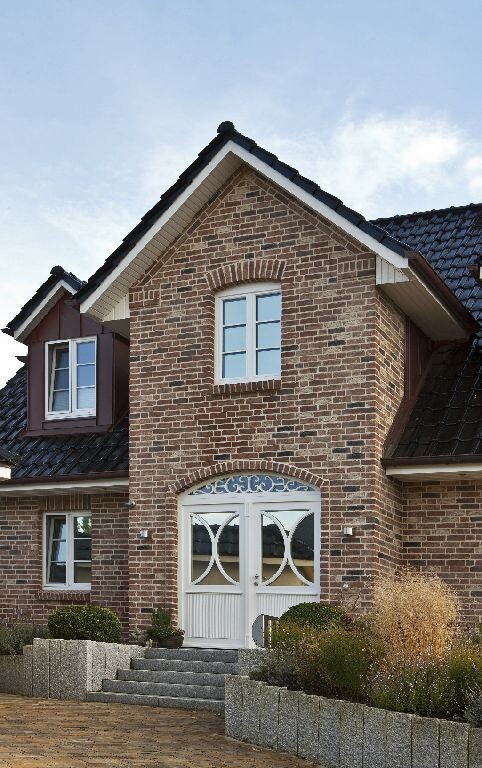
This is what we have in mind:
we want to build with a clinker brick facade.
However, we don’t want the perfectly smooth, uniform bricks but rather the more "rustic" ones.
In a conversation, we were told that the latter are "hand-formed" bricks, while the others are fired at higher temperatures.
If I understood correctly, the hand-fired bricks are also referred to as "Dutch clinkers."
Is that correct?
Besides the appearance, the main difference is how much water the bricks can absorb.
Hard-fired clinkers absorb very little water (< 2%?), while hand-fired bricks can absorb up to 15%, depending on the type.
People from the older generation around me always say, "Don’t choose Dutch clinkers; they absorb water." However, I was told in stores that this is no longer the case.
This is what we have in mind:
So, is it true that hand-molded bricks are also called Dutch bricks?
I was told that up to 10% water absorption is not a problem as long as the wall is not constantly wet (for example, due to lack of roof overhang).
However, I doubt 0% water absorption. I was told that even hard-fired clinker bricks have about 5-6% or less.
On the Egernsund website (company headquarters and showroom in Egernsund, Denmark), you can view technical data for each brick product, but for "water absorption," the field is left blank. So this information is missing, and I don’t believe it means 0%.
I was told that up to 10% water absorption is not a problem as long as the wall is not constantly wet (for example, due to lack of roof overhang).
However, I doubt 0% water absorption. I was told that even hard-fired clinker bricks have about 5-6% or less.
On the Egernsund website (company headquarters and showroom in Egernsund, Denmark), you can view technical data for each brick product, but for "water absorption," the field is left blank. So this information is missing, and I don’t believe it means 0%.
Now I have another question.
We looked at brick samples in the showroom and browsed through several catalogs.
After noting the name of an interesting brick, we searched online to find photos of entire houses using that brick.
A sample usually consists of bricks in different colors.
For the same brick pattern, we found several houses that look quite different.
Is this due to different production batches, or can the proportion of certain bricks in the pattern be varied, for example, using fewer dark bricks and more light bricks?
Are there separate pallets for each brick color, or are the different colors already mixed on the delivered pallets?
Is it generally possible to influence the mix, or does this depend on the manufacturer?
We looked at brick samples in the showroom and browsed through several catalogs.
After noting the name of an interesting brick, we searched online to find photos of entire houses using that brick.
A sample usually consists of bricks in different colors.
For the same brick pattern, we found several houses that look quite different.
Is this due to different production batches, or can the proportion of certain bricks in the pattern be varied, for example, using fewer dark bricks and more light bricks?
Are there separate pallets for each brick color, or are the different colors already mixed on the delivered pallets?
Is it generally possible to influence the mix, or does this depend on the manufacturer?
K
Knallkörper4 Feb 2017 23:36Hello,
If I were you, I wouldn’t focus too much on the question of water absorption, and the terminology doesn’t really matter that much either. In the end, almost all decent facing bricks, Dutch bricks, hand-formed bricks, and similar types are suitable for your house construction.
The facing bricks come mixed randomly on pallets. You don’t have any influence on the composition. When in doubt, you should choose a mix that is less varied in color. The appearance of the finished facade depends heavily on the mortar color but also on the weather.
If I were you, I wouldn’t focus too much on the question of water absorption, and the terminology doesn’t really matter that much either. In the end, almost all decent facing bricks, Dutch bricks, hand-formed bricks, and similar types are suitable for your house construction.
The facing bricks come mixed randomly on pallets. You don’t have any influence on the composition. When in doubt, you should choose a mix that is less varied in color. The appearance of the finished facade depends heavily on the mortar color but also on the weather.
Similar topics