
Hello everyone.
We are facing the following issue with our construction project. According to building regulations, rainwater must be infiltrated on-site or retained within the property. However, according to our soil report, the ground is not suitable for this.
The groundwater level is approximately 3.50 meters (11.5 feet).
Attached is an excerpt from the report.
What options do we have for infiltrating the rainwater? I have already read a lot about soakaway pits, infiltration trenches, and similar solutions, but I am completely unsure.
I look forward to constructive suggestions.
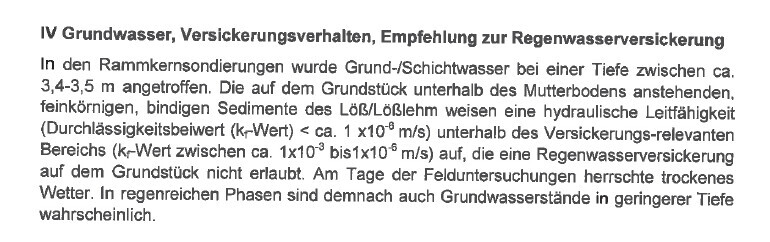
We are facing the following issue with our construction project. According to building regulations, rainwater must be infiltrated on-site or retained within the property. However, according to our soil report, the ground is not suitable for this.
The groundwater level is approximately 3.50 meters (11.5 feet).
Attached is an excerpt from the report.
What options do we have for infiltrating the rainwater? I have already read a lot about soakaway pits, infiltration trenches, and similar solutions, but I am completely unsure.
I look forward to constructive suggestions.
B
Bieber081525 Aug 2016 20:50The thread actually begins with the statement that, according to the soil report, infiltration is not possible. A retention tank definitely helps, but wouldn’t the soil report have suggested infiltration with pre-treatment retention from the start? Are there others who have had similar issues (soil unsuitable for infiltration but still installed infiltration system)?
 Chriscross13 Sep 2016 07:58
We are currently facing the issue that the development plan requires stormwater to infiltrate on-site, which, according to the soil report, is not feasible. My architect is now requesting a quote for an infiltration system. I’m curious to see how much this will cost.
Even though you always plan with a buffer, it’s money that ultimately ends up missing somewhere.
Even though you always plan with a buffer, it’s money that ultimately ends up missing somewhere.

What I would generally like to understand:
What kind of "policy" is this, that completely forbids the discharge of rainwater into the sewer system in general, but at the same time complains that the sewer cannot be flushed properly because people are conserving water?
I can understand that municipalities do not allow general discharge, since with the increasing number of new housing developments, the sewer system can quickly become overloaded. This results in higher maintenance efforts and increased loads on the wastewater treatment plant.
However, if an overflow is allowed, it would mean there are not excessive volumes to handle in normal conditions, but during heavy rainfall it would provide a useful "flushing" effect for the sewer system.
Additionally, I am concerned that for properties where the soil report states that infiltration is not possible, repeated heavy rainfall (like this year) will likely overwhelm even a soakaway system, and the rainwater cannot be absorbed. In the worst case, the property owner then faces two problems – 1. a flooded property and 2. the municipality insisting that rainwater must be infiltrated on their land.
What kind of "policy" is this, that completely forbids the discharge of rainwater into the sewer system in general, but at the same time complains that the sewer cannot be flushed properly because people are conserving water?
I can understand that municipalities do not allow general discharge, since with the increasing number of new housing developments, the sewer system can quickly become overloaded. This results in higher maintenance efforts and increased loads on the wastewater treatment plant.
However, if an overflow is allowed, it would mean there are not excessive volumes to handle in normal conditions, but during heavy rainfall it would provide a useful "flushing" effect for the sewer system.
Additionally, I am concerned that for properties where the soil report states that infiltration is not possible, repeated heavy rainfall (like this year) will likely overwhelm even a soakaway system, and the rainwater cannot be absorbed. In the worst case, the property owner then faces two problems – 1. a flooded property and 2. the municipality insisting that rainwater must be infiltrated on their land.
I’m wondering who is actually liable if water flows across your own property, for example into public areas. Or if it continues onto a neighbor’s property and causes damage there. Am I, as the landowner, responsible if water runs over my land?
As for why rainwater should not be discharged… maybe someone with expertise will comment, but I’d like to speculate. From what I understand, managing rainwater drainage is relatively expensive. Treatment plants and pumps must be designed to handle extreme peak loads in order to dispose of rainwater. Household wastewater is fairly predictable and only rarely experiences extreme situations. So, excess capacity is maintained continuously but seldom used.
Additionally, there are separate systems, meaning rainwater and wastewater are carried in different sewer pipes. The wastewater sewer is therefore smaller in diameter and thus cheaper. If I avoid the rainwater sewer during development, I’m saving costs for the municipality as well.
As for why rainwater should not be discharged… maybe someone with expertise will comment, but I’d like to speculate. From what I understand, managing rainwater drainage is relatively expensive. Treatment plants and pumps must be designed to handle extreme peak loads in order to dispose of rainwater. Household wastewater is fairly predictable and only rarely experiences extreme situations. So, excess capacity is maintained continuously but seldom used.
Additionally, there are separate systems, meaning rainwater and wastewater are carried in different sewer pipes. The wastewater sewer is therefore smaller in diameter and thus cheaper. If I avoid the rainwater sewer during development, I’m saving costs for the municipality as well.

f-pNo schrieb:
... What kind of “policy” is it that generally forbids the discharge of rainwater into the sewer system in general, but at the same time complains that the sewers cannot be flushed enough because people are using less water?
I understand that municipalities do not allow general discharge, since with more and more new housing developments the sewer system can quickly become overloaded, resulting in higher maintenance and treatment plant costs.
However, if an overflow were allowed, it would reduce the volume of water to manage while still providing a helpful “flushing” of the sewer system during heavy rain...It’s actually quite simple.
During heavy rainfall events or when the wastewater treatment plant is overloaded, wastewater is only mechanically pretreated and diluted sewage is discharged into natural water bodies.
This reduces the water quality of these bodies, which is prohibited by river basin authorities because otherwise the EU would sanction them.
Rainwater, however, can almost always be discharged directly, since it usually only carries fertilizer runoff from agricultural fields.
This is also why more and more municipalities are switching to separate sewer systems.
To reduce and manage the much greater volume of wastewater during rainy periods compared to dry weather, stormwater retention basins or storage sewers are often built, and homeowners are frequently required to install rainwater cisterns.
I would refuse to install an infiltration system. Why conduct a soil survey if its findings are simply ignored in the end? Ultimately, you are the one who suffers if your garden turns into a marshland. This is often the problem in new housing developments. Municipalities or cities struggle to connect entirely new areas to the existing system because capacity is limited or due to elevation challenges. Then a soil survey is conducted, which is sometimes interpreted to mean that water can possibly be infiltrated, and this is included in the building regulations. Problem solved. However, when detailed assessments are done by the builders after site development starts and construction begins, and the soil actually does not allow infiltration, the original soil surveyor is suddenly unreachable. I have experienced this multiple times.
Typically, a soakaway system is installed in combination with a rainwater tank to delay water runoff. Part of the tank is used as an intermediate storage, and the water is slowly released to the soakaway through a flow restrictor. This naturally reduces the usable volume of the tank or means the tank must be enlarged to accommodate the retention volume. This is usually in the range of 1.5-3m³ (1.5-3 cubic yards), depending on the roof area, soakaway size, and soil conditions. For me, this would not be a solution regardless of costs since no one can guarantee there will be sufficient infiltration capacity, or the soil survey may even contradict it. Of course, it also does not help if you dispose of your own water “somehow” differently and you get washed away because of water infiltrating from the neighbors, but at least in that case, you can take legal action.
If a sewer connection is technically not feasible, it naturally becomes difficult because the municipality or city will oppose you, and you are left alone with the problem. Then your only options (besides finding a different building plot) are to allow the water to infiltrate and hope that nothing goes wrong. With groundwater at 3.5m (11.5 feet), there is also the question of how deep a soakaway may be to prevent infiltrated water from reaching the groundwater directly.
Typically, a soakaway system is installed in combination with a rainwater tank to delay water runoff. Part of the tank is used as an intermediate storage, and the water is slowly released to the soakaway through a flow restrictor. This naturally reduces the usable volume of the tank or means the tank must be enlarged to accommodate the retention volume. This is usually in the range of 1.5-3m³ (1.5-3 cubic yards), depending on the roof area, soakaway size, and soil conditions. For me, this would not be a solution regardless of costs since no one can guarantee there will be sufficient infiltration capacity, or the soil survey may even contradict it. Of course, it also does not help if you dispose of your own water “somehow” differently and you get washed away because of water infiltrating from the neighbors, but at least in that case, you can take legal action.
If a sewer connection is technically not feasible, it naturally becomes difficult because the municipality or city will oppose you, and you are left alone with the problem. Then your only options (besides finding a different building plot) are to allow the water to infiltrate and hope that nothing goes wrong. With groundwater at 3.5m (11.5 feet), there is also the question of how deep a soakaway may be to prevent infiltrated water from reaching the groundwater directly.
Similar topics