
After gutting our bathroom, the walls now present a rather "grim" appearance.
We are currently considering which option would be better or more cost-effective.
The walls are to be partially tiled and partially plastered. Either way, a smooth surface needs to be created.
Either have the walls fully plastered or use paneling materials to create an even wall.
The photo might help to better understand the starting situation.
The picture is a few days old. Since then, the toilet cistern and the old drain pipes have also been removed. The plumbing company will start with the new pipes on Monday.
How would you proceed?
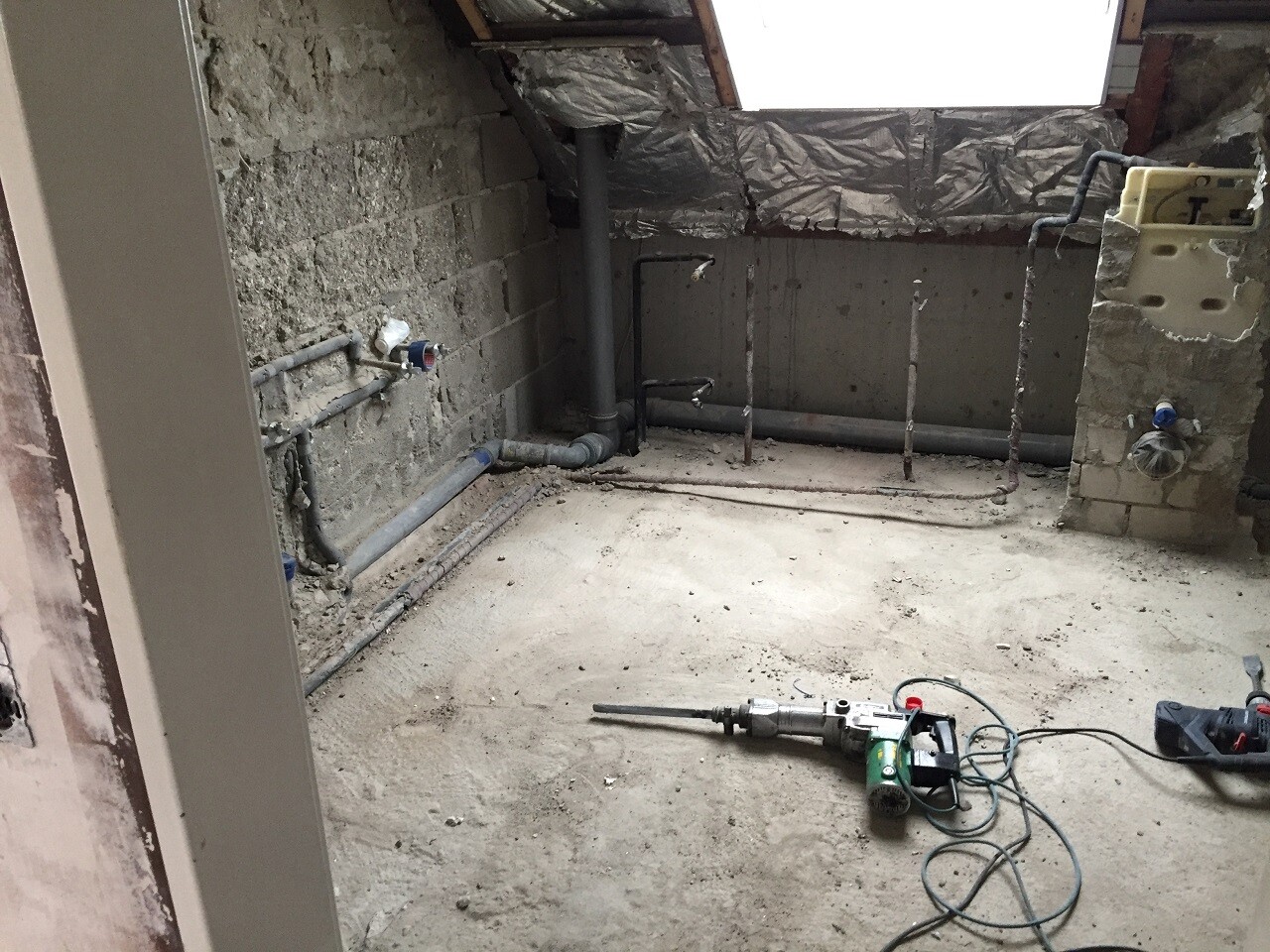
We are currently considering which option would be better or more cost-effective.
The walls are to be partially tiled and partially plastered. Either way, a smooth surface needs to be created.
Either have the walls fully plastered or use paneling materials to create an even wall.
The photo might help to better understand the starting situation.
The picture is a few days old. Since then, the toilet cistern and the old drain pipes have also been removed. The plumbing company will start with the new pipes on Monday.
How would you proceed?
So, it’s not THAT critical if the vapor barrier isn’t 100% airtight. Of course, you should pay attention to it, but you can design the construction in a way that tolerates some imperfections—at least when it comes to mold issues. Much more serious is the impact on wind and thermal protection.
Regards, Joe
Regards, Joe

Joedreck schrieb:
So, it’s not THAT critical if the vapor barrier isn’t 100% airtight. Of course, you should pay attention to it, but the construction can be designed to tolerate some imperfections—at least when it comes to mold.
Much worse is the impact on wind and thermal protection…
Regards, JoeDo you know this for sure, meaning are you an expert, or is this just your opinion?
I spoke with a roofer who said that warm (and rather moist) air creates a slight positive pressure and escapes through any holes, similar to air leaking from a punctured balloon.
If the layer behind this is cold (for example, in winter), moisture from the warm air condenses there. Condensation combined with insulation is definitely a concerning combination. In winter, this moisture may not dry out properly or at all, which could eventually lead to mold growth.
Is this just scare-mongering or is it a valid concern?
G
garfunkel2 Jul 2017 18:59Consider this justified. I have spent a considerable amount of time studying this topic myself.
Heat protection has nothing whatsoever to do with the vapor retarder.
Regarding airtightness, it is more accurate, and yes, it is possible to design a construction assembly that is less prone to mold. However, this is not always simple, especially for non-professionals.
You do not choose the assembly just to be careless with the vapor-retarding layer.
I do not believe that a vapor retarder can be 100% airtight. In my opinion, 100% airtightness is practically impossible—hardly achievable (in a lasting way)—BUT the system must be sealed almost completely. Any carelessness can be costly later on.
The airtight layer MUST be installed as perfectly as possible. It is better to be too meticulous than too careless.
How large a leak can be and what size is still acceptable cannot really be answered. It depends entirely on the conditions inside the space.
I would not take any risks.
Heat protection has nothing whatsoever to do with the vapor retarder.
Regarding airtightness, it is more accurate, and yes, it is possible to design a construction assembly that is less prone to mold. However, this is not always simple, especially for non-professionals.
You do not choose the assembly just to be careless with the vapor-retarding layer.
I do not believe that a vapor retarder can be 100% airtight. In my opinion, 100% airtightness is practically impossible—hardly achievable (in a lasting way)—BUT the system must be sealed almost completely. Any carelessness can be costly later on.
The airtight layer MUST be installed as perfectly as possible. It is better to be too meticulous than too careless.
How large a leak can be and what size is still acceptable cannot really be answered. It depends entirely on the conditions inside the space.
I would not take any risks.
The vapor barrier acts as an airtight layer when it comes to heat protection. So, it is definitely involved in this context.
If you have ventilation behind the insulation, small holes in the vapor barrier are not a big issue. Moisture entering here can be carried away through the air to the outside. The problem arises when there is another airtight layer to the outside after the insulation. In that case, moisture cannot escape, and the insulation becomes saturated.
However, there are also vapor-retarding membranes that allow diffusion back into the room to prevent mold.
It is often assumed that a 100% vapor barrier is installed to lay OSB boards in the top floor ceiling. These boards are vapor-tight in a broader sense. Moisture cannot pass through, and problems are likely.
Overall, it is correct that the vapor barrier (whether a film or another type) should be as airtight as possible. However, some construction setups are more tolerant of errors, while others are not.
Regards, Joe
If you have ventilation behind the insulation, small holes in the vapor barrier are not a big issue. Moisture entering here can be carried away through the air to the outside. The problem arises when there is another airtight layer to the outside after the insulation. In that case, moisture cannot escape, and the insulation becomes saturated.
However, there are also vapor-retarding membranes that allow diffusion back into the room to prevent mold.
It is often assumed that a 100% vapor barrier is installed to lay OSB boards in the top floor ceiling. These boards are vapor-tight in a broader sense. Moisture cannot pass through, and problems are likely.
Overall, it is correct that the vapor barrier (whether a film or another type) should be as airtight as possible. However, some construction setups are more tolerant of errors, while others are not.
Regards, Joe
R
roadrun873 Jul 2017 11:08In my case, it is exclusively about interior walls.
Similar topics