
Hello everyone,
In the kitchen of my single-family house, unfortunately only one light switch was installed, which controls a ceiling light. I would like to replace the single light switch with a double switch/two-gang switch to also be able to turn the retrofitted LED lights under the upper cabinets of my built-in kitchen on and off from the door, in addition to the ceiling light. Currently, these lights can only be controlled by motion sensors, so I have to wave my hand briefly under each of the four lights separately. The LED lights run on 12 V and each has a small plug-in transformer with a Europlug at the end of the cable, which are all currently plugged into a power strip above the kitchen counter.
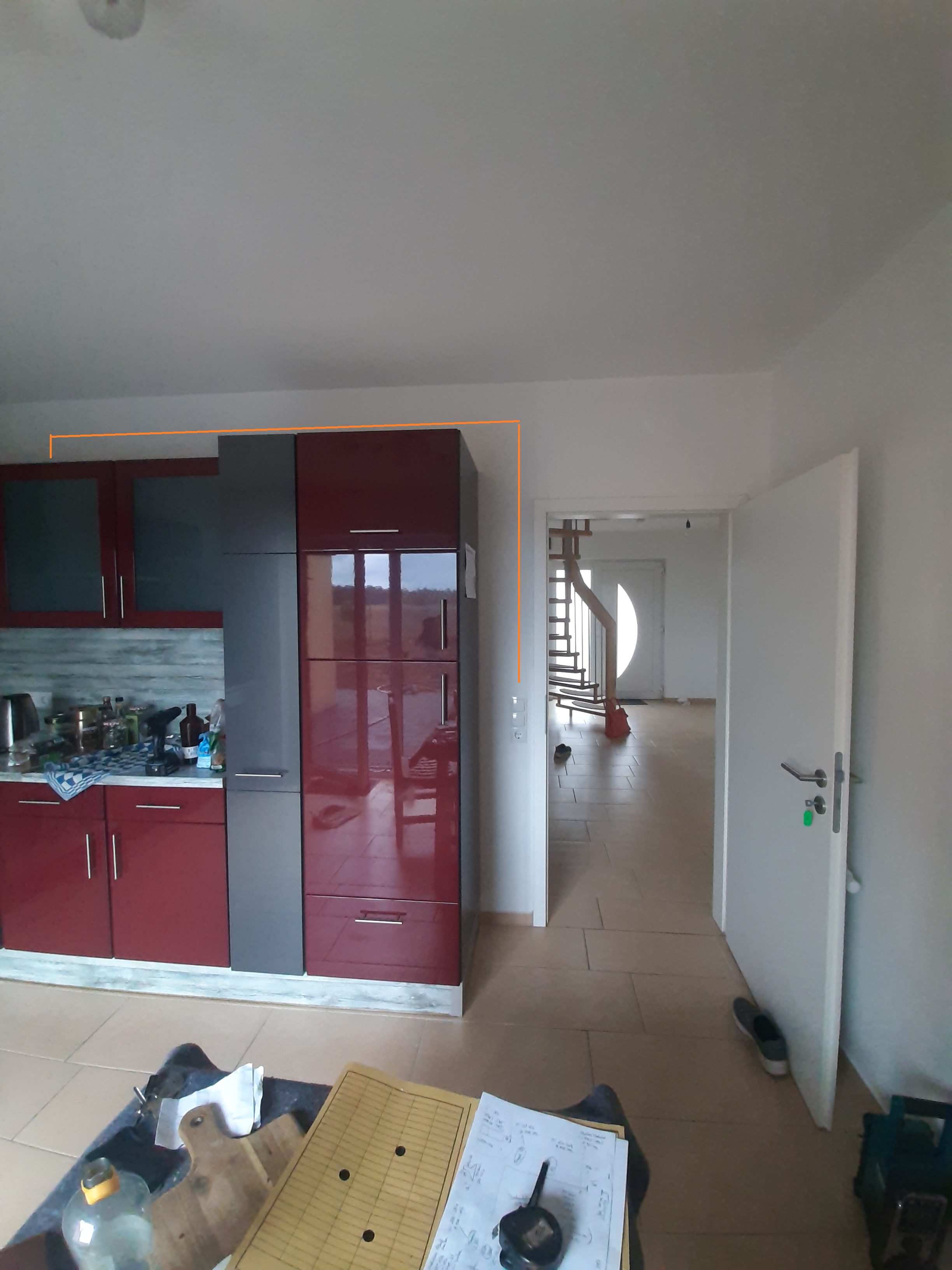
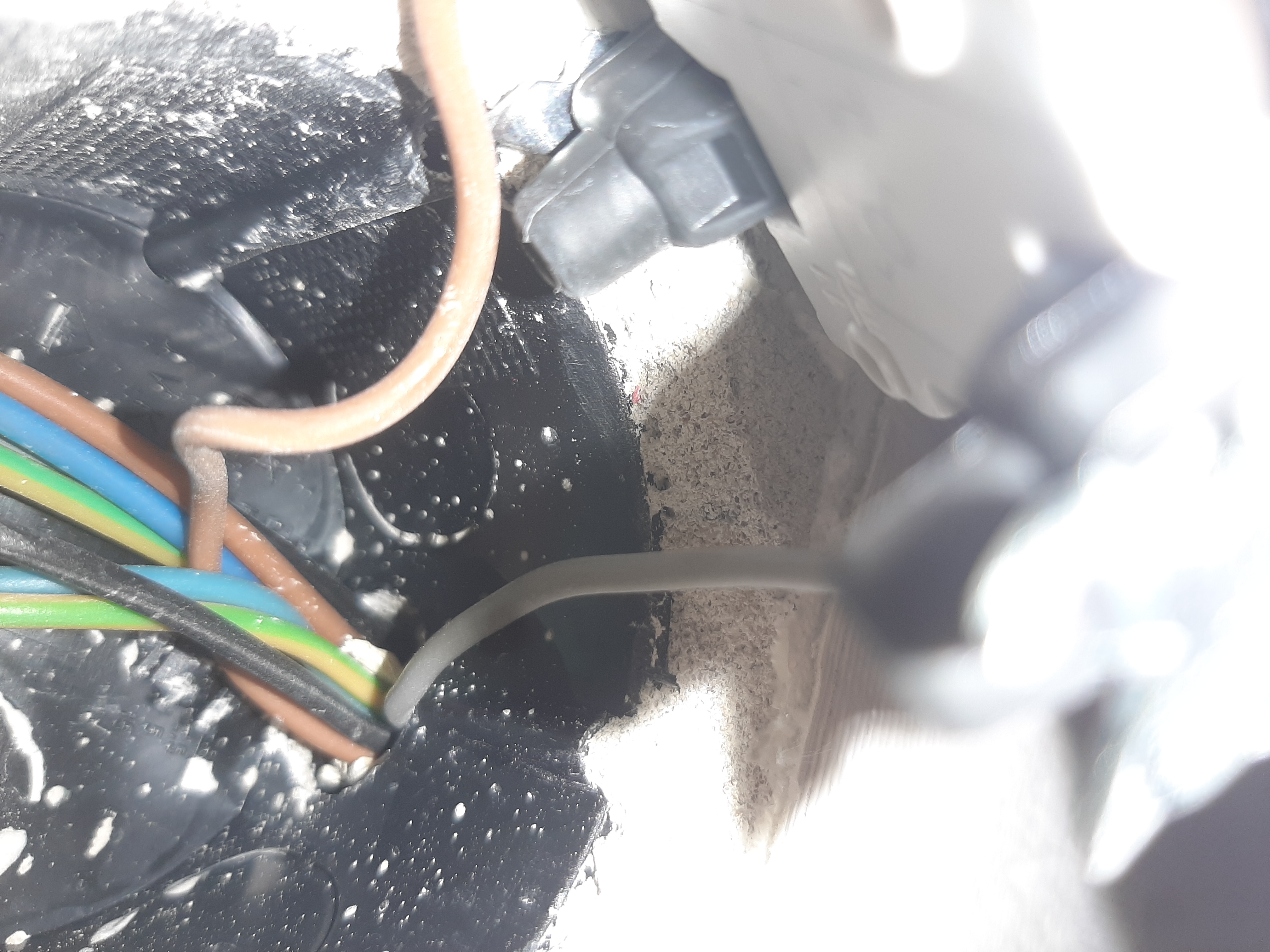
Since this is only blurry in the photo: In the triple combination, at the very top is the light switch to be replaced, wired with a brown live wire and a switched grey live wire. Below it is a switch for the electric roller shutter of the kitchen window, and below that is a socket outlet. Everything is on a common circuit breaker. I had hoped to find an unused neutral conductor in this triple combination, so I could pick up the new switched live wire in the flush-mounted distribution box above the triple combination, but unfortunately all existing conductors are occupied, so I have to start directly at the bottom of the switch.
The plan now is as follows:
- Lay a two-core flat installation cable 2 x 1.5 mm (14 AWG) YDYp in a surface-mounted cable duct 12 x 7 mm, fixed to the wall with two-component epoxy adhesive (for permanent hold). Cable route see orange line. The cable has a solid copper core, not stranded.
- Carefully open the wall directly above the light switch to access the cable entry of the flush-mounted box, to avoid damaging already installed cables. The new installation cable will then be pulled into the topmost flush-mounted box as well. The cable duct will rest directly on the upper edge of the switch, and the cable will be completely hidden, routed through the back wall of the cable duct into the wall and into the flush-mounted box.
- Replace the single light switch with a two-gang switch, where the new switched live for the cabinet lights will be taken off. The neutral conductor will be connected where there is a free neutral terminal, e.g., at the socket outlet unit.
- Install a surface-mounted junction box above the cabinet.
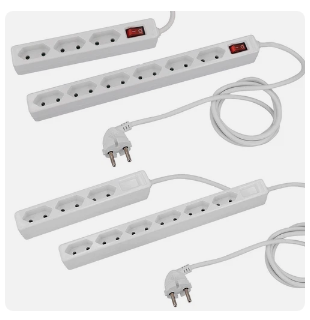
- The plug will be cut off from a power strip and the cable firmly connected inside the junction box. To prevent anyone mistakenly assuming the power strip has a protective earth (PE) contact, a power strip with only Euro sockets will be used.
This is intended as a temporary interim solution until we have to renovate the kitchen completely in a few years anyway; at that time, the wall above the triple combination can be opened up and a new cable installed flush-mounted.
Technically this would work perfectly, I have no doubt about that. But is it also allowed?
Thanks for your well-founded opinions,
best regards
Marco
In the kitchen of my single-family house, unfortunately only one light switch was installed, which controls a ceiling light. I would like to replace the single light switch with a double switch/two-gang switch to also be able to turn the retrofitted LED lights under the upper cabinets of my built-in kitchen on and off from the door, in addition to the ceiling light. Currently, these lights can only be controlled by motion sensors, so I have to wave my hand briefly under each of the four lights separately. The LED lights run on 12 V and each has a small plug-in transformer with a Europlug at the end of the cable, which are all currently plugged into a power strip above the kitchen counter.
Since this is only blurry in the photo: In the triple combination, at the very top is the light switch to be replaced, wired with a brown live wire and a switched grey live wire. Below it is a switch for the electric roller shutter of the kitchen window, and below that is a socket outlet. Everything is on a common circuit breaker. I had hoped to find an unused neutral conductor in this triple combination, so I could pick up the new switched live wire in the flush-mounted distribution box above the triple combination, but unfortunately all existing conductors are occupied, so I have to start directly at the bottom of the switch.
The plan now is as follows:
- Lay a two-core flat installation cable 2 x 1.5 mm (14 AWG) YDYp in a surface-mounted cable duct 12 x 7 mm, fixed to the wall with two-component epoxy adhesive (for permanent hold). Cable route see orange line. The cable has a solid copper core, not stranded.
- Carefully open the wall directly above the light switch to access the cable entry of the flush-mounted box, to avoid damaging already installed cables. The new installation cable will then be pulled into the topmost flush-mounted box as well. The cable duct will rest directly on the upper edge of the switch, and the cable will be completely hidden, routed through the back wall of the cable duct into the wall and into the flush-mounted box.
- Replace the single light switch with a two-gang switch, where the new switched live for the cabinet lights will be taken off. The neutral conductor will be connected where there is a free neutral terminal, e.g., at the socket outlet unit.
- Install a surface-mounted junction box above the cabinet.
- The plug will be cut off from a power strip and the cable firmly connected inside the junction box. To prevent anyone mistakenly assuming the power strip has a protective earth (PE) contact, a power strip with only Euro sockets will be used.
This is intended as a temporary interim solution until we have to renovate the kitchen completely in a few years anyway; at that time, the wall above the triple combination can be opened up and a new cable installed flush-mounted.
Technically this would work perfectly, I have no doubt about that. But is it also allowed?
Thanks for your well-founded opinions,
best regards
Marco
M
MarcomitZeh21 Apr 2026 19:09nordanney schrieb:
If it works, I’m not really concerned about whether it’s officially allowed. Although the house is currently empty, it will be rented out soon. From a landlord’s perspective, compliance with regulations is a major issue—especially if you take liability and similar matters somewhat seriously. Even for private use, you shouldn’t entirely disregard such things; standards exist for good reasons.
nordanney schrieb:
It’s a pity none of the much simpler alternatives interest you. Well, what do you mean by “interest”… I have set a goal (to control from the door), and the question is how to achieve precisely that goal—not just any other solution. Installing a switch on the underside of the upper cabinet is a well-meant suggestion, but it’s not what I want. Shelly would have been an option, but it doesn’t fit in the wall box. And honestly, it’s not that complicated to surface-mount an additional cable, so the other suggestions aren’t actually much “simpler.”
Is there no electrician here familiar with VDE standards who can answer my question?
N
nordanney21 Apr 2026 21:16MarcomitZeh schrieb:
Is there no electrician here who is familiar with VDE standards and can answer my question? No, this forum is for homeowners. You should ask in a specialized electrical forum.
Besides, the effort for renting out is too much for me. You MUST hire a licensed electrician for this, as it is prohibited for private individuals to do such work themselves according to the standards. Since you want to comply with regulations, and especially when renting out, it is dangerous to tamper with electrical installations on your own. You would be personally liable because you are not an electrician. It’s really a major issue.
I am a landlord myself and would never do something like this myself. It can really cause serious problems.

M
MachsSelbst21 Apr 2026 22:42By the way, it is ALWAYS an issue if you tamper with the electrical system yourself when you are not allowed to.
If the house burns down and the insurance proves that the fire was caused by improper electrical work, you will not receive a single cent.
This is even more serious in the case of renting out the property, because then you would also have to cover the tenant’s damages and might end up in court for negligent bodily injury up to negligent manslaughter.
In general, with electrical work:
If you need to ask for advice in an online forum, you should stay away from it because you lack the necessary knowledge. Too much can go wrong if you make a mistake, as laypersons usually do not have the proper measuring instruments to check their work after completion. Insulation resistance, loop impedance, trip time and trip current of RCDs, and so on—all these parameters must be measured for the relevant circuits once the electrical system has been modified...
If the house burns down and the insurance proves that the fire was caused by improper electrical work, you will not receive a single cent.
This is even more serious in the case of renting out the property, because then you would also have to cover the tenant’s damages and might end up in court for negligent bodily injury up to negligent manslaughter.
In general, with electrical work:
If you need to ask for advice in an online forum, you should stay away from it because you lack the necessary knowledge. Too much can go wrong if you make a mistake, as laypersons usually do not have the proper measuring instruments to check their work after completion. Insulation resistance, loop impedance, trip time and trip current of RCDs, and so on—all these parameters must be measured for the relevant circuits once the electrical system has been modified...
M
MarcomitZeh22 Apr 2026 14:04nordanney schrieb:
You MUST hire a licensed electrician for this, as it is prohibited by regulations for private individuals to do such work themselves. MachsSelbst schrieb:
By the way, it’s ALWAYS an issue when someone without permission tampers with electrical installations.
If the house burns down and the insurance proves the fire was caused by improper electrical work, you won’t get a single cent. Believe me, I have done plenty of electrical work myself, even in rental properties. This is generally allowed as long as a certified electrician inspects and approves the work before it is put into operation.
MachsSelbst schrieb:
If you have to ask in an internet forum, you should just leave it alone because you clearly don’t know what you’re doing. Every time I read something like that, I can’t help but roll my eyes. By that logic, the entire electricity/electrical planning section of the forum would be pointless—if you have questions, just give up and stay out of the forum. And if you already know everything, then you don’t need a forum at all.
Knöpfchen schrieb:
No, the protective earth conductor must always be connected.
According to the new VDE 410 Thanks, Knöpfchen, for the first and so far only response that actually addresses the question. Of course, I could also connect a PE conductor at the outlet, then route switched live, neutral, and PE up through the conduit. Instead of mounting a surface-mounted junction box on top of the cabinet, I would install a surface-mounted outlet with Schuko sockets there, and the Euro-style power strip could be omitted. Would that be acceptable?
N
nordanney22 Apr 2026 14:12MarcomitZeh schrieb:
This is generally allowed, as long as an electrician inspects and approves the in-house electrical work before it is put into operation. Then alternatively, just ask your electrician, the one who usually approves your electrical installations anyway. You need them regardless.
Similar topics