
ᐅ Recommendation: Air-to-Water Heat Pump versus Local District Heating Network for KFW40 New Construction
Created on: 29 Oct 2023 08:16
M
Mark_xx
Hello everyone,
We are about to start construction on our single-family house.
Key facts:
2 full floors
200 sqm (2,150 sq ft)
No basement
KfW40 standard
3 people
Photovoltaic system 7-9 kWp (depending on heat pump or district heating), battery storage optional
Underfloor heating throughout the house
There are two specific energy supply options we have been offered:
Option 1: District heating
Technology: Transfer station, meter, and downstream combined storage tank for heating and hot water (CS Solar KSR 1000), plus two 3 kW heating rods with control for feeding in photovoltaic electricity. Supply temperature from the district heating network: 65-80 degrees Celsius (149-176 degrees Fahrenheit)
Flat price per kWh independent of consumption: 300 euros + €0.0995/kWh
One-time connection fee including transfer station: 14,000 euros
Option 2: Air-to-water heat pump
Technology: iDM ALM 4-12 with integrated storage tanks (100 l (26 gallons) heating, 295 l (78 gallons) hot water)
Comparable price: 18,000 euros
Overall costs over the service life, assuming a heat pump lifespan of 15 years, favor district heating.
However, I have two questions:
I am not sure whether a combined storage tank is really practical with district heating, especially in summer. For example, do you have to heat the entire buffer tank to temperature for showering even if the heating water isn’t needed? Could this possibly lead to issues with legionella?
Also, there is a claim that a photovoltaic system works more efficiently with an air-to-water heat pump than with a heating element, because the PV system likely does not produce 3-6 kW at the time of the heat demand.
Does anyone have experience with one of these options or answers to my two questions?
I would also appreciate any suggestions for improvement.
Thank you!
We are about to start construction on our single-family house.
Key facts:
2 full floors
200 sqm (2,150 sq ft)
No basement
KfW40 standard
3 people
Photovoltaic system 7-9 kWp (depending on heat pump or district heating), battery storage optional
Underfloor heating throughout the house
There are two specific energy supply options we have been offered:
Option 1: District heating
Technology: Transfer station, meter, and downstream combined storage tank for heating and hot water (CS Solar KSR 1000), plus two 3 kW heating rods with control for feeding in photovoltaic electricity. Supply temperature from the district heating network: 65-80 degrees Celsius (149-176 degrees Fahrenheit)
Flat price per kWh independent of consumption: 300 euros + €0.0995/kWh
One-time connection fee including transfer station: 14,000 euros
Option 2: Air-to-water heat pump
Technology: iDM ALM 4-12 with integrated storage tanks (100 l (26 gallons) heating, 295 l (78 gallons) hot water)
Comparable price: 18,000 euros
Overall costs over the service life, assuming a heat pump lifespan of 15 years, favor district heating.
However, I have two questions:
I am not sure whether a combined storage tank is really practical with district heating, especially in summer. For example, do you have to heat the entire buffer tank to temperature for showering even if the heating water isn’t needed? Could this possibly lead to issues with legionella?
Also, there is a claim that a photovoltaic system works more efficiently with an air-to-water heat pump than with a heating element, because the PV system likely does not produce 3-6 kW at the time of the heat demand.
Does anyone have experience with one of these options or answers to my two questions?
I would also appreciate any suggestions for improvement.
Thank you!
Yes, the limitation to IDM is not really ideal in this case – there are several other manufacturers (mainly from Japan and South Korea) that offer 4 to 5 kW heat pumps, which can modulate down to just over 1 kW. These would fit much better and provide significant savings, especially during transitional seasons. Some of them are also available as monoblock units, meaning you lose no more indoor space than with an all-in-one system. They are also considerably cheaper...
Now I need to turn to you again because my heating engineer still recommends the ALM 4-12 for a heating load of 5.05 kW (without domestic hot water).
Furthermore, he states that a value of 7 kW is assumed for domestic hot water heating. I cannot reconcile this value at all with the common recommendations of 0.25 kW per person per day. Perhaps he means the total demand for heating and hot water combined is 7 kW, but even then, I wouldn’t choose the 4-12 version, right?
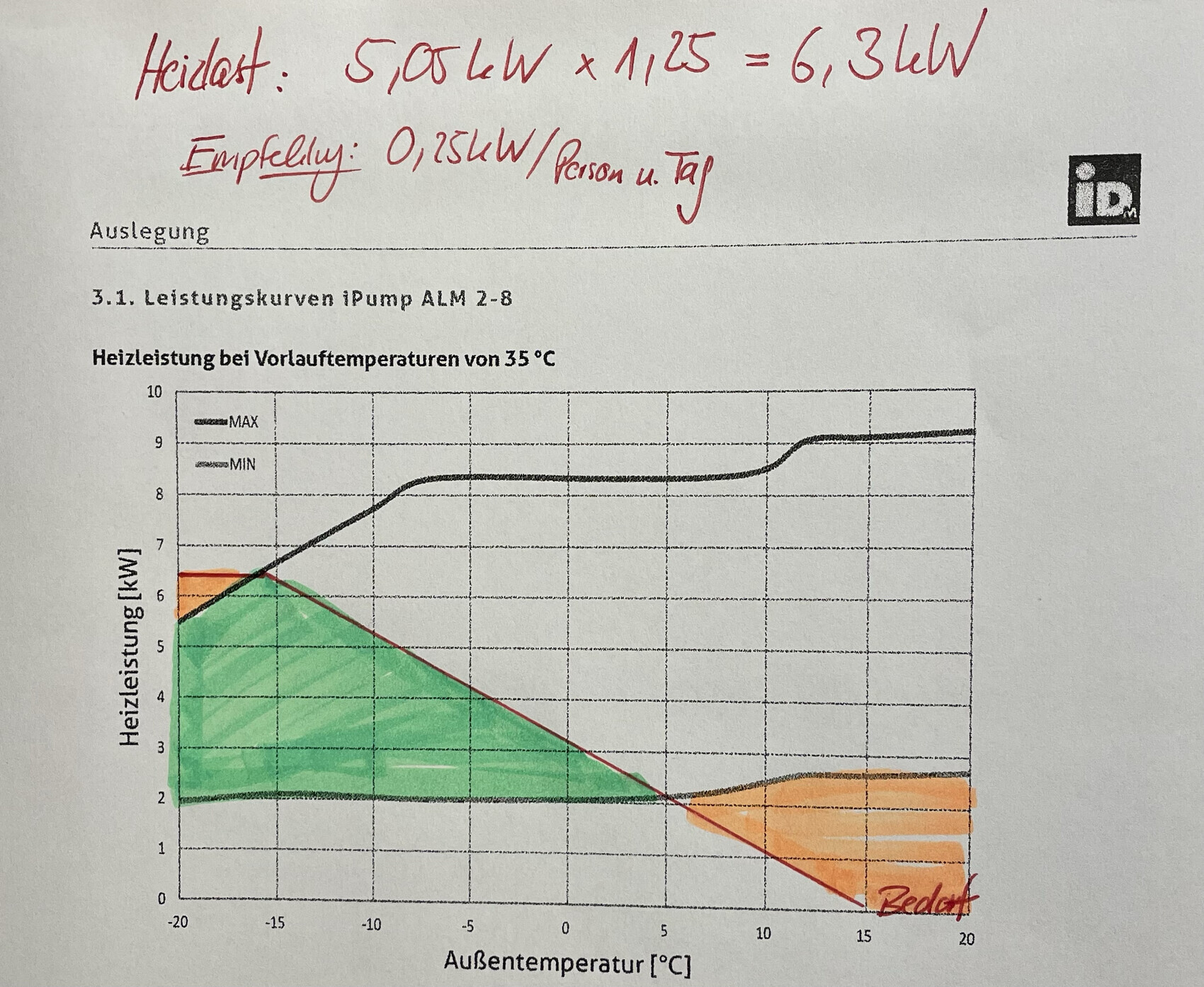
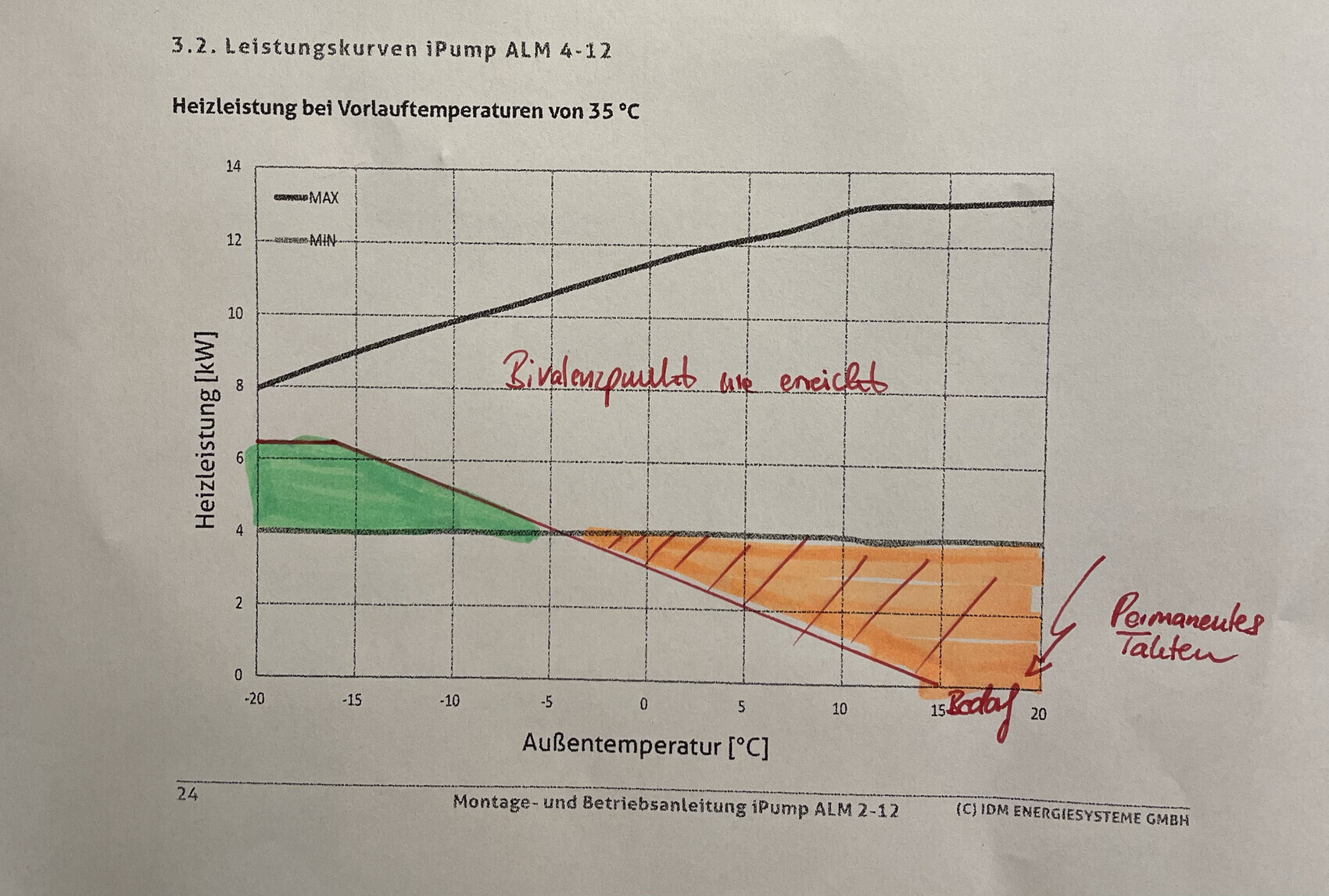
For illustration, I have plotted the heating demand (5 kW heating + 1.25 kW domestic hot water) against the performance curves of the iPump ALM 2-8 and 4-12.
You can quite clearly see that the 4-12 will constantly cycle at temperatures above -5 degrees Celsius (23°F), as the minimum output is 4 kW.
Even the 2-8 version doesn’t really run efficiently above 5 degrees Celsius (41°F), or am I missing something?
In any case, the bivalence point in both cases lies outside the corridor recommended by iDM, which is between -3 and -10 degrees Celsius (27°F and 14°F).
It would be great if you could let me know if I’m making any mistakes in my reasoning 🙂
Furthermore, he states that a value of 7 kW is assumed for domestic hot water heating. I cannot reconcile this value at all with the common recommendations of 0.25 kW per person per day. Perhaps he means the total demand for heating and hot water combined is 7 kW, but even then, I wouldn’t choose the 4-12 version, right?
For illustration, I have plotted the heating demand (5 kW heating + 1.25 kW domestic hot water) against the performance curves of the iPump ALM 2-8 and 4-12.
You can quite clearly see that the 4-12 will constantly cycle at temperatures above -5 degrees Celsius (23°F), as the minimum output is 4 kW.
Even the 2-8 version doesn’t really run efficiently above 5 degrees Celsius (41°F), or am I missing something?
In any case, the bivalence point in both cases lies outside the corridor recommended by iDM, which is between -3 and -10 degrees Celsius (27°F and 14°F).
It would be great if you could let me know if I’m making any mistakes in my reasoning 🙂
D
Daniel-Sp11 Nov 2023 18:49Hello,
the heat pump either produces hot water or heats, but never both at the same time. So, you don't need to add those up. During the domestic hot water production period (depending on the heat pump capacity, 30-60 minutes), the screed cools down measurably but not noticeably. The heat pump might then briefly operate at a higher modulation level, but this does not mean you need a more powerful heat pump!
How much flexibility do you have in your choice?
the heat pump either produces hot water or heats, but never both at the same time. So, you don't need to add those up. During the domestic hot water production period (depending on the heat pump capacity, 30-60 minutes), the screed cools down measurably but not noticeably. The heat pump might then briefly operate at a higher modulation level, but this does not mean you need a more powerful heat pump!
How much flexibility do you have in your choice?
R
RotorMotor11 Nov 2023 19:55Creating the drawings was definitely a great idea and clearly shows how both devices are oversized. One is clearly significantly more oversized than the other.
Or how was your NAT again? ;-)
Or how was your NAT again? ;-)
Daniel-Sp schrieb:
Hello,
the heat pump either produces domestic hot water or provides heating, but never both at the same time. So you don’t need to add those up. During the domestic hot water production phase (depending on the heat pump’s capacity, about 30-60 minutes), the screed cools down measurably but not noticeably. The heat pump may briefly run at a higher modulation level, but that doesn’t mean you need a more powerful heat pump!
How much freedom do you have in your choice? Thanks for your explanation!
Well, we are building with a general contractor who works with a heating technician that sells iDM and Viessmann products. So, in theory, our options are somewhat limited unless I strongly insist on a different manufacturer. However, I’ve generally heard little bad about iDM, so I would prefer to stick with them.
RotorMotor schrieb:
Creating the drawings was a great idea and clearly shows how both systems are oversized.
One is definitely much more oversized than the other.
Or what was your NAT again? ;-) Our NAT is -13.5 degrees Celsius (7.7 degrees Fahrenheit). However, in the drawing, I even assumed the worse case of -16 degrees Celsius (3.2 degrees Fahrenheit).
There are hardly any heat pumps with even less capacity. Is short cycling of the heat pump actually that problematic at demands below 2 kW, or is it just a minor disadvantage so that I might still consider switching to local heat supply?
Similar topics