
Hello everyone,
Since I plan to move into my newly purchased property in 3 months and no plumber is available to install the new drinking water pipes, I am thinking of doing it myself.
Stainless steel pipes with a press fitting system will be used. The heating system will be newly installed by a professional plumber.
Since I have little knowledge about sizing, I am turning to you for advice.
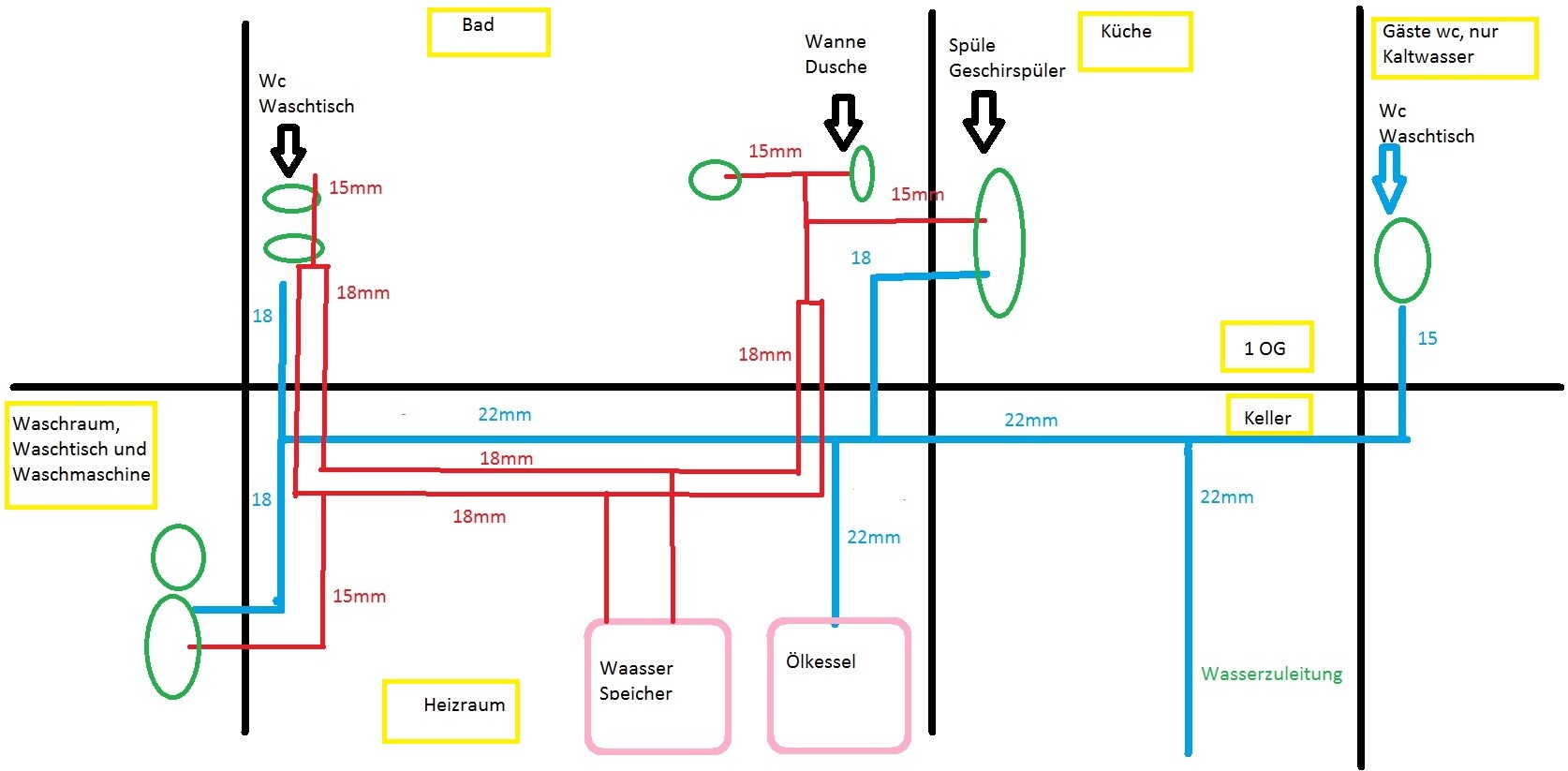
It’s a bungalow. The bathroom is located below, meaning I will run the pipes up along the left and right sides of the wall to supply the washbasin and toilet, and on the other side the bathtub with shower. Then, through the wall, I will connect to the kitchen sink and dishwasher. It’s not really complicated, but how large should the pipes be?
I have attached a picture. What do you think?
Is 18mm (3/4 inch) hot water pipe enough for circulation?
18mm (3/4 inch) cold water pipe for the washing machine?
15mm (1/2 inch) cold water pipe for the dishwasher?
I would be very grateful for any advice you can give.
Since I plan to move into my newly purchased property in 3 months and no plumber is available to install the new drinking water pipes, I am thinking of doing it myself.
Stainless steel pipes with a press fitting system will be used. The heating system will be newly installed by a professional plumber.
Since I have little knowledge about sizing, I am turning to you for advice.
It’s a bungalow. The bathroom is located below, meaning I will run the pipes up along the left and right sides of the wall to supply the washbasin and toilet, and on the other side the bathtub with shower. Then, through the wall, I will connect to the kitchen sink and dishwasher. It’s not really complicated, but how large should the pipes be?
I have attached a picture. What do you think?
Is 18mm (3/4 inch) hot water pipe enough for circulation?
18mm (3/4 inch) cold water pipe for the washing machine?
15mm (1/2 inch) cold water pipe for the dishwasher?
I would be very grateful for any advice you can give.

Tom1607 schrieb:
§ 12 (2) of the AVB-WasserV states that installation and significant modifications may only be carried out by plumbing companies registered in the installer directory of a WVU.
...If the cross-section is undersized, the pressure loss is too high. If the cross-section is oversized, the retention time is too long.
Damage to buildings is "only" financial damage.
The main risk nowadays is the simultaneous use of rainwater.
Due to excessive enthusiasm or cost-cutting, for example, pathogens can enter both the private system and the public network through faulty installation.
To prevent this, many municipalities or utility companies require certified professionals for the installation of water pipes.
So, sizing a water pipe is not that difficult.
The flow velocity inside the house should be around 2 m/s (or less). With the pipe’s inner diameter, you can calculate the cross-sectional area and immediately know how much water can reasonably flow through in a given time.
Then you just need to know how much water each individual fixture uses, and you can start sizing the system. If the branch lines are very long, it’s better to size them a bit larger. However, with a circulation line, there are no long branch lines (10 m (33 feet) or more). Now, you add up all the fixtures in the house that might reasonably be used at the same time, and you can calculate the diameter for the circulation pipe.
For example:
Possible simultaneous use could be:
Shower bathroom 1: 20 l/min (5.3 gal/min)
Shower bathroom 2: 15 l/min (4 gal/min)
Bathroom 1 sink: 5 l/min (1.3 gal/min)
Washing machine: 10 l/min (2.6 gal/min) (because it just started)
Dishwasher: 10 l/min (2.6 gal/min)
Additionally present:
Bathroom 2 sink: 5 l/min (1.3 gal/min)
Kitchen sink: 5 l/min (1.3 gal/min)
Outdoor faucet: 20 l/min (5.3 gal/min)
Total theoretical flow: 80 l/min (21 gal/min)
Calculated theoretical peak demand: 50 l/min (13 gal/min)
50 l/min = 3 m³/h (3.5 yd³/h)
DN20 pipe at v=2 m/s has 2.3 m³/h (2.8 yd³/h)
DN25 pipe at v=2 m/s has 3.6 m³/h (4.7 yd³/h)
Selection: DN25
The values above are purely fictional. Real consumption is often specified on the devices and also depends somewhat on water pressure. You should seriously consider which fixtures will actually be used simultaneously. The example above is not ideal because you don’t usually need to size a larger pipe for five washes a week. But if you wash in the morning while showering, then it becomes unavoidable. It is essential to avoid under-sizing to prevent the typical dribbling noise often found in older buildings.
I would be much more concerned about ensuring the entire system is finally leak-proof.
The flow velocity inside the house should be around 2 m/s (or less). With the pipe’s inner diameter, you can calculate the cross-sectional area and immediately know how much water can reasonably flow through in a given time.
Then you just need to know how much water each individual fixture uses, and you can start sizing the system. If the branch lines are very long, it’s better to size them a bit larger. However, with a circulation line, there are no long branch lines (10 m (33 feet) or more). Now, you add up all the fixtures in the house that might reasonably be used at the same time, and you can calculate the diameter for the circulation pipe.
For example:
Possible simultaneous use could be:
Shower bathroom 1: 20 l/min (5.3 gal/min)
Shower bathroom 2: 15 l/min (4 gal/min)
Bathroom 1 sink: 5 l/min (1.3 gal/min)
Washing machine: 10 l/min (2.6 gal/min) (because it just started)
Dishwasher: 10 l/min (2.6 gal/min)
Additionally present:
Bathroom 2 sink: 5 l/min (1.3 gal/min)
Kitchen sink: 5 l/min (1.3 gal/min)
Outdoor faucet: 20 l/min (5.3 gal/min)
Total theoretical flow: 80 l/min (21 gal/min)
Calculated theoretical peak demand: 50 l/min (13 gal/min)
50 l/min = 3 m³/h (3.5 yd³/h)
DN20 pipe at v=2 m/s has 2.3 m³/h (2.8 yd³/h)
DN25 pipe at v=2 m/s has 3.6 m³/h (4.7 yd³/h)
Selection: DN25
The values above are purely fictional. Real consumption is often specified on the devices and also depends somewhat on water pressure. You should seriously consider which fixtures will actually be used simultaneously. The example above is not ideal because you don’t usually need to size a larger pipe for five washes a week. But if you wash in the morning while showering, then it becomes unavoidable. It is essential to avoid under-sizing to prevent the typical dribbling noise often found in older buildings.
I would be much more concerned about ensuring the entire system is finally leak-proof.

Tom1607 schrieb:
§ 12 (2) of the AVB-WasserV, the installation and significant modifications may only be carried out by plumbing companies registered in the installer directory of a WVU.
As mentioned, where there is no plaintiff, there is no judge Good morning
THANK YOU
nelly190 schrieb:
Take a look at an aluminum composite pipe. Often also called PEX. Anyone can do it themselves. Just use a few threaded compression fittings. It holds up great.
Hi Nelly
That’s really nonsense
Olli
Regulations vary with each water supplier. Not all include the clause that only certified installers are allowed to carry out the work.
The idea that anyone can complete a full installation is nonsense. Such a sensitive topic—especially regarding water tightness—cannot be handled properly without basic knowledge.
Each trade tends to create a certain mystique or barrier through half-truths to prevent customers from doing the work themselves and to ensure they can make money from it. For example, installing a new faucet including travel time often costs around 150€ (about $160) excluding material costs, which is quite unreasonable and almost exploitative. If I ask a plumber friend, they usually only charge a few beers or 20-30€ ($22-33) for nearly the same service.
The idea that anyone can complete a full installation is nonsense. Such a sensitive topic—especially regarding water tightness—cannot be handled properly without basic knowledge.
Each trade tends to create a certain mystique or barrier through half-truths to prevent customers from doing the work themselves and to ensure they can make money from it. For example, installing a new faucet including travel time often costs around 150€ (about $160) excluding material costs, which is quite unreasonable and almost exploitative. If I ask a plumber friend, they usually only charge a few beers or 20-30€ ($22-33) for nearly the same service.
Similar topics