
ᐅ Electrical Connection – Conduit to Garage / Electric Vehicle Charging Station
Created on: 3 Dec 2017 16:17
S
SonnengartenS
Sonnengarten3 Dec 2017 16:17Hello everyone,
We have a garage about 30 meters (100 feet) away from our house, accessible via a shared driveway. (I have attached an overview image to this post.) The shared driveway will be renovated soon, and we want to supply electricity to our garage. Currently, the plan is to install a standard outdoor power cable rated for 0.03A.
To allow for the possibility of installing an additional cable in the future, we are considering running the cable through a suitably sized empty conduit for protection. What type and diameter of conduit would be best for this? The external contractor suggested using a PE (polyethylene) conduit to avoid problematic bends when pulling the cable through later.
For example, an electric vehicle charging station might require a high-voltage cable. Would it be better to install the high-voltage cable at the same time? Does anyone have recommendations on the best type, size, or conductor thickness for the high-voltage cable? Is there any reason not to install it as a precaution, without connecting it immediately?
Thanks in advance for all your answers!
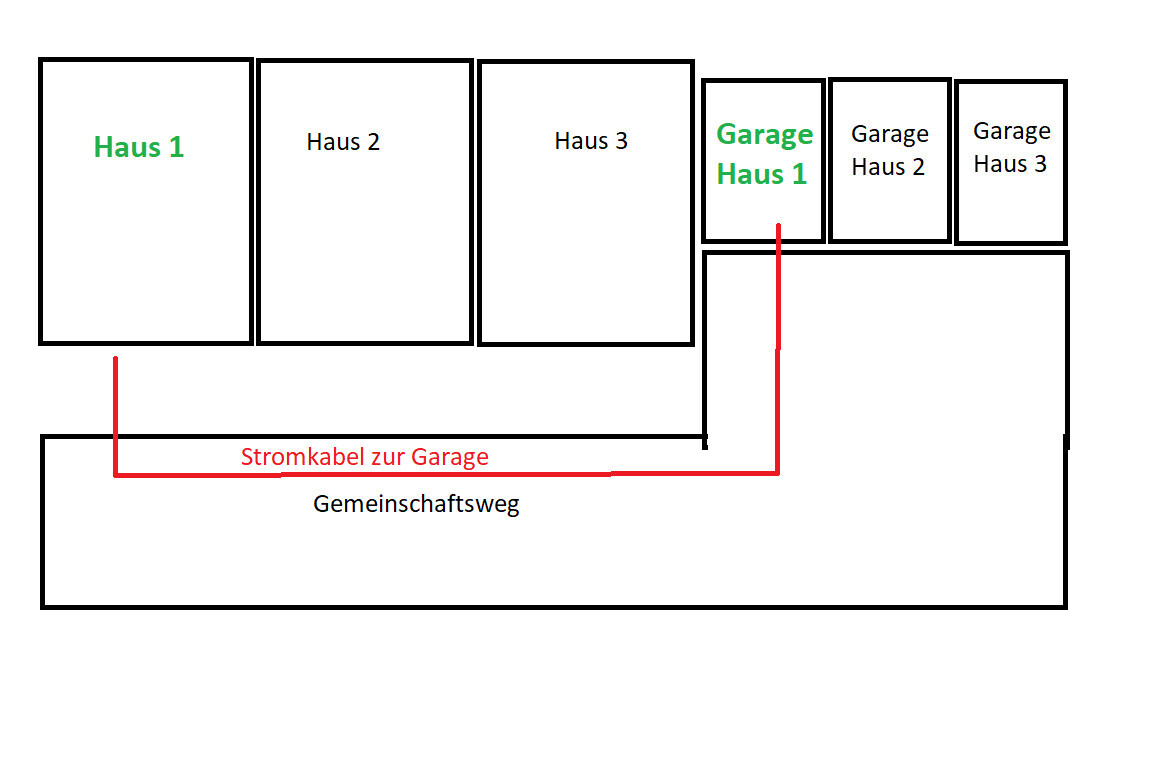
We have a garage about 30 meters (100 feet) away from our house, accessible via a shared driveway. (I have attached an overview image to this post.) The shared driveway will be renovated soon, and we want to supply electricity to our garage. Currently, the plan is to install a standard outdoor power cable rated for 0.03A.
To allow for the possibility of installing an additional cable in the future, we are considering running the cable through a suitably sized empty conduit for protection. What type and diameter of conduit would be best for this? The external contractor suggested using a PE (polyethylene) conduit to avoid problematic bends when pulling the cable through later.
For example, an electric vehicle charging station might require a high-voltage cable. Would it be better to install the high-voltage cable at the same time? Does anyone have recommendations on the best type, size, or conductor thickness for the high-voltage cable? Is there any reason not to install it as a precaution, without connecting it immediately?
Thanks in advance for all your answers!
I just went through this topic myself, although my cable length wasn’t quite as long. I installed a 5x10mm2 cable right from the start. This allows me to comfortably charge at 11kW (the cross-section is actually oversized; 5x6mm2 would have been sufficient). But maybe a second charging point will be added at some point. During the installation of the wallbox (Tesla Wall Connector), it became clear that using more than 10mm2 cables would definitely make the wiring difficult—it was already pushing the limits.
T
toxicmolotof3 Dec 2017 16:47I would also recommend sizing everything adequately from the start and installing as much as makes sense right away.
Otherwise, you'll be dealing with it again in 5 or 10 years. You don't just open up a sidewalk for a small amount of money.
Otherwise, you'll be dealing with it again in 5 or 10 years. You don't just open up a sidewalk for a small amount of money.
B
Bau-Schmidt3 Dec 2017 20:00Use an NYY-J cable with 5 cores and 6 or 10 mm² (0.01 or 0.015 in²). For the conduit, I recommend at least a 50 mm (2 inch), preferably 63 mm (2.5 inch) or even 110 mm (4 inch) diameter. Avoid using KG pipes as they are often mistaken for drainage pipes later on.

We have an empty conduit with a diameter of 100/110 millimeters (4/4.3 inches) running from the basement to the garage. This is connected directly to the multi-utility house entry and sealed. We have one cable with 5x10 mm² (5x0.02 in²) and a “standard” 3x5 mm² (3x0.008 in²) cable for lighting, the gate, etc.
Ideally, install a cable right away. Over long distances, a cable with the correct cross-section cannot be easily pulled through a conduit using standard household tools.
At about 30 meters (100 feet) in length, resulting in an estimated effective cable length of around 35 meters (115 feet), a 10mm² (13 AWG) cable is just sufficient for 2 × 11 kW or a 22 kW charger, assuming a 1% voltage drop. So, 10 mm² is the minimum cross-section I would start with. This cable should be connected to a sub-distribution board, not directly to the wallbox.
Please also ensure compliance with the local technical connection conditions (e.g., TAB) and have the sizing planned by a professional. You can pull the cable yourself afterward, provided conditions are not freezing.
At about 30 meters (100 feet) in length, resulting in an estimated effective cable length of around 35 meters (115 feet), a 10mm² (13 AWG) cable is just sufficient for 2 × 11 kW or a 22 kW charger, assuming a 1% voltage drop. So, 10 mm² is the minimum cross-section I would start with. This cable should be connected to a sub-distribution board, not directly to the wallbox.
Please also ensure compliance with the local technical connection conditions (e.g., TAB) and have the sizing planned by a professional. You can pull the cable yourself afterward, provided conditions are not freezing.
Similar topics