
Hello,
now that we have completed construction and moved into our new home, we are probably in the fortunate position to add a carport with a solid shed.
Since we hadn’t planned for this financially before construction started, we have only looked into the topic superficially so far. I have already requested an appointment with the shell builder and don’t want to go there unprepared.
To my knowledge, in Schleswig-Holstein a 9m x 6m (30 ft x 20 ft) structure does not require a building permit / planning permission. We want to make full use of the length, but we cannot fully use the width.
We are thinking of dividing the length into 5m (16.5 ft) for the carport and 4m (13 ft) for the shed.
Here are some questions we have:
1. Gable roof: Why choose a gable roof at all? -> For storage space, e.g., garden furniture, car tires, etc. But we are basically open to alternatives, although none really come to mind. We are struggling with the height and the roof overhang. Preferably both should be as low as possible, as long as it remains practical. I am 1.94m (6 ft 4 in) tall and would like to be able to stand straight up in the middle under the roof. However, this is not a must if something else makes more sense. Our house is 8.5m (28 ft) high and has a roof pitch of 45°. So the roof pitch should only be reduced enough that both roofs still look harmonious. The roof overhang should be kept quite small, e.g., about 30cm (12 inches), so the shed does not get too close to the patio door.
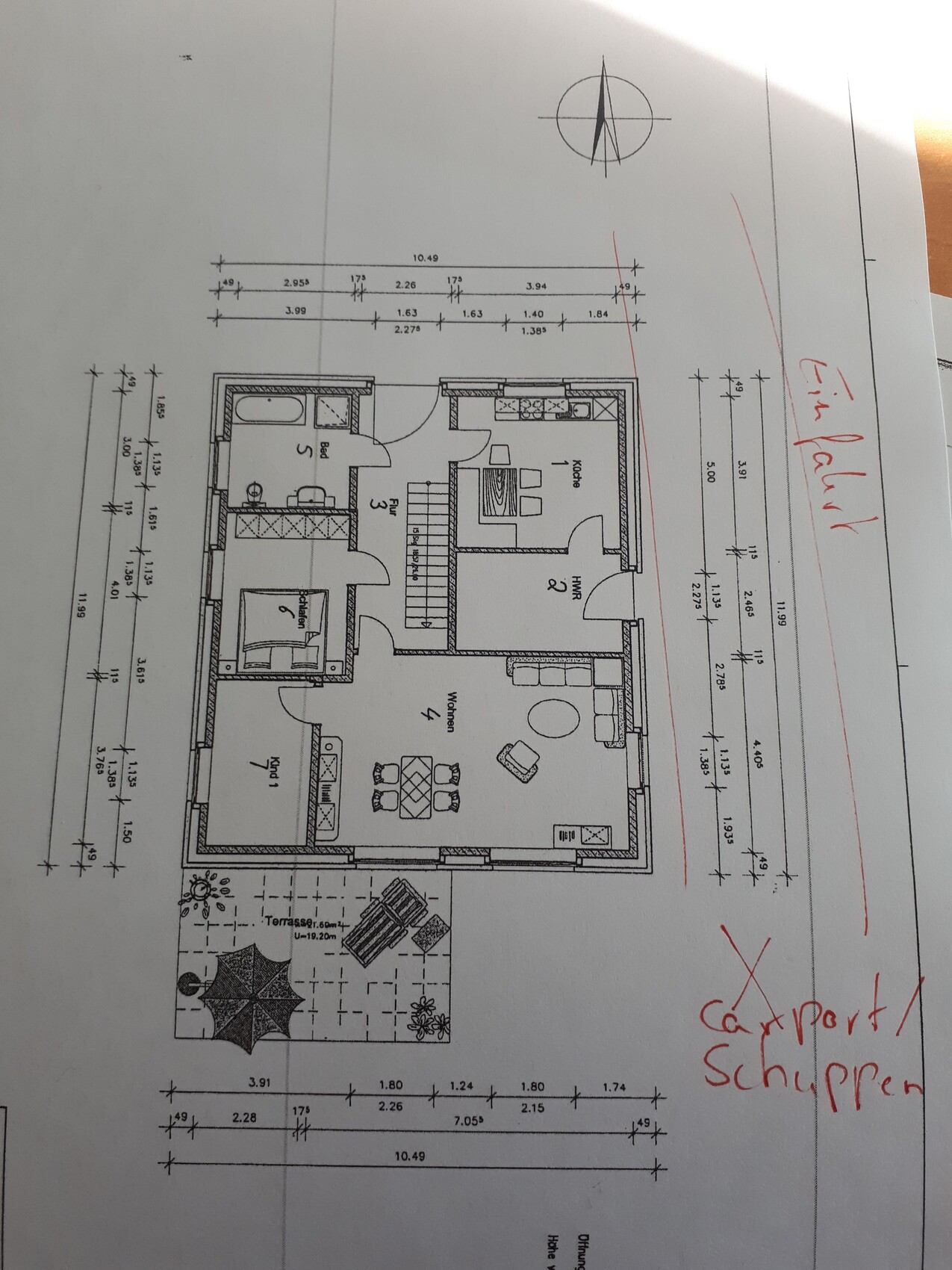
2. Shed material: The shed will not be insulated but should have a facing (cladding). We also want a concrete slab foundation instead of paving. The most practical material for the thinnest wall is probably wood, but I would rather avoid that. What would be an alternative? We could install Ytong (aerated concrete blocks) ourselves, but is another material more suitable? Wall thickness would probably be 17.5cm (7 inches) Ytong + 11.5cm (4.5 inches) facing. This would reduce the usable interior space from roughly 20m² (215 sq ft) outer dimensions to about 17m² (183 sq ft).
3. Positioning:
This is roughly what we have in mind:
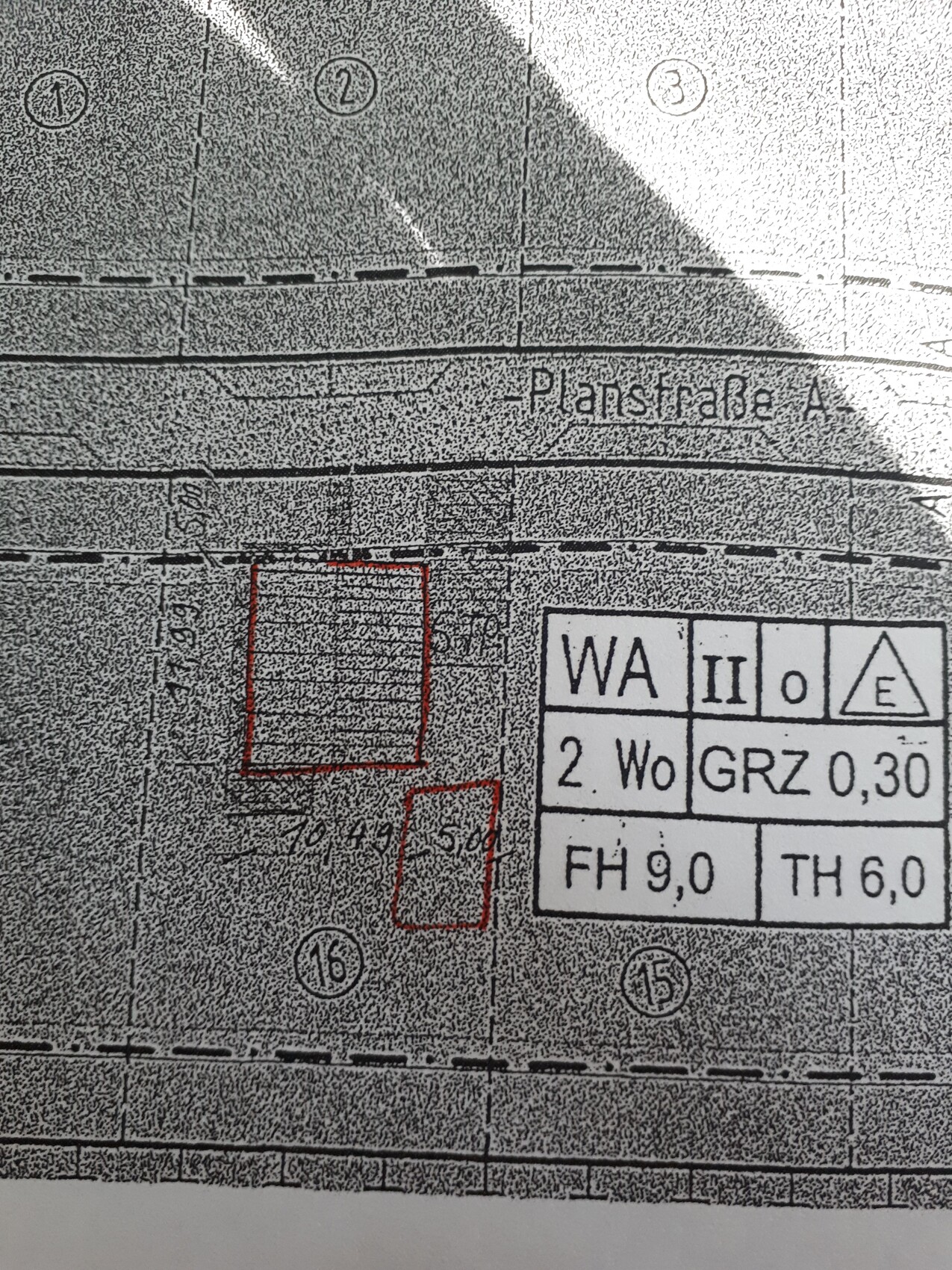
We will probably have to “set back” the shed a bit towards the house as shown above. The distance to the patio door is 1.74m (5 ft 9 in), which we naturally do not want to fully use up. Although the house is exactly 5m (16.5 ft) away from the property boundary, the shed will have to be set back because of the roof overhang if we want to keep that 5m distance. Does this make sense to you and seem reasonable?
Probably a bit confusingly written, but I hope it is at least somewhat clear.
now that we have completed construction and moved into our new home, we are probably in the fortunate position to add a carport with a solid shed.
Since we hadn’t planned for this financially before construction started, we have only looked into the topic superficially so far. I have already requested an appointment with the shell builder and don’t want to go there unprepared.
To my knowledge, in Schleswig-Holstein a 9m x 6m (30 ft x 20 ft) structure does not require a building permit / planning permission. We want to make full use of the length, but we cannot fully use the width.
We are thinking of dividing the length into 5m (16.5 ft) for the carport and 4m (13 ft) for the shed.
Here are some questions we have:
1. Gable roof: Why choose a gable roof at all? -> For storage space, e.g., garden furniture, car tires, etc. But we are basically open to alternatives, although none really come to mind. We are struggling with the height and the roof overhang. Preferably both should be as low as possible, as long as it remains practical. I am 1.94m (6 ft 4 in) tall and would like to be able to stand straight up in the middle under the roof. However, this is not a must if something else makes more sense. Our house is 8.5m (28 ft) high and has a roof pitch of 45°. So the roof pitch should only be reduced enough that both roofs still look harmonious. The roof overhang should be kept quite small, e.g., about 30cm (12 inches), so the shed does not get too close to the patio door.
2. Shed material: The shed will not be insulated but should have a facing (cladding). We also want a concrete slab foundation instead of paving. The most practical material for the thinnest wall is probably wood, but I would rather avoid that. What would be an alternative? We could install Ytong (aerated concrete blocks) ourselves, but is another material more suitable? Wall thickness would probably be 17.5cm (7 inches) Ytong + 11.5cm (4.5 inches) facing. This would reduce the usable interior space from roughly 20m² (215 sq ft) outer dimensions to about 17m² (183 sq ft).
3. Positioning:
This is roughly what we have in mind:
We will probably have to “set back” the shed a bit towards the house as shown above. The distance to the patio door is 1.74m (5 ft 9 in), which we naturally do not want to fully use up. Although the house is exactly 5m (16.5 ft) away from the property boundary, the shed will have to be set back because of the roof overhang if we want to keep that 5m distance. Does this make sense to you and seem reasonable?
Probably a bit confusingly written, but I hope it is at least somewhat clear.

boxandroof schrieb:
Is it possible to match the look of the house using brick slips? In principle, brick slips are the same material, just cut thinner—but not every manufacturer offers brick slips as a format option for every type of facing brick. Therefore, the original poster would need to check if their house’s facing brick is available as brick slips for the garage. A different model could look noticeably different—more than just the typical variation between batches of the same model. In this particular case, the garage is not attached to the house, so visual similarity should be sufficient. It would be more challenging if it were an extension with shared corners.
https://www.instagram.com/11antgmxde/
https://www.linkedin.com/company/bauen-jetzt/

11ant schrieb:
In this regard, the original poster should check whether their house brick for the garage is also available as thin brick veneerOr have them cut. With a continuous length of 18m (59 feet) and a height of 2.5m (8 feet), approximately 2,300 pieces of thin brick veneer would be needed. This should be possible to cut within three working days. In my opinion, the additional effort, when spread over the extra square meters gained, should still be worthwhile even for purely storage space.
P
pffreestyler18 Sep 2019 08:49Clinker bricks are out of the question since there are still 1.5 pallets of facing bricks left, but the idea of cutting them in half sounds interesting. I can bring that up again, although the builder will probably think I’m crazy.
I was also surprised that 11.5 cm (4.5 inches) sand-lime bricks are sufficient, but when I asked the builder, he said that the ring beam provides enough rigidity. He has done this several times before. He even gave me a reference address. I will probably ask again how satisfied they are with the construction. I also still need to talk to the carpenter, who will have his opinion on this as well.
Is the roof weight really that significant?
A word of caution—layman’s opinion:
Comparison house - shed
Rafter length: 8.125 meters (26.7 feet) vs. 3.59 meters (11.8 feet)
Wall: 17.5 cm (7 inches) aerated concrete blocks vs. 11.5 cm (4.5 inches)
Based on that, the shed roof should weigh less than half but still has more than half the wall thickness?!
Anchors should not be a problem. Only a screw cabinet and a hook for a shovel/rake etc. are planned. Tires will go on an existing rack, for example. Shelves will be installed on one wall. The rest is intended as storage space for a bicycle, wheelbarrow, lawn mower, and so on.
I was also surprised that 11.5 cm (4.5 inches) sand-lime bricks are sufficient, but when I asked the builder, he said that the ring beam provides enough rigidity. He has done this several times before. He even gave me a reference address. I will probably ask again how satisfied they are with the construction. I also still need to talk to the carpenter, who will have his opinion on this as well.
Is the roof weight really that significant?
A word of caution—layman’s opinion:
Comparison house - shed
Rafter length: 8.125 meters (26.7 feet) vs. 3.59 meters (11.8 feet)
Wall: 17.5 cm (7 inches) aerated concrete blocks vs. 11.5 cm (4.5 inches)
Based on that, the shed roof should weigh less than half but still has more than half the wall thickness?!
Anchors should not be a problem. Only a screw cabinet and a hook for a shovel/rake etc. are planned. Tires will go on an existing rack, for example. Shelves will be installed on one wall. The rest is intended as storage space for a bicycle, wheelbarrow, lawn mower, and so on.
pffreestyler schrieb:
I will probably need to ask again how satisfied they are with the construction. Also, I still have to talk to the carpenter, who will have his opinion on this as well.The most important opinion is that of the structural engineer.
In principle, you can do quite a bit with sand-lime brick in the different thermal insulation classes (R-values). However, for practical reasons, I would prefer a thicker material here.
pffreestyler schrieb:
Tires are placed, for example, on an existing rack. Shelves go on one side of a wall. The remaining space is intended as storage for a bicycle, wheelbarrow, and lawn mower.What are the exact interior dimensions?
Don’t overestimate the available floor space. You have to be able to pull out a lawn mower without having to clear half the room first in frustration. Four bicycles also need space and maneuvering room.
Therefore, everything that can be placed against the wall should be placed there.
Space for a utility sink would also be a good idea, provided there is water and drainage available. But it should also be accessible.
P
pffreestyler18 Sep 2019 10:01The interior dimensions are currently 4.46 x 3.46 meters (14.6 x 11.3 feet), which gives 15.43 square meters (166 square feet).
I know the measurements and volumes from practical experience with my parents, and this is enough for us. However, we still need to discuss the positioning of the door. I'm not yet sure whether centering it or placing it slightly to the left is better for storage space.
We won’t have any water supply inside. Instead, we have a sink in the utility room and an outdoor faucet nearby, which is sufficient. But one more thing: we are installing two empty conduits in the shed. One is for the 5 x 1.5 mm (about 10 AWG) underground cable we have already run from the house, intended for an outlet and lighting. The second is for a potentially needed electric vehicle charging point (wallbox) in the future. How is this usually done? Should the empty conduit go into the shed with the wallbox installed on the interior wall and the outlet routed outside through a core drill? Or should the box be mounted on the covered exterior wall with the conduit run up in front of the shed?
I know the measurements and volumes from practical experience with my parents, and this is enough for us. However, we still need to discuss the positioning of the door. I'm not yet sure whether centering it or placing it slightly to the left is better for storage space.
We won’t have any water supply inside. Instead, we have a sink in the utility room and an outdoor faucet nearby, which is sufficient. But one more thing: we are installing two empty conduits in the shed. One is for the 5 x 1.5 mm (about 10 AWG) underground cable we have already run from the house, intended for an outlet and lighting. The second is for a potentially needed electric vehicle charging point (wallbox) in the future. How is this usually done? Should the empty conduit go into the shed with the wallbox installed on the interior wall and the outlet routed outside through a core drill? Or should the box be mounted on the covered exterior wall with the conduit run up in front of the shed?
Similar topics