
M
MaxMustaman9214 Sep 2021 09:03Hello,
we have two identical outdoor water faucets (model: Polar II outdoor valve by Schell) installed on different spots on the exterior wall of our house. They worked perfectly fine over the past 7 months. Two days ago, I turned on one of the faucets and watered the lawn through the attached hose as usual. After about 10 minutes, I tried to turn the faucet off by turning the handle to the right, but no matter how much I turned, the water kept flowing. As a complete DIY novice, I was quite worried at first. I then turned the handle to the right again, applying some pressure against the handle (towards the wall), and that closed the faucet.
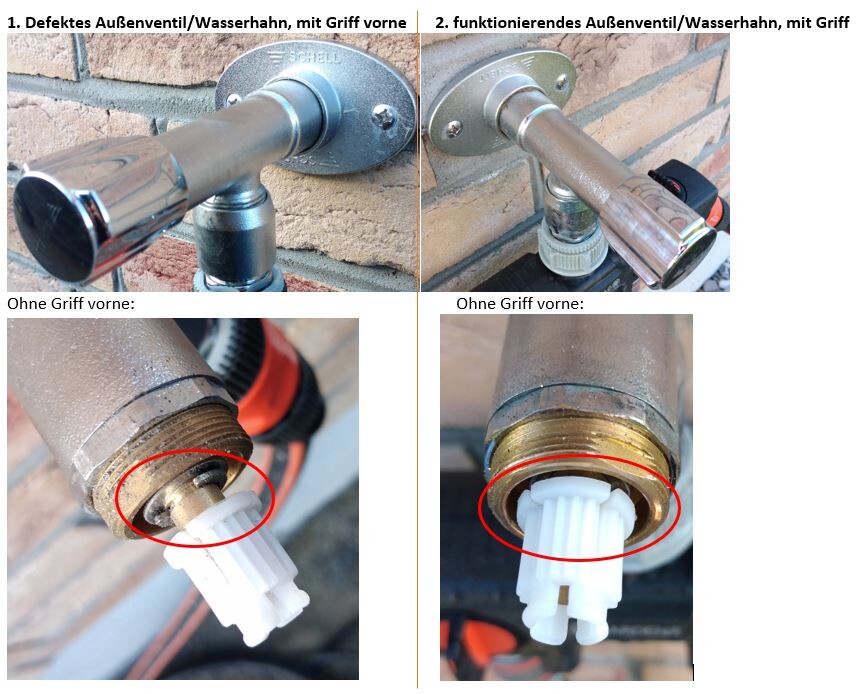
This issue still persists with this particular faucet. To compare, I removed the handle from both faucets and noticed that on the "faulty" faucet a gold-colored part sticks out (see the attached photo, marked in red). This part is presumably called the "top part with spindle." In addition, the white plastic part can be freely turned left and right without resistance, and nothing happens. However, if I push the white plastic part firmly towards the wall/faucet while turning it, I can open and close the water flow.
For comparison: On the working faucet, the gold-colored part does not stick out, and the white plastic part is firmly in place; without the handle, I cannot turn it by hand alone.
Now for the question: I have tried, as a layperson, to gently push the white plastic part or the gold-colored part back in with light pressure, but it didn’t work. I also avoided hitting it with something hard because I am unsure if anything might break then. Does anyone have tips on how I can solve this problem?
we have two identical outdoor water faucets (model: Polar II outdoor valve by Schell) installed on different spots on the exterior wall of our house. They worked perfectly fine over the past 7 months. Two days ago, I turned on one of the faucets and watered the lawn through the attached hose as usual. After about 10 minutes, I tried to turn the faucet off by turning the handle to the right, but no matter how much I turned, the water kept flowing. As a complete DIY novice, I was quite worried at first. I then turned the handle to the right again, applying some pressure against the handle (towards the wall), and that closed the faucet.
This issue still persists with this particular faucet. To compare, I removed the handle from both faucets and noticed that on the "faulty" faucet a gold-colored part sticks out (see the attached photo, marked in red). This part is presumably called the "top part with spindle." In addition, the white plastic part can be freely turned left and right without resistance, and nothing happens. However, if I push the white plastic part firmly towards the wall/faucet while turning it, I can open and close the water flow.
For comparison: On the working faucet, the gold-colored part does not stick out, and the white plastic part is firmly in place; without the handle, I cannot turn it by hand alone.
Now for the question: I have tried, as a layperson, to gently push the white plastic part or the gold-colored part back in with light pressure, but it didn’t work. I also avoided hitting it with something hard because I am unsure if anything might break then. Does anyone have tips on how I can solve this problem?
H
hampshire14 Sep 2021 09:53The white plastic part transfers the rotational force from the silver-colored knob to the shaft. If something is slipping, it is most likely because the white plastic part is not seated properly. To check this, gently pull the plastic part off the shaft (without using force!). Then you can see whether the inner part is already worn out or still has a chance to grip the shaft. The shaft is not perfectly round but has at least one flat spot. Pushing the plastic part back on should be easy by hand; it might be a bit tight. The important thing is to fit it on without it being tilted. That’s basically all there is to it. If the plastic part is damaged, you can either order a new one or glue it onto the shaft (which is the less ideal solution). The shaft should be fine, as brass is generally harder than the plastic.
M
MaxMustaman9214 Sep 2021 10:40A brief update—I just quickly went home because this issue is bothering me:
I was able to remove the plastic part from the faulty faucet. It doesn’t appear damaged anywhere. When it’s in place, it can be moved slightly back and forth, so there is very minimal play in that direction (this is also the case with the functioning faucet). However, with the functioning faucet, the part cannot be turned from side to side like it can on the faulty faucet, because it fits tightly.
With the functioning faucet, I at least cannot remove the plastic part by hand, probably because there isn’t enough clearance at the back, which is present on the faulty faucet, allowing a proper grip on the plastic part.
Looking inside the plastic parts from the front on both faucets, it seems to me that they are seated the same way; in other words, it doesn’t appear that the plastic part on the faulty faucet is only halfway positioned (see comparison photo).
I also cannot push the plastic part on the faulty faucet further onto the final section of the upper part/spindle with normal finger strength. If I press harder, I am afraid it might break.
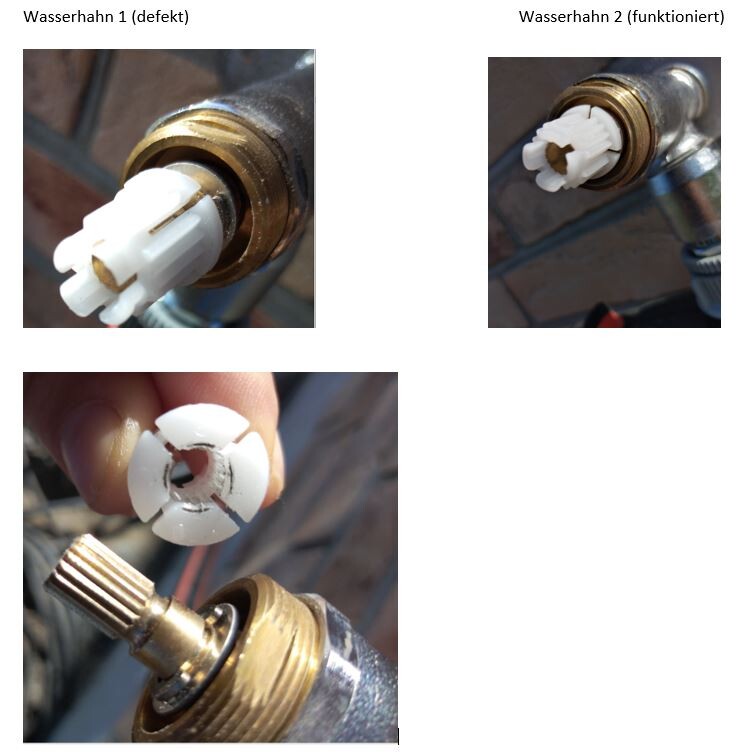
I was able to remove the plastic part from the faulty faucet. It doesn’t appear damaged anywhere. When it’s in place, it can be moved slightly back and forth, so there is very minimal play in that direction (this is also the case with the functioning faucet). However, with the functioning faucet, the part cannot be turned from side to side like it can on the faulty faucet, because it fits tightly.
With the functioning faucet, I at least cannot remove the plastic part by hand, probably because there isn’t enough clearance at the back, which is present on the faulty faucet, allowing a proper grip on the plastic part.
Looking inside the plastic parts from the front on both faucets, it seems to me that they are seated the same way; in other words, it doesn’t appear that the plastic part on the faulty faucet is only halfway positioned (see comparison photo).
I also cannot push the plastic part on the faulty faucet further onto the final section of the upper part/spindle with normal finger strength. If I press harder, I am afraid it might break.
H
hampshire14 Sep 2021 14:45Try replacing the faulty faucet's plastic part with the plastic part from the working faucet. This will clarify whether the problem lies with the plastic component or not.
The effect occurs when the water contains minerals (although it tastes better that way).
These minerals accumulate inside the faucet and block the mechanism.
Shut off the main water valve.
When the circlip (retaining ring) is removed, you can unscrew the valve cartridge (movable internal part of the faucet).
Clean the parts (if necessary, use a wire brush), lubricate them with faucet grease (available at hardware stores), and reassemble.
If the handle’s internal splines are worn or damaged, replace the handle!
Done.
These minerals accumulate inside the faucet and block the mechanism.
Shut off the main water valve.
When the circlip (retaining ring) is removed, you can unscrew the valve cartridge (movable internal part of the faucet).
Clean the parts (if necessary, use a wire brush), lubricate them with faucet grease (available at hardware stores), and reassemble.
If the handle’s internal splines are worn or damaged, replace the handle!
Done.
M
MaxMustaman9214 Sep 2021 18:13I’m a bit confused because both plastic parts (I believe they’re called retaining bushes) cover the same amount of the brass-colored part on both outdoor faucets. Sorry for the layman’s terms. I can also push the presumably defective plastic part fully onto the first faucet, but then it can be turned left and right without any resistance, which is not the case with the other faucet. However, on the other faucet, the brass-colored part doesn’t seem to stick out as far, which you can see in the first comparison picture where both plastic parts are pushed on as far as possible/equally far. Of course, I don’t know if this is relevant at all.
In any case, I also took the rotary handle off the "working faucet" earlier and put it on the "defective faucet with the possibly faulty plastic part." The same problem occurs: when turning it (either left or right), nothing happens, there is no resistance, and no water flows. The more often I try, the more I feel like I have to push the handle toward the faucet while turning for the water to eventually flow.
I couldn’t remove the presumably functioning plastic part and didn’t want to apply too much force right now.
I will buy new retaining bushes tomorrow and report whether that was the issue.
@konibar thanks for the advice. If it’s not the plastic part, I will try it as you suggested.
In any case, I also took the rotary handle off the "working faucet" earlier and put it on the "defective faucet with the possibly faulty plastic part." The same problem occurs: when turning it (either left or right), nothing happens, there is no resistance, and no water flows. The more often I try, the more I feel like I have to push the handle toward the faucet while turning for the water to eventually flow.
I couldn’t remove the presumably functioning plastic part and didn’t want to apply too much force right now.
I will buy new retaining bushes tomorrow and report whether that was the issue.
@konibar thanks for the advice. If it’s not the plastic part, I will try it as you suggested.
Similar topics