
ᐅ Transition Between Terrace and House Wall (Prefabricated House)
Created on: 4 Feb 2025 16:36
N
Nyne9590Hello everyone, we are currently working on our terrace and are facing the issue of connecting it to the house wall.
The final height of the terrace surface is marked with the red line in the picture:
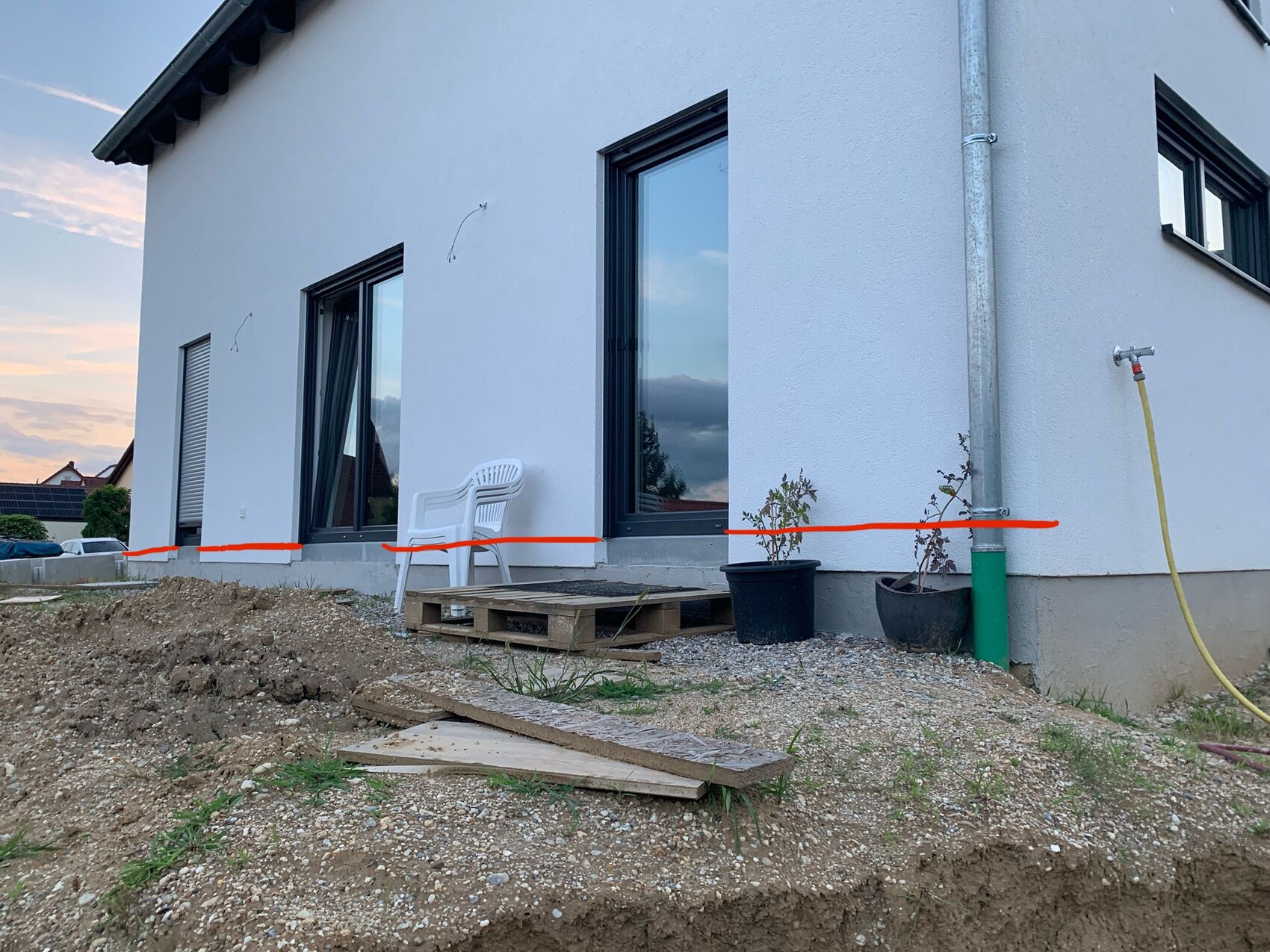
The construction company told us to either ventilate the gap (which we find very unattractive) or to seal the facade at least 5cm (2 inches) above the finished terrace surface.
The terrace itself is about 2 meters (6.5 feet) above the actual ground level. We bordered it with L-shaped concrete blocks and have so far filled up with gravel to the level shown in the photo.
As you can see, the finished terrace surface will reach the area of the facade.
I have also talked to several others who suggested the following approach:
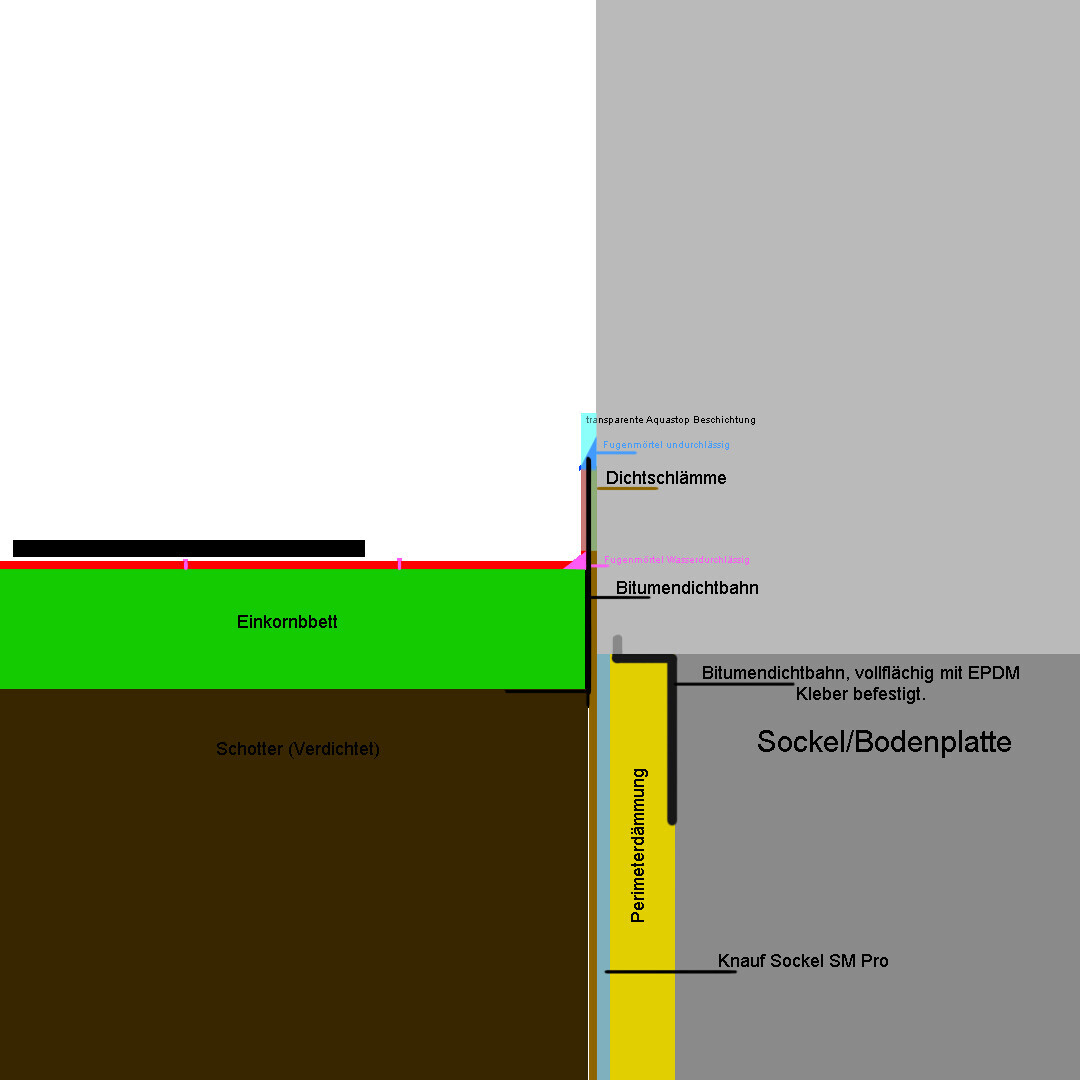
The transition from house wall to base slab (which is covered with Knauf Katja Sprint) is sealed with a bitumen membrane extending from the wall, glued to the concrete slab with EPDM adhesive, and the perimeter insulation is applied on top. The base area is now plastered with Sockel SM Pro.
In the area of the three windows, a drainage channel would be installed in the reveals, connected to the adjacent downpipe. Our windows are, as I hope is clear, NOT at ground level. The final terrace height is slightly lower than the interior floor height. The terrace is planned with a 2% slope (naturally away from the house) and has already been measured accordingly above the L-blocks.
Following this scheme, I would first apply sealing slurry up to just above the finished terrace height. Then, I would lay a waterproof membrane slightly higher than the finished terrace, extending just under the bedding layer.
Anything that extends above the finished terrace surface should then be covered with skirting boards (made from the same material as the terrace tiles) and sealed on top with waterproof joint compound. The terrace joints themselves should consist of permeable joint compound, including the transition from tile to skirting board.
Finally, I would apply an Aquastop coating from the skirting board up to about 5cm (2 inches) above it.
A terrace roof is also planned in the near future.
According to my theory, this setup should work without needing those unsightly ventilation gaps.
I would appreciate further opinions on this.
Thanks in advance.
The final height of the terrace surface is marked with the red line in the picture:
The construction company told us to either ventilate the gap (which we find very unattractive) or to seal the facade at least 5cm (2 inches) above the finished terrace surface.
The terrace itself is about 2 meters (6.5 feet) above the actual ground level. We bordered it with L-shaped concrete blocks and have so far filled up with gravel to the level shown in the photo.
As you can see, the finished terrace surface will reach the area of the facade.
I have also talked to several others who suggested the following approach:
The transition from house wall to base slab (which is covered with Knauf Katja Sprint) is sealed with a bitumen membrane extending from the wall, glued to the concrete slab with EPDM adhesive, and the perimeter insulation is applied on top. The base area is now plastered with Sockel SM Pro.
In the area of the three windows, a drainage channel would be installed in the reveals, connected to the adjacent downpipe. Our windows are, as I hope is clear, NOT at ground level. The final terrace height is slightly lower than the interior floor height. The terrace is planned with a 2% slope (naturally away from the house) and has already been measured accordingly above the L-blocks.
Following this scheme, I would first apply sealing slurry up to just above the finished terrace height. Then, I would lay a waterproof membrane slightly higher than the finished terrace, extending just under the bedding layer.
Anything that extends above the finished terrace surface should then be covered with skirting boards (made from the same material as the terrace tiles) and sealed on top with waterproof joint compound. The terrace joints themselves should consist of permeable joint compound, including the transition from tile to skirting board.
Finally, I would apply an Aquastop coating from the skirting board up to about 5cm (2 inches) above it.
A terrace roof is also planned in the near future.
According to my theory, this setup should work without needing those unsightly ventilation gaps.
I would appreciate further opinions on this.
Thanks in advance.
I definitely would not do it that way. Actually, you shouldn’t extend above the top edge of the foundation slab with your terrain at all. According to standard guidelines, you should always stay at least 15 cm (6 inches) below and in front of it. With special measures (including ventilation) it might be possible to be flush at height, but still with some distance from the wall. This remains a special construction with associated risks—I would be very surprised if your house manufacturer has not provided you with a list of approved house connection solutions along with what is excluded from warranty coverage. If not, have your construction company provide written confirmation about the 5 cm (2 inches) “sealing”—this is not really a solution based on recognized rules of technology, and almost all other timber frame prefab manufacturers would deny warranty claims if the facade shows any kind of moisture damage.
In general, I would always recommend facade drainage gutters, not just at the windows. Alternatively, you can set edge stones and attach grids to them using angle brackets. Or, if you go with a loose-laid construction for the terrace, install appropriate grids, for example, on an aluminum substructure. There are many systems that allow proper ventilation, and there are almost endless grid designs that look quite good (admittedly, the most attractive ones are rather expensive per running meter).
You should also carry the waterproofing up high, especially because of snow—I did this myself on my roof terrace. I would also have it protected additionally with a metal or plastic cover. Waterproofing is inherently not protected against mechanical damage, which cannot be ruled out on a terrace.
In general, I would always recommend facade drainage gutters, not just at the windows. Alternatively, you can set edge stones and attach grids to them using angle brackets. Or, if you go with a loose-laid construction for the terrace, install appropriate grids, for example, on an aluminum substructure. There are many systems that allow proper ventilation, and there are almost endless grid designs that look quite good (admittedly, the most attractive ones are rather expensive per running meter).
You should also carry the waterproofing up high, especially because of snow—I did this myself on my roof terrace. I would also have it protected additionally with a metal or plastic cover. Waterproofing is inherently not protected against mechanical damage, which cannot be ruled out on a terrace.
M
Maulwurfbau3 Sep 2025 10:32I have the same problem and I’m starting to regret building with wood, especially when I look back at the hassle with the terrace connections I’m dealing with.
The entire residential area where we built solved their outdoor landscaping exactly the way we always wanted. Now it’s supposedly not possible for us because our house is made of wood. I would never do that again.
The solution is this: a metal grate is placed on edge stones up to the window, allowing for ventilation and water drainage. You then step directly from the grate onto the terrace paving without a step. Something like this.
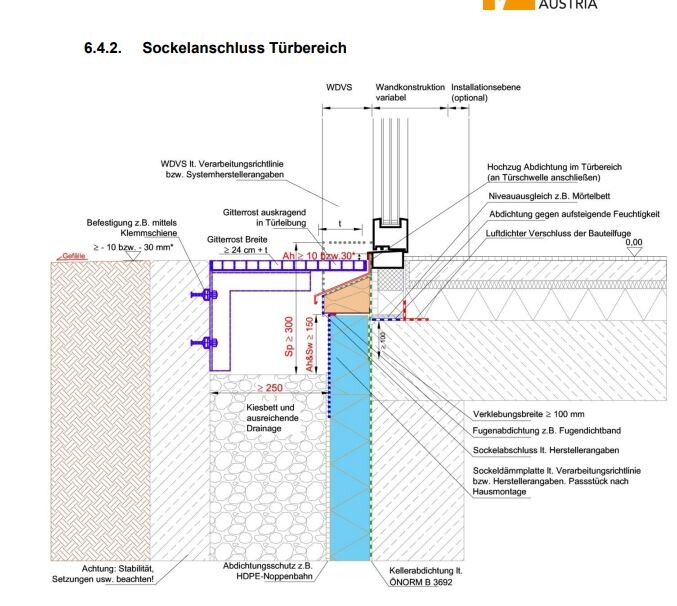
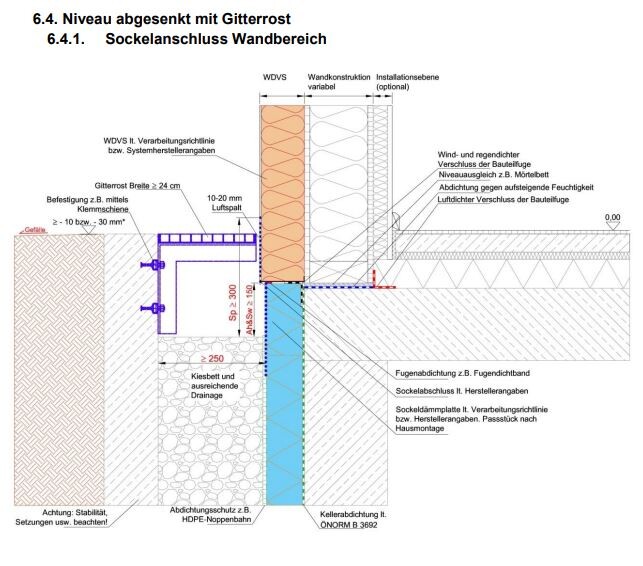
It costs more, but the construction company doesn’t complain about water drainage, ventilation, etc. For warranty reasons, I wouldn’t experiment here.
This is probably easier to do in masonry construction, judging by other houses in my neighborhood that aren’t wood-built. If I had known this in detail before... well, hindsight is always 20/20 ;-)
Or you can have a step down to the terrace so that the rendered facade remains clear.
The entire residential area where we built solved their outdoor landscaping exactly the way we always wanted. Now it’s supposedly not possible for us because our house is made of wood. I would never do that again.
The solution is this: a metal grate is placed on edge stones up to the window, allowing for ventilation and water drainage. You then step directly from the grate onto the terrace paving without a step. Something like this.
It costs more, but the construction company doesn’t complain about water drainage, ventilation, etc. For warranty reasons, I wouldn’t experiment here.
This is probably easier to do in masonry construction, judging by other houses in my neighborhood that aren’t wood-built. If I had known this in detail before... well, hindsight is always 20/20 ;-)
Or you can have a step down to the terrace so that the rendered facade remains clear.
I feel the same, not like a molehill build, but we have the problem not only at the terrace but actually around the entire house, and we can’t really go deeper because of the slope.
The examples from the supplier are always only for paved terraces/paths, as already shown.
What I’m wondering is whether it’s sufficient to raise the terrace/paths on supports. That way, there’s no direct contact and the facade/foundation slab is ventilated.
I have seen this approach a few times but haven’t found any descriptions or opinions on it yet. Only in one post was it mentioned as a possible option.
I’d be interested to hear your opinions; otherwise, I would contact the manufacturer directly.
The examples from the supplier are always only for paved terraces/paths, as already shown.
What I’m wondering is whether it’s sufficient to raise the terrace/paths on supports. That way, there’s no direct contact and the facade/foundation slab is ventilated.
I have seen this approach a few times but haven’t found any descriptions or opinions on it yet. Only in one post was it mentioned as a possible option.
I’d be interested to hear your opinions; otherwise, I would contact the manufacturer directly.

I can’t imagine building a raised terrace using stone slabs or tiles like you mean. The loads are very high, and if you want the finished floor level inside to be flush with the terrace, you would need a closely spaced steel support structure to hold it (adjustable pedestals probably won’t be enough), which would get quite expensive...
It’s actually quite simple. Build the terrace in wood as well. Stay true to your material. This is basically a type of raised structure anyway.
It’s actually quite simple. Build the terrace in wood as well. Stay true to your material. This is basically a type of raised structure anyway.
Similar topics