
Dear forum,
we are currently planning the construction of our single-family house. Last week, I created an initial draft for the lighting and electrical installation, which I would like to share here for discussion.
Do you think I should reduce the number of recessed ceiling lights? Are the power outlets sufficient? I look forward to your comments!
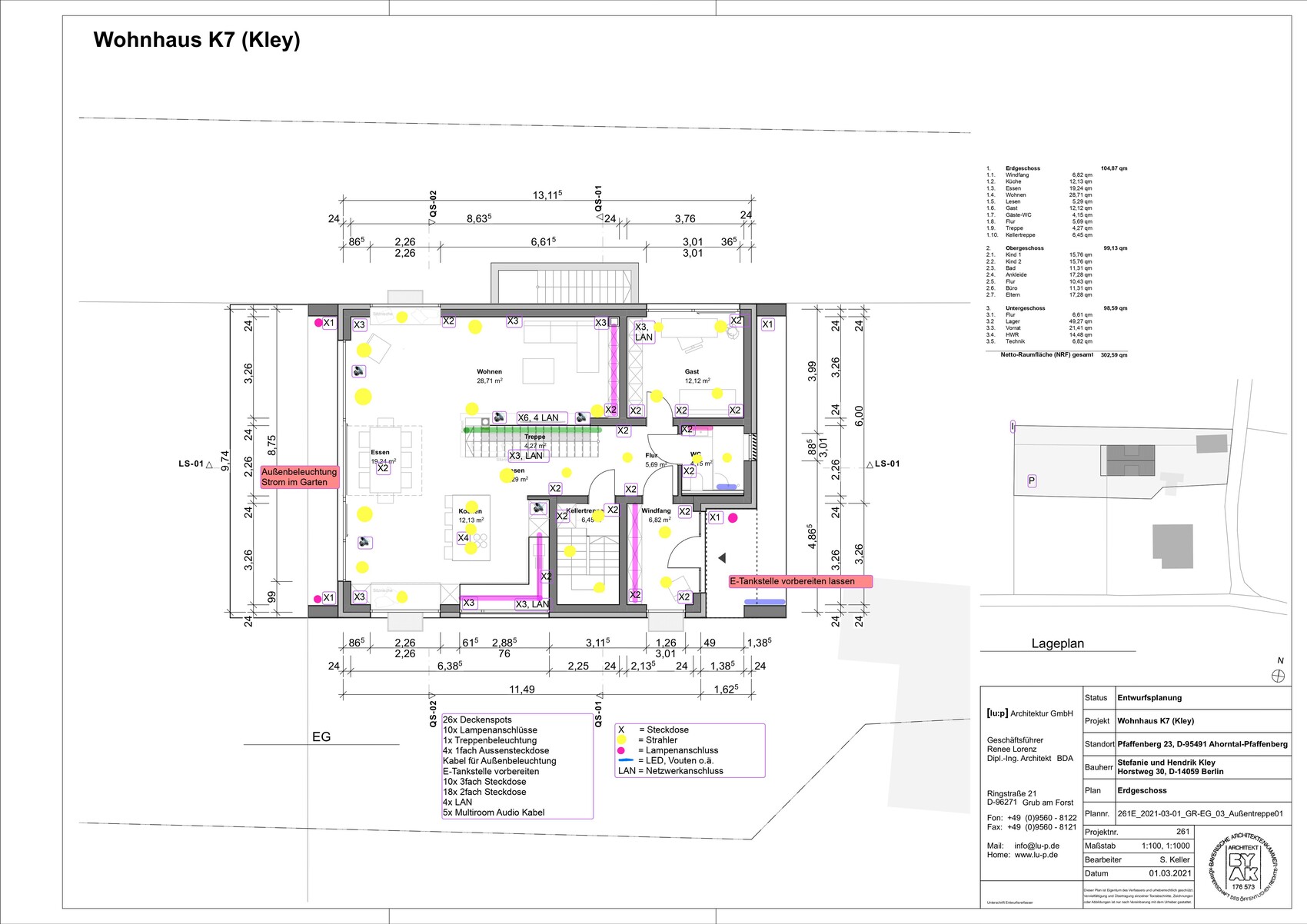
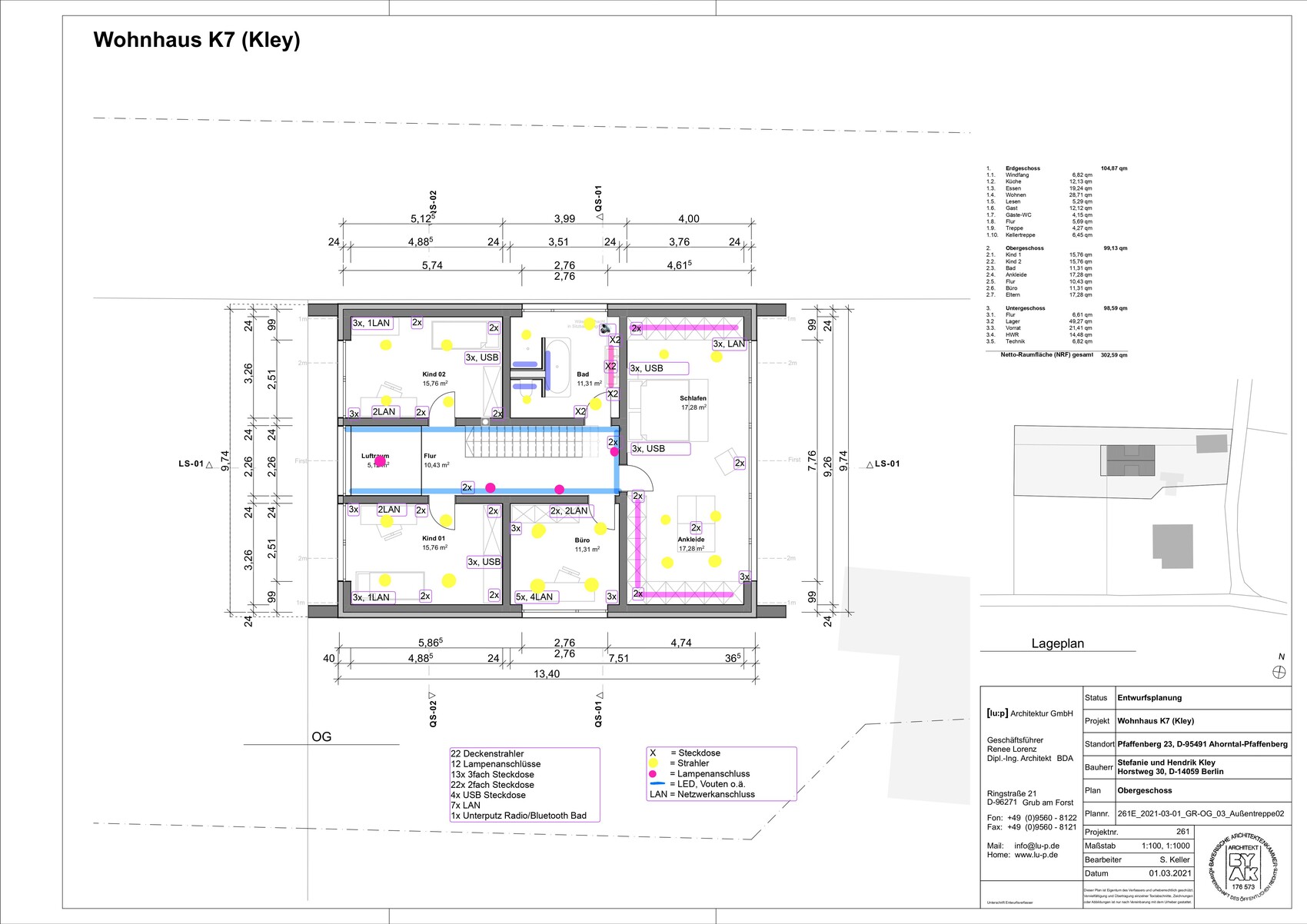
we are currently planning the construction of our single-family house. Last week, I created an initial draft for the lighting and electrical installation, which I would like to share here for discussion.
Do you think I should reduce the number of recessed ceiling lights? Are the power outlets sufficient? I look forward to your comments!
 Hendrik198012 May 2021 13:50
Hello Danvane,
these are really valuable pieces of information for me! Great!! Thank you! The square meters are roughly comparable, and the requirements seem similar to me as well. Did you build with a basement?
I have a few more questions:
- Why did you go through an (external?) system integrator? Couldn’t the electrician do it themselves, or is this generally recommended?
- How did you find the right system integrator? Were you satisfied?
- Does a double power outlet count as one or two outlets? Probably a silly question...
- What exactly do you mean by connection of all outlets?
- What is a 19-inch rack?
- Did you also run power to the garden (outdoor lighting) and the garage (possibly preparing for an electric vehicle charging station)?
- Are we talking about 40k net or gross?
these are really valuable pieces of information for me! Great!! Thank you! The square meters are roughly comparable, and the requirements seem similar to me as well. Did you build with a basement?
I have a few more questions:
- Why did you go through an (external?) system integrator? Couldn’t the electrician do it themselves, or is this generally recommended?
- How did you find the right system integrator? Were you satisfied?
- Does a double power outlet count as one or two outlets? Probably a silly question...
- What exactly do you mean by connection of all outlets?
- What is a 19-inch rack?
- Did you also run power to the garden (outdoor lighting) and the garage (possibly preparing for an electric vehicle charging station)?
- Are we talking about 40k net or gross?
Hendrik1980 schrieb:
Hello Danvane,
these are obviously very valuable pieces of information for me! Great!! Thank you! The square meters are roughly comparable and the requirements seem to be similar as well. Did you build with a basement?
I still have a few questions:
- Why did you do this through an (external?) system integrator? Couldn't the electrician handle it himself, or is this generally recommended?
- How did you find the right SI? Were you satisfied?
- Does a double socket count as one or two sockets? Probably a silly question...
- What exactly do you mean by connection of all sockets?
- What is a 19-inch rack?
- Did you also install electricity in the garden (outdoor lighting) and to the garage (possibly prepare for an electric vehicle charging station)?
- Are we talking about 40k net or gross? We built without a basement.
- For the electrician, this was actually his first KNX installation in the single-family home sector (he has only been self-employed for about 2 years). The good thing was that he was very open to the topic and excited about the project to develop his skills and be better prepared for similar installations in the future. He himself expects that KNX will become increasingly relevant to him, which has been confirmed by two more inquiries he received in recent months.
Of course, he was not able to handle the entire planning process alone. Since I did not trust myself to do the planning (which included creating the entire wiring diagram, so the electrician only had to pull the cables), I found a system integrator nearby. There are certainly differences here as well, but my system integrator was definitely worth every cent. From planning to building the control cabinet (I supplied the materials myself) and comprehensive support during construction, he covered everything. We really got lucky with this choice. Of course, there has to be good coordination between the electrician and the system integrator, especially regarding interfaces like the control cabinet assembly.
- A socket requires one “hole” in the wall. Two sockets next to each other (a double socket) naturally require two holes. Accordingly, a double socket is a bit more expensive due to the extra holes needed (more work for the electrician). But the cable has to be pulled there anyway for one socket. So if you make a single socket into a multi-socket, the extra effort is basically only the additional drilling (some more wear on the tools), which is why multi-sockets usually make sense whenever a socket is planned at that location anyway.
- Connection of sockets: I mean that we connected, as part of our own work, the sockets, LAN, and satellite outlets. That means we used the cables that the electrician had pulled to the installed outlets and connected them to the internal parts of these components, then screwed on the visible cover plates. However, not every electrician will agree to this. We have electricians in the family, so in the end only a final check from an electrician was necessary. So there was trust involved. As I said, this is not common practice for electricians to allow this.
- A 19-inch rack is a cabinet where, among other things, switches, patch panels, routers, and in my case also the multiswitch for satellite TV can be housed. It’s simply a good way to keep all these components organized in one place.
- Power supply outside was also installed, yes.
- Gross price.
However, in such lists, it is fair to also consider that network components like cables, network outlets, patch panels, network cabinets, access points, switches, as well as everything related to satellite systems, are also present in a conventional electrical installation.

M
MontyPython12 May 2021 20:29@Danvane Which manufacturer have you used most frequently in your build?

hanse987 schrieb:
However, when making such comparisons, it is only fair to also consider that network components like cables, network outlets, patch panels, server cabinets, access points, switches, as well as everything related to satellite systems, are also part of a conventional electrical installation.That’s exactly how I described it in my thread, because it’s absolutely true. Just the network alone has cost a lot of money. That’s why the originally planned 20,000 € (about 21,500 USD) for 230 m² (2,475 sq ft) including the garage, and 60,000 € (about 64,500 USD) including KNX automation, are somewhat relative figures.