
Dear forum,
we are currently planning the construction of our single-family house. Last week, I created an initial draft for the lighting and electrical installation, which I would like to share here for discussion.
Do you think I should reduce the number of recessed ceiling lights? Are the power outlets sufficient? I look forward to your comments!
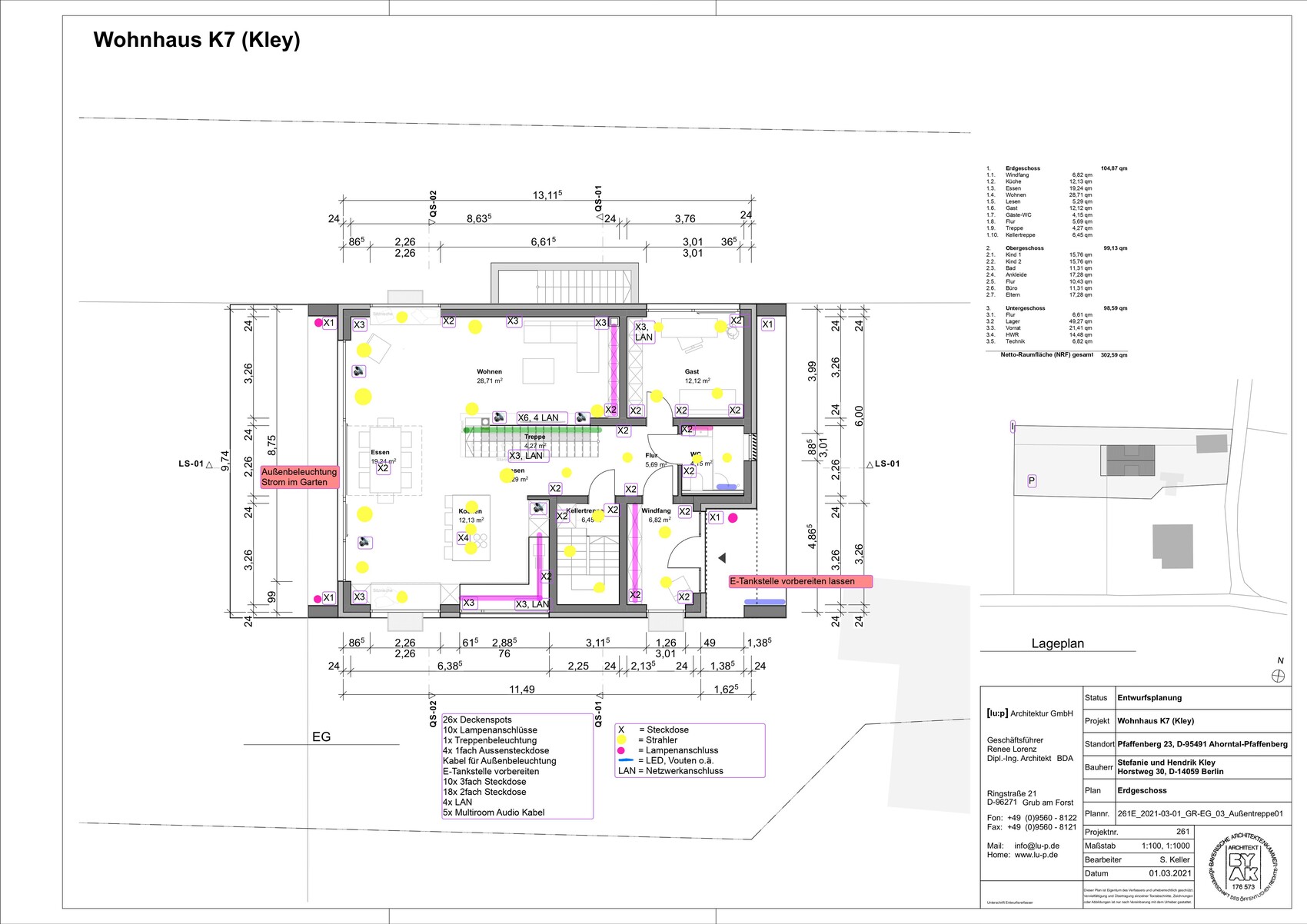
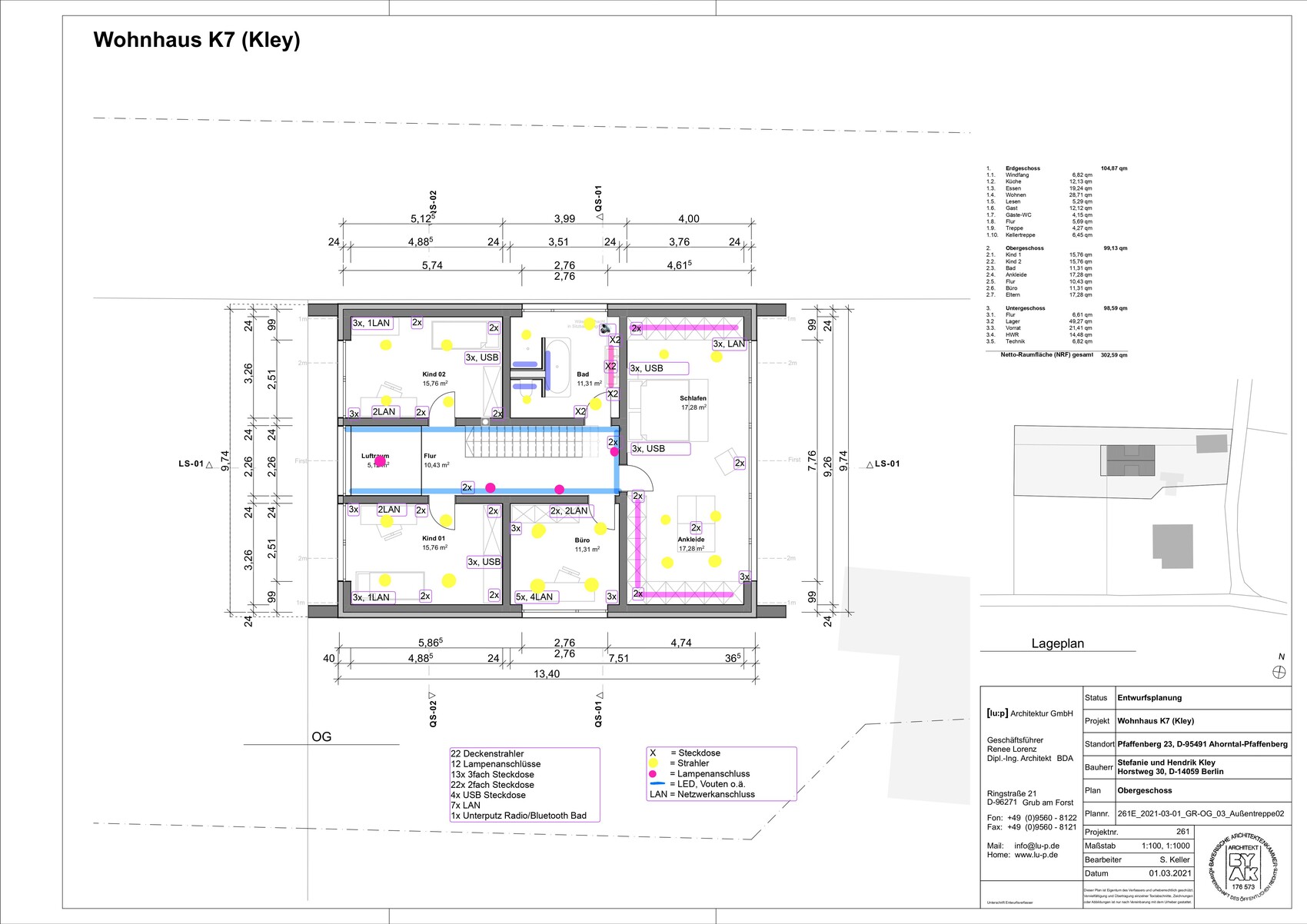
we are currently planning the construction of our single-family house. Last week, I created an initial draft for the lighting and electrical installation, which I would like to share here for discussion.
Do you think I should reduce the number of recessed ceiling lights? Are the power outlets sufficient? I look forward to your comments!
motorradsilke schrieb:
For example, a Fritz repeater connected by cable to a LAN socket.But then it is not used as a repeater, rather as an access point. That is the "terminological accuracy" that [B] K1300S mentioned. Specialized access points like Ubiquiti are much better suited for this.M
motorradsilke9 May 2021 12:11Gudeen. schrieb:
Then it is not used as a repeater but as an access point. That’s the “linguistic precision” that K1300S mentioned. Specialized APs like Ubiquiti are significantly better in this regard. In what way?
We are also planning, so this topic interests me.
Oetzberger schrieb:
I can’t confirm that. A single centrally mounted wall access point per floor covers the entire large solid building including the garden.That might work for you, but generally the design is like this. For example, I have a wall access point with the following radiation pattern:and a ceiling access point from the same series:
As you can see, the coverage from the ceiling access point is more uniform in all directions. This is especially true for 5 GHz.
Of course, this doesn’t mean wall APs are bad or that you can never cover a house with them. It’s just that they are usually not ideally designed for that purpose.

motorradsilke schrieb:
And then you connect a cable and a repeater there. That gives you the full bandwidth.But only if it is an access point. A repeater, as the name (and its function) implies, only extends the existing network and shares the bandwidth with all other devices.An access point, on the other hand, creates its own network and provides the full bandwidth you mentioned. Ideally, the devices work as a mesh network, allowing the end devices to switch between access points without any loss of signal or quality.
motorradsilke schrieb:
No, the new repeaters do not halve the bandwidth.
And they do not create a separate Wi-Fi network, which is actually an advantage. You always stay on the same Wi-Fi network, which in my opinion is a benefit. You are mistaken here. Manufacturers can, of course, name their devices however they want. They can also label regular access points as "new repeater." But that doesn’t change the fact that it is an access point, and a repeater is still a repeater.
M
motorradsilke9 May 2021 12:29Mycraft schrieb:
But only if it is an access point. A repeater, true to its name (and function), simply extends the existing network and shares the bandwidth with all other devices.
An access point, on the other hand, creates its own network and provides the full bandwidth you mentioned. Ideally, the devices work as a mesh so that end devices can switch between access points without any loss of signal or quality.So the new Fritz repeaters are access points. But from my experience, having a separate network isn’t really an advantage. You sit on the terrace using your phone connected to the Wi-Fi of that area. Then you go to the kitchen, and the original network is still used until you lose signal completely. In the worst case, you stay connected to the terrace’s network, even though the kitchen’s network would have a much better signal.