
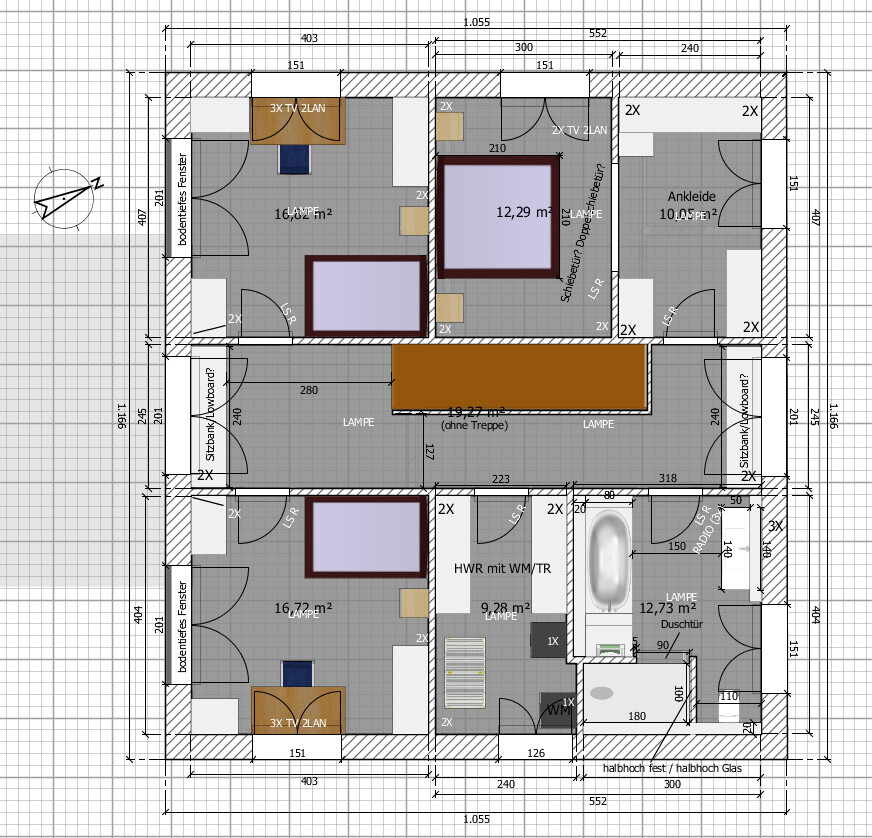
Ok, now let’s think about the topic from a practical perspective. I’m quite familiar with KNX, but I can’t really come up with a scenario where KNX would clearly benefit us. Here are our floor plans again:
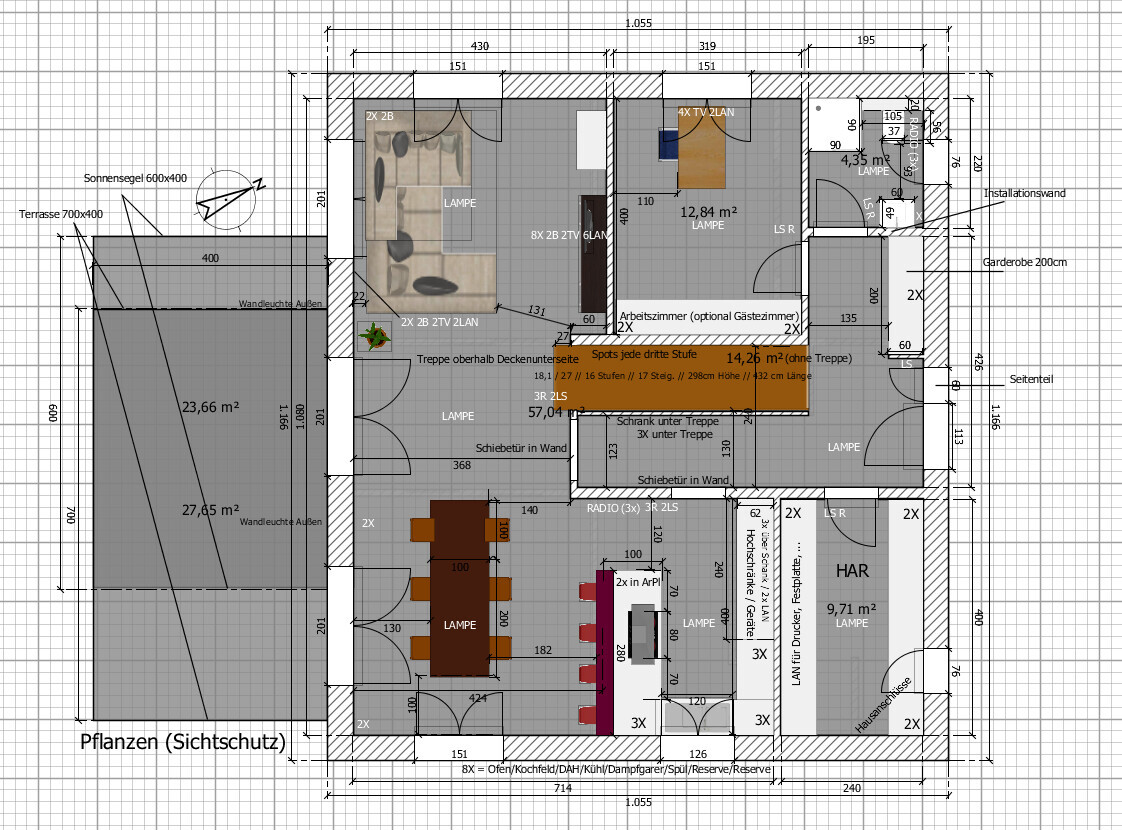
According to the current planning status, roller shutters will be installed everywhere (current planning status!). There will be a large sun sail to shade the central window and the dining room window from the sun. The dining room window facing east and the kitchen window will be in the shade shortly after noon.
A heat pump with cooling function and a ground loop exchanger for the controlled ventilation system are planned. Simple logic functions, such as bypass for the controlled ventilation or controlling the underfloor heating based on outside and return temperatures, are handled by the devices themselves. In winter, when the sun heats the floor, the return flow temperature rises, and the heat pump realizes it needs to heat less because of the external heat input. The ventilation system detects when the bypass should be activated.
Individual room control is pointless, or so everyone says in the pink forum. At least for our KfW55-standard building, it’s probably very unnecessary. Night setback is also not needed.
Energy-saving functions don’t interest me because the investment cost will always be higher than the electricity savings. Conventional smoke detectors will be installed, and please no hysterical discussions about this. There will be no gas, oil, or fireplace in the house. And if the house burns down while we’re away, it’s insured. There will be no photovoltaic system, and I’m not interested in any other extreme energy-saving measures. The washing machine has its own timer. Usually, we just load it in the afternoon and hang the laundry in the evening. It doesn’t need to run for three hours at night because of lower tariffs to save 0.3 cents per wash cycle.
The living/dining/kitchen area will have six roller shutters and four dimmable lights. Three shutters and two lights each will be controlled from switches next to the living room door and the kitchen door. The switches are arranged side by side so that the leftmost switch controls the left side of the room, and so on. So the west, south, and central living areas are controlled from the living room door; the south dining area, east dining area, and east kitchen are controlled from the kitchen door. For shading, only the two roller shutters next to the living room are relevant (south living room, as it is not under the sun sail, and west living room).
Currently, in the old building, we have internal blinds and a large west-facing facade. Apart from the five warmest days of the year, we don’t fully shade the windows. We just want to avoid direct sunlight where we are sitting, working, playing, etc. Depending on the situation, some blinds go up and others go down, and so on.
Constant light regulation is not desired. Even now, we switch lights on and off based on feeling. When we want to go to bed soon, the lights are usually off or more distant lights are on (kind of indirect lighting). I have different lighting preferences than my wife, and when we are together in the room, naturally, a compromise solution applies.
I sometimes work flexible hours, and sometimes I might sleep only four hours one night and seven hours the next day. A rule like “dim after xx o’clock” won’t work.
There is no defined TV lighting plan. It depends on the program. For briefly watching the news, all lighting can remain as is. For a moderately interesting football game, only the direct light is turned off, but indirect lighting can stay. For a ‘Game of Thrones’ episode or a good movie, everything should be off, especially since these often have dark scenes. Sometimes, for example, the hallway light stays on as indirect lighting for the living area (which makes sole hallway lighting with motion sensors pointless now).
Hallway lighting will have switches (two-way switches) next to each door, which can turn the lighting of the respective floor on and off. So yes, exactly one switch next to each door. The two lamps upstairs will switch on and off simultaneously. It is a floor-level switch. At stair landings, of course, there are exactly two switches: one for upstairs and one for downstairs. So, coming down the stairs, you can operate both switches to turn lights off upstairs and on downstairs. Or you turn off the upstairs light at the bottom of the stairs (top switch off = upstairs off; makes perfect sense to me).
Stair lighting could theoretically be controlled similarly, but that also depends a bit on the show effect, right? It could also be done with a timer or motion sensor. And if pets trigger the stair lighting, well, that’s just how it is. At the moment, we don’t have pets.
As for roller shutter control in the living/dining/kitchen areas, as I said before: short press for fully up/down and hold for precise positioning. But half-positioning is discouraged because temperature differences across the glass can cause damage. For example, next to the living room door, pressing the button three times briefly will raise (or lower) the three shutters. All other roller shutters follow the same principle and are arranged next to their respective doors. Only for bedrooms could I imagine a switch with a timer function, and I would only program the opening time for the next morning. I don’t need a closing time. A short press closes the roller shutter. But if I set my alarm clock to 6:53, I also set the roller shutter to 6:53 so that daylight wakes me at the same time (in the future, we will have joint wake-up times again, and my wife won’t have shift work anymore). BUT: all this can be done conventionally and very simply. So: the office (guest room), bedroom, and two children's rooms will have a switch (short = fully up/down) that allows an opening time to be set.
Just to summarize the shading logic during the day: roller shutters go down in the morning when leaving the room/living area and stay down until the first person returns home in the afternoon. This covers the first 10–12 hours of sunlight exposure.
The lighting in many rooms will be dimmable, but I don’t want expensive color lighting effects. The bulbs should have low blue light and good quality.
So, I think I’ve described the most important areas: roller shutters, lighting, heating, and a few other things...
How can automation like KNX help us now? What comfort gains are possible? What should we automate and why?
According to the current planning status, roller shutters will be installed everywhere (current planning status!). There will be a large sun sail to shade the central window and the dining room window from the sun. The dining room window facing east and the kitchen window will be in the shade shortly after noon.
A heat pump with cooling function and a ground loop exchanger for the controlled ventilation system are planned. Simple logic functions, such as bypass for the controlled ventilation or controlling the underfloor heating based on outside and return temperatures, are handled by the devices themselves. In winter, when the sun heats the floor, the return flow temperature rises, and the heat pump realizes it needs to heat less because of the external heat input. The ventilation system detects when the bypass should be activated.
Individual room control is pointless, or so everyone says in the pink forum. At least for our KfW55-standard building, it’s probably very unnecessary. Night setback is also not needed.
Energy-saving functions don’t interest me because the investment cost will always be higher than the electricity savings. Conventional smoke detectors will be installed, and please no hysterical discussions about this. There will be no gas, oil, or fireplace in the house. And if the house burns down while we’re away, it’s insured. There will be no photovoltaic system, and I’m not interested in any other extreme energy-saving measures. The washing machine has its own timer. Usually, we just load it in the afternoon and hang the laundry in the evening. It doesn’t need to run for three hours at night because of lower tariffs to save 0.3 cents per wash cycle.
The living/dining/kitchen area will have six roller shutters and four dimmable lights. Three shutters and two lights each will be controlled from switches next to the living room door and the kitchen door. The switches are arranged side by side so that the leftmost switch controls the left side of the room, and so on. So the west, south, and central living areas are controlled from the living room door; the south dining area, east dining area, and east kitchen are controlled from the kitchen door. For shading, only the two roller shutters next to the living room are relevant (south living room, as it is not under the sun sail, and west living room).
Currently, in the old building, we have internal blinds and a large west-facing facade. Apart from the five warmest days of the year, we don’t fully shade the windows. We just want to avoid direct sunlight where we are sitting, working, playing, etc. Depending on the situation, some blinds go up and others go down, and so on.
Constant light regulation is not desired. Even now, we switch lights on and off based on feeling. When we want to go to bed soon, the lights are usually off or more distant lights are on (kind of indirect lighting). I have different lighting preferences than my wife, and when we are together in the room, naturally, a compromise solution applies.
I sometimes work flexible hours, and sometimes I might sleep only four hours one night and seven hours the next day. A rule like “dim after xx o’clock” won’t work.
There is no defined TV lighting plan. It depends on the program. For briefly watching the news, all lighting can remain as is. For a moderately interesting football game, only the direct light is turned off, but indirect lighting can stay. For a ‘Game of Thrones’ episode or a good movie, everything should be off, especially since these often have dark scenes. Sometimes, for example, the hallway light stays on as indirect lighting for the living area (which makes sole hallway lighting with motion sensors pointless now).
Hallway lighting will have switches (two-way switches) next to each door, which can turn the lighting of the respective floor on and off. So yes, exactly one switch next to each door. The two lamps upstairs will switch on and off simultaneously. It is a floor-level switch. At stair landings, of course, there are exactly two switches: one for upstairs and one for downstairs. So, coming down the stairs, you can operate both switches to turn lights off upstairs and on downstairs. Or you turn off the upstairs light at the bottom of the stairs (top switch off = upstairs off; makes perfect sense to me).
Stair lighting could theoretically be controlled similarly, but that also depends a bit on the show effect, right? It could also be done with a timer or motion sensor. And if pets trigger the stair lighting, well, that’s just how it is. At the moment, we don’t have pets.
As for roller shutter control in the living/dining/kitchen areas, as I said before: short press for fully up/down and hold for precise positioning. But half-positioning is discouraged because temperature differences across the glass can cause damage. For example, next to the living room door, pressing the button three times briefly will raise (or lower) the three shutters. All other roller shutters follow the same principle and are arranged next to their respective doors. Only for bedrooms could I imagine a switch with a timer function, and I would only program the opening time for the next morning. I don’t need a closing time. A short press closes the roller shutter. But if I set my alarm clock to 6:53, I also set the roller shutter to 6:53 so that daylight wakes me at the same time (in the future, we will have joint wake-up times again, and my wife won’t have shift work anymore). BUT: all this can be done conventionally and very simply. So: the office (guest room), bedroom, and two children's rooms will have a switch (short = fully up/down) that allows an opening time to be set.
Just to summarize the shading logic during the day: roller shutters go down in the morning when leaving the room/living area and stay down until the first person returns home in the afternoon. This covers the first 10–12 hours of sunlight exposure.
The lighting in many rooms will be dimmable, but I don’t want expensive color lighting effects. The bulbs should have low blue light and good quality.
So, I think I’ve described the most important areas: roller shutters, lighting, heating, and a few other things...
How can automation like KNX help us now? What comfort gains are possible? What should we automate and why?
S
Sebastian7931 Aug 2016 22:26They glow blue
They are touch dimmers and one of them is simply turned on. And yes, they are shutter switches.
RTR? No way, I don’t have that. It is the control for the air conditioning.
They are touch dimmers and one of them is simply turned on. And yes, they are shutter switches.
RTR? No way, I don’t have that. It is the control for the air conditioning.
@Grym: You better not buy a car because those great aluminum wheels, costing 2,500€ each, that you might put on your car after half a year would make the car 10,000 euros more expensive. Oh, and you also better not buy an oven for your kitchen because you might prefer the designer oven for 3,500€ after a year. Or better yet, don’t buy a kitchen at all… because it could be that…
Sorry, but I have never heard a more ridiculous argument against a fundamentally sensible purchase. And yes, there are great products for KNX systems, and yes, they cost a lot of money, but there are also great options for traditional installations, like the slate switches from Hager, and yes, they cost a lot too — you easily pay 100€ for a switch with a frame. So better don’t install any electrical systems because it might get expensive.
And a quick side note: you can also use regular switches if you want the tactile feel. There are flush-mounted (in-wall) sensors with 2-channel and 4-channel options for around 35€, which you connect to normal switches to turn a ‘regular push button’ into a KNX button — with all the usual downsides of push buttons, like no feedback about switching statuses, etc.
So, I’m out of this discussion from now on. My recommendation for you: better don’t build a house!
Sorry, but I have never heard a more ridiculous argument against a fundamentally sensible purchase. And yes, there are great products for KNX systems, and yes, they cost a lot of money, but there are also great options for traditional installations, like the slate switches from Hager, and yes, they cost a lot too — you easily pay 100€ for a switch with a frame. So better don’t install any electrical systems because it might get expensive.
And a quick side note: you can also use regular switches if you want the tactile feel. There are flush-mounted (in-wall) sensors with 2-channel and 4-channel options for around 35€, which you connect to normal switches to turn a ‘regular push button’ into a KNX button — with all the usual downsides of push buttons, like no feedback about switching statuses, etc.
So, I’m out of this discussion from now on. My recommendation for you: better don’t build a house!

Alex85 schrieb:
There was a picture in this thread of a silver/aluminum touch panel completely without any labels. What is that supposed to be? Nobody would understand that without instructions. 4-6 touch sensors and then just want to turn on the light? That’s not help anymore, it’s work.So where is the difference compared to a regular switch? In my opinion, those are also unlabeled in 90% of houses and arranged next to or above each other. See the example from Sebastian:
Sebastian79 schrieb:
Here is our horrible switch panel – logically divided, easy for anyone to use. The lamps controlled there can also be operated and dimmed from two other locations.I don’t find it that horrible… here someone actually invested some money and planned it thoughtfully instead of just installing the basic standard option from the general contractor.
But I still don’t see a “better” way of operating it…
KNX switches can be arranged and used just as logically…
P.S. I agree with Sebastian that KNX might not be the right choice for you, Grym…