
Ok, now let’s think about the topic from a practical perspective. I’m quite familiar with KNX, but I can’t really come up with a scenario where KNX would clearly benefit us. Here are our floor plans again:
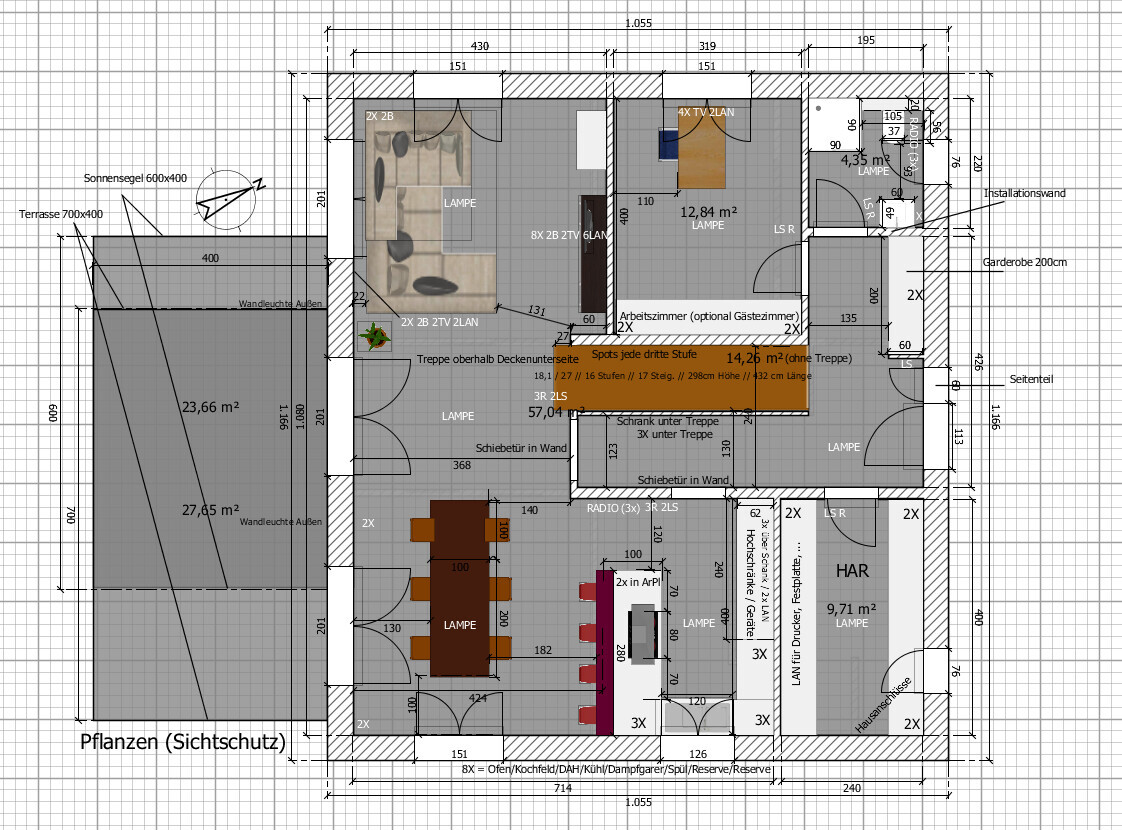
According to the current planning status, roller shutters will be installed everywhere (current planning status!). There will be a large sun sail to shade the central window and the dining room window from the sun. The dining room window facing east and the kitchen window will be in the shade shortly after noon.
A heat pump with cooling function and a ground loop exchanger for the controlled ventilation system are planned. Simple logic functions, such as bypass for the controlled ventilation or controlling the underfloor heating based on outside and return temperatures, are handled by the devices themselves. In winter, when the sun heats the floor, the return flow temperature rises, and the heat pump realizes it needs to heat less because of the external heat input. The ventilation system detects when the bypass should be activated.
Individual room control is pointless, or so everyone says in the pink forum. At least for our KfW55-standard building, it’s probably very unnecessary. Night setback is also not needed.
Energy-saving functions don’t interest me because the investment cost will always be higher than the electricity savings. Conventional smoke detectors will be installed, and please no hysterical discussions about this. There will be no gas, oil, or fireplace in the house. And if the house burns down while we’re away, it’s insured. There will be no photovoltaic system, and I’m not interested in any other extreme energy-saving measures. The washing machine has its own timer. Usually, we just load it in the afternoon and hang the laundry in the evening. It doesn’t need to run for three hours at night because of lower tariffs to save 0.3 cents per wash cycle.
The living/dining/kitchen area will have six roller shutters and four dimmable lights. Three shutters and two lights each will be controlled from switches next to the living room door and the kitchen door. The switches are arranged side by side so that the leftmost switch controls the left side of the room, and so on. So the west, south, and central living areas are controlled from the living room door; the south dining area, east dining area, and east kitchen are controlled from the kitchen door. For shading, only the two roller shutters next to the living room are relevant (south living room, as it is not under the sun sail, and west living room).
Currently, in the old building, we have internal blinds and a large west-facing facade. Apart from the five warmest days of the year, we don’t fully shade the windows. We just want to avoid direct sunlight where we are sitting, working, playing, etc. Depending on the situation, some blinds go up and others go down, and so on.
Constant light regulation is not desired. Even now, we switch lights on and off based on feeling. When we want to go to bed soon, the lights are usually off or more distant lights are on (kind of indirect lighting). I have different lighting preferences than my wife, and when we are together in the room, naturally, a compromise solution applies.
I sometimes work flexible hours, and sometimes I might sleep only four hours one night and seven hours the next day. A rule like “dim after xx o’clock” won’t work.
There is no defined TV lighting plan. It depends on the program. For briefly watching the news, all lighting can remain as is. For a moderately interesting football game, only the direct light is turned off, but indirect lighting can stay. For a ‘Game of Thrones’ episode or a good movie, everything should be off, especially since these often have dark scenes. Sometimes, for example, the hallway light stays on as indirect lighting for the living area (which makes sole hallway lighting with motion sensors pointless now).
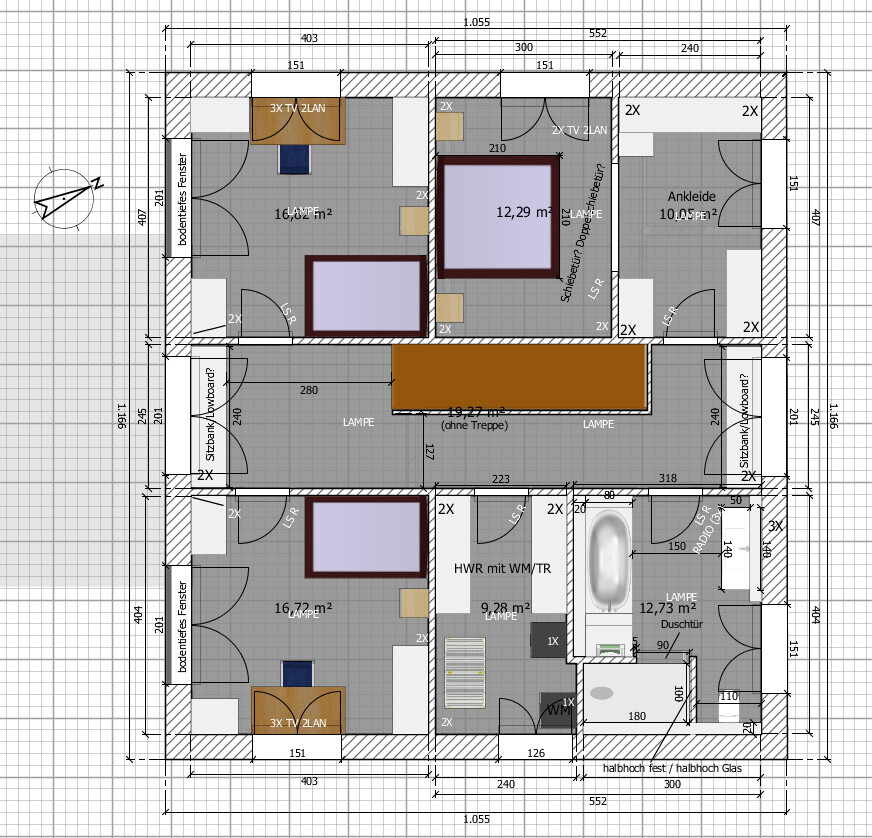
Hallway lighting will have switches (two-way switches) next to each door, which can turn the lighting of the respective floor on and off. So yes, exactly one switch next to each door. The two lamps upstairs will switch on and off simultaneously. It is a floor-level switch. At stair landings, of course, there are exactly two switches: one for upstairs and one for downstairs. So, coming down the stairs, you can operate both switches to turn lights off upstairs and on downstairs. Or you turn off the upstairs light at the bottom of the stairs (top switch off = upstairs off; makes perfect sense to me).
Stair lighting could theoretically be controlled similarly, but that also depends a bit on the show effect, right? It could also be done with a timer or motion sensor. And if pets trigger the stair lighting, well, that’s just how it is. At the moment, we don’t have pets.
As for roller shutter control in the living/dining/kitchen areas, as I said before: short press for fully up/down and hold for precise positioning. But half-positioning is discouraged because temperature differences across the glass can cause damage. For example, next to the living room door, pressing the button three times briefly will raise (or lower) the three shutters. All other roller shutters follow the same principle and are arranged next to their respective doors. Only for bedrooms could I imagine a switch with a timer function, and I would only program the opening time for the next morning. I don’t need a closing time. A short press closes the roller shutter. But if I set my alarm clock to 6:53, I also set the roller shutter to 6:53 so that daylight wakes me at the same time (in the future, we will have joint wake-up times again, and my wife won’t have shift work anymore). BUT: all this can be done conventionally and very simply. So: the office (guest room), bedroom, and two children's rooms will have a switch (short = fully up/down) that allows an opening time to be set.
Just to summarize the shading logic during the day: roller shutters go down in the morning when leaving the room/living area and stay down until the first person returns home in the afternoon. This covers the first 10–12 hours of sunlight exposure.
The lighting in many rooms will be dimmable, but I don’t want expensive color lighting effects. The bulbs should have low blue light and good quality.
So, I think I’ve described the most important areas: roller shutters, lighting, heating, and a few other things...
How can automation like KNX help us now? What comfort gains are possible? What should we automate and why?
According to the current planning status, roller shutters will be installed everywhere (current planning status!). There will be a large sun sail to shade the central window and the dining room window from the sun. The dining room window facing east and the kitchen window will be in the shade shortly after noon.
A heat pump with cooling function and a ground loop exchanger for the controlled ventilation system are planned. Simple logic functions, such as bypass for the controlled ventilation or controlling the underfloor heating based on outside and return temperatures, are handled by the devices themselves. In winter, when the sun heats the floor, the return flow temperature rises, and the heat pump realizes it needs to heat less because of the external heat input. The ventilation system detects when the bypass should be activated.
Individual room control is pointless, or so everyone says in the pink forum. At least for our KfW55-standard building, it’s probably very unnecessary. Night setback is also not needed.
Energy-saving functions don’t interest me because the investment cost will always be higher than the electricity savings. Conventional smoke detectors will be installed, and please no hysterical discussions about this. There will be no gas, oil, or fireplace in the house. And if the house burns down while we’re away, it’s insured. There will be no photovoltaic system, and I’m not interested in any other extreme energy-saving measures. The washing machine has its own timer. Usually, we just load it in the afternoon and hang the laundry in the evening. It doesn’t need to run for three hours at night because of lower tariffs to save 0.3 cents per wash cycle.
The living/dining/kitchen area will have six roller shutters and four dimmable lights. Three shutters and two lights each will be controlled from switches next to the living room door and the kitchen door. The switches are arranged side by side so that the leftmost switch controls the left side of the room, and so on. So the west, south, and central living areas are controlled from the living room door; the south dining area, east dining area, and east kitchen are controlled from the kitchen door. For shading, only the two roller shutters next to the living room are relevant (south living room, as it is not under the sun sail, and west living room).
Currently, in the old building, we have internal blinds and a large west-facing facade. Apart from the five warmest days of the year, we don’t fully shade the windows. We just want to avoid direct sunlight where we are sitting, working, playing, etc. Depending on the situation, some blinds go up and others go down, and so on.
Constant light regulation is not desired. Even now, we switch lights on and off based on feeling. When we want to go to bed soon, the lights are usually off or more distant lights are on (kind of indirect lighting). I have different lighting preferences than my wife, and when we are together in the room, naturally, a compromise solution applies.
I sometimes work flexible hours, and sometimes I might sleep only four hours one night and seven hours the next day. A rule like “dim after xx o’clock” won’t work.
There is no defined TV lighting plan. It depends on the program. For briefly watching the news, all lighting can remain as is. For a moderately interesting football game, only the direct light is turned off, but indirect lighting can stay. For a ‘Game of Thrones’ episode or a good movie, everything should be off, especially since these often have dark scenes. Sometimes, for example, the hallway light stays on as indirect lighting for the living area (which makes sole hallway lighting with motion sensors pointless now).
Hallway lighting will have switches (two-way switches) next to each door, which can turn the lighting of the respective floor on and off. So yes, exactly one switch next to each door. The two lamps upstairs will switch on and off simultaneously. It is a floor-level switch. At stair landings, of course, there are exactly two switches: one for upstairs and one for downstairs. So, coming down the stairs, you can operate both switches to turn lights off upstairs and on downstairs. Or you turn off the upstairs light at the bottom of the stairs (top switch off = upstairs off; makes perfect sense to me).
Stair lighting could theoretically be controlled similarly, but that also depends a bit on the show effect, right? It could also be done with a timer or motion sensor. And if pets trigger the stair lighting, well, that’s just how it is. At the moment, we don’t have pets.
As for roller shutter control in the living/dining/kitchen areas, as I said before: short press for fully up/down and hold for precise positioning. But half-positioning is discouraged because temperature differences across the glass can cause damage. For example, next to the living room door, pressing the button three times briefly will raise (or lower) the three shutters. All other roller shutters follow the same principle and are arranged next to their respective doors. Only for bedrooms could I imagine a switch with a timer function, and I would only program the opening time for the next morning. I don’t need a closing time. A short press closes the roller shutter. But if I set my alarm clock to 6:53, I also set the roller shutter to 6:53 so that daylight wakes me at the same time (in the future, we will have joint wake-up times again, and my wife won’t have shift work anymore). BUT: all this can be done conventionally and very simply. So: the office (guest room), bedroom, and two children's rooms will have a switch (short = fully up/down) that allows an opening time to be set.
Just to summarize the shading logic during the day: roller shutters go down in the morning when leaving the room/living area and stay down until the first person returns home in the afternoon. This covers the first 10–12 hours of sunlight exposure.
The lighting in many rooms will be dimmable, but I don’t want expensive color lighting effects. The bulbs should have low blue light and good quality.
So, I think I’ve described the most important areas: roller shutters, lighting, heating, and a few other things...
How can automation like KNX help us now? What comfort gains are possible? What should we automate and why?

Tom1607 schrieb:
Well, not in my case. I only have one floor for living space. OK, then that’s a different situation. But I didn’t want more RCDs; there are already enough.
Sebastian79 schrieb:
But that’s the problem with you “enthusiasts”: it’s considered standard for new builds—like all houses without a walk-in shower are deemed low-income housing. It’s not a requirement, and a house doesn’t become less livable without it—this attitude is present in many posts here. Whether consciously or unconsciously expressed, that keeps bothering me. No, it’s not mandatory. That’s why I recommended the original poster to skip it. Only those who recognize the added value beforehand and are willing to put in the necessary work will benefit. For others, it just costs more money without providing “extra value.”
However, I think that in the future, such installations will become more common, especially considering the energy transition. Today, heat pumps already have to support network-side shutdowns, and smart meters exist. In 10 years, this will likely be standard, with more optional controls and “saving options,” leading to more automation at home. Whether our current systems will still be sufficient remains to be seen. But they could form a basic foundation.
Sebastian79 schrieb:
Still, I think it’s great how you are educating people here—although the questioner is still approaching the issue the wrong way. Absolutely correct.
What about the topic of lightning protection? At least in this region, there are quite often voltage spikes in the electrical network caused by lightning strikes.
How do you protect the expensive actuators from lightning strikes? They are connected directly to the power supply, after all.
How do you protect the expensive actuators from lightning strikes? They are connected directly to the power supply, after all.
Uwe82 schrieb:
That would certainly have been one of the next questions. The OP two days ago wasn’t even considering KNX for their own house, and now they’re already asking where to connect the live and neutral wires. You’ve convinced me. Of course, I would have the wiring done by an electrician, so my question was really more about understanding the system.
Tom1607 schrieb:
One of the biggest misconceptions is still that KNX is expensive. Anyone who understands the basics will realize that the additional costs for functionally comparable equipment are, if anything, only slightly higher. It only becomes expensive due to luxury add-ons, which then have nothing to do with comparable functionality—it’s like comparing a duck to a Lamborghini. That’s also an argument for me. Either I’m massively overestimating the price of “normal” electrical installations, or KNX technology isn’t that expensive—especially if it doesn’t have to be a costly brand but, for example, something from MDT.
Sebastian79 schrieb:
although the questioner is still approaching the matter incorrectly. Why?
The expandability, ease of modifications, and flexibility are probably reason enough, even if I don’t want to do significantly more than with conventional automation right now.
I have already had some doubts about decisions like whether I want to control this roller shutter from here or there? Should I control the bedroom roller shutter from the door side, or the left or right side of the bed? Do I really want to control everything individually? Maybe not, but I don’t want to limit those possibilities now. With KNX, I know I can adjust this anytime after six months and easily control the roller shutter from all three locations.
In addition to a solution basically mimicking conventional setups, there are extras like scenes, or having the lights gradually brighten together with the roller shutter opening as an alarm, or a central switch to lower all roller shutters at once, or a “turn off all lights” switch. Or an indicator to show if any windows are open before I leave the house last.
Apparently, I can, for example, initially install regular lamps without dimmers and later retrofit a dimmer actuator in the distribution box at any time, then simply switch the sensor from on/off to dimming. Otherwise, I probably would have frantically installed dimmers everywhere just to not forget anything.
And even if I stick to my motto, at least for now, to control everything individually, an MDT Glastaster II Smart with 12 functions is better than 12 separate switches. And once we’re used to it, maybe only 8 functions and 4 scenes will be saved there…
That’s why I’d like to have KNX wiring installed now, maybe just a basic version at first, but I want to consider things that are difficult or impossible to retrofit later. Like window contacts.
S
Sebastian7930 Aug 2016 18:18Sorry, but completely rejecting it just four days ago, and now you want to install it... it's like this with every topic you bring up.
And this constant rehashing... I never want to have such worries and fears.
Do you know what’s great about conventional wiring? It’s there, and basically, you can’t change anything about it – just think about how much time you save when you no longer have to think about configuration changes. Just try to calculate THAT.
And this constant rehashing... I never want to have such worries and fears.
Do you know what’s great about conventional wiring? It’s there, and basically, you can’t change anything about it – just think about how much time you save when you no longer have to think about configuration changes. Just try to calculate THAT.
Sebastian79 schrieb:
You know what’s great about conventional wiring? It’s fixed and you basically can’t change it—which saves you a lot of time by not having to think about configuration changes. Just calculate how much time that adds up to. That argument definitely holds weight. I’ve looked into it, and if you start with KNX, sooner or later you’ll add a weather station. Then you’ll want to install window contacts everywhere. And then presence detectors throughout the house. I could solve my hallway lighting issue by adding even more technology, like an apartment building-style doorbell system and cameras integrated into the home automation. Eventually, a visualization system and server will be added. And then you’ll ̶w̶a̶n̶t̶ a voice control system. After that, cool new stylish switches will come out, and with KNX it’s easy to swap them—so you buy and install new switches here and there. Then you have to pay for an upgrade to ETS6. Later on, you might integrate heating and ventilation, and so on—so you end up with 20,000–30,000 in additional costs. Either all at once or spread out over time...
The second thing that really bothers me a bit are the switches. They look really nice (at least the expensive ones—one can cost 500 EUR for 11 rooms, which adds up to 5,500 EUR), but I’ve consciously operated our electrical installation over the last day or two and noticed that with a conventional light switch, you can turn it on without looking or stopping—just a quick flick while walking past. For example, when I go into the kitchen to grab something from the fridge, I just reach out without looking as I go through the door, then head to the fridge, and when I leave I switch off the light while walking past again. This blind operation isn’t possible with those switches. So, unless I go all the way and make everything fully automated with no switches at all (the 30k scenario), I’m partially reintroducing the opposite of convenience. You walk in, have to find the little “button” for the light on a display; then go to the fridge; and when leaving, you have to find the correct one again among six closely spaced “buttons” to turn off the light.
So, a tricky topic...