
Hello!
We visited the empty plot again today, and unfortunately, it still looks like a pond...
The soil seems to be very compact, so hardly any water is seeping away.
We will probably have to install drainage pipes across the entire property. I don’t want to be standing ankle-deep in water as soon as I step onto the lawn.
How would you recommend laying the drainage pipes on the plot? I have attached the site plan with the planned house marked on it.
Can the drainage pipes wrapped in coconut fiber be placed directly in the ground? Or do I also need to add a drainage layer of gravel or similar?
I would really appreciate any suggestions.
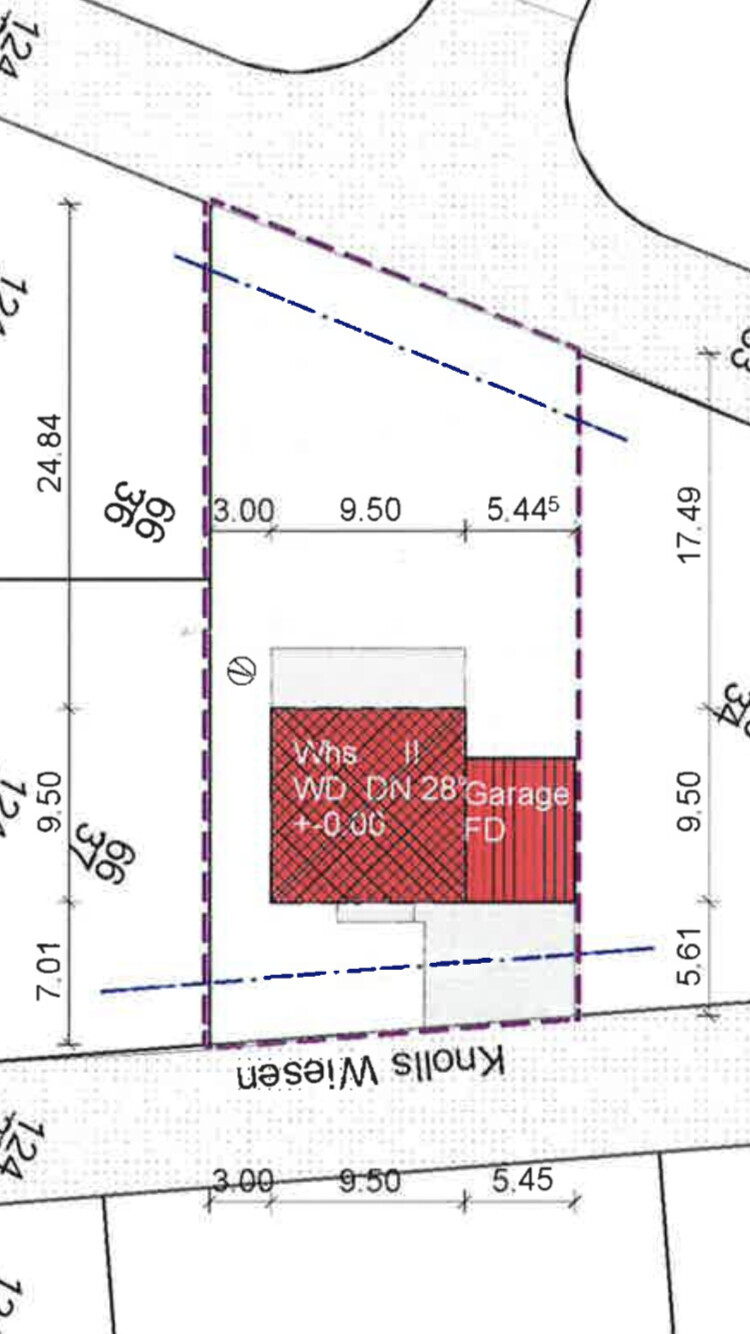
We visited the empty plot again today, and unfortunately, it still looks like a pond...
The soil seems to be very compact, so hardly any water is seeping away.
We will probably have to install drainage pipes across the entire property. I don’t want to be standing ankle-deep in water as soon as I step onto the lawn.
How would you recommend laying the drainage pipes on the plot? I have attached the site plan with the planned house marked on it.
Can the drainage pipes wrapped in coconut fiber be placed directly in the ground? Or do I also need to add a drainage layer of gravel or similar?
I would really appreciate any suggestions.

You don’t understand the principle of ring drainage.
How have fields and plots been kept dry for centuries along the North Sea coast? You surround the area to be drained with a ditch, which flows into a larger channel that then leads to a sluice system, with the outlet located at the dike. At low tide, you open the sluice and the water from the ditches drains out. Water collects in the ditches and seeps laterally from the soil. This is the original form of ring drainage.
Please only proceed after consulting a civil engineer specialized in deep foundations or a landscape gardener. By the way, your land looks like a hollow. You may need to add soil in the center. The center should be higher than the edges.
- Karsten
How have fields and plots been kept dry for centuries along the North Sea coast? You surround the area to be drained with a ditch, which flows into a larger channel that then leads to a sluice system, with the outlet located at the dike. At low tide, you open the sluice and the water from the ditches drains out. Water collects in the ditches and seeps laterally from the soil. This is the original form of ring drainage.
Please only proceed after consulting a civil engineer specialized in deep foundations or a landscape gardener. By the way, your land looks like a hollow. You may need to add soil in the center. The center should be higher than the edges.
- Karsten

@Golfi90 How did you decide, and has everything stayed dry so far?
Which installation grid did you choose?
-------------------------------------------------------------
According to the commissioned geologist, the upper third of our plot is very clay-rich. Also, our plot is located at the lower part of the slope, so water tends to accumulate on our property during heavy or prolonged rain.
To have a dry garden, our geologist recommended installing a drainage system across the entire width of the plot at the upper edge. Additionally, a drainage system should be installed around the house.
We have a combined sewer system. According to a verbal statement from the local authority, we are allowed to discharge the rainwater collected by the drainage systems directly into the combined sewer.
Can anyone tell me how much extra cost these measures might add? We would have 30m (100 feet) width at the upper edge of the plot and around 55m (180 feet) around the perimeter of the slab.
tomtom79 schrieb:
Definitely lay it in gravel. We have a clay soil plot, and during excavation, we removed 20cm (8 inches) of it. Additionally, we installed 50m (165 feet) of drainage pipe as well as possible in a mineral bed in the area where the lawn is.
Around the entire house, there is another drainage system.
So far, no issues.
Which installation grid did you choose?
-------------------------------------------------------------
According to the commissioned geologist, the upper third of our plot is very clay-rich. Also, our plot is located at the lower part of the slope, so water tends to accumulate on our property during heavy or prolonged rain.
To have a dry garden, our geologist recommended installing a drainage system across the entire width of the plot at the upper edge. Additionally, a drainage system should be installed around the house.
We have a combined sewer system. According to a verbal statement from the local authority, we are allowed to discharge the rainwater collected by the drainage systems directly into the combined sewer.
Can anyone tell me how much extra cost these measures might add? We would have 30m (100 feet) width at the upper edge of the plot and around 55m (180 feet) around the perimeter of the slab.

Similar topics