
Currently, the attic floor consists of OSB boards.
The walls and ceilings will be covered with gypsum board. Both an architect and the drywall installer said this is a very good combination.
Because of a minor issue, I started researching and found a lot of contradictory information out there.
Among other things, it is said that the expansion rates of OSB and gypsum board are so different that cracks often occur.
I don’t want to believe that. 😎
My question:
Is there anyone here who has cracks in the gypsum board that can be traced back to the OSB substrate?
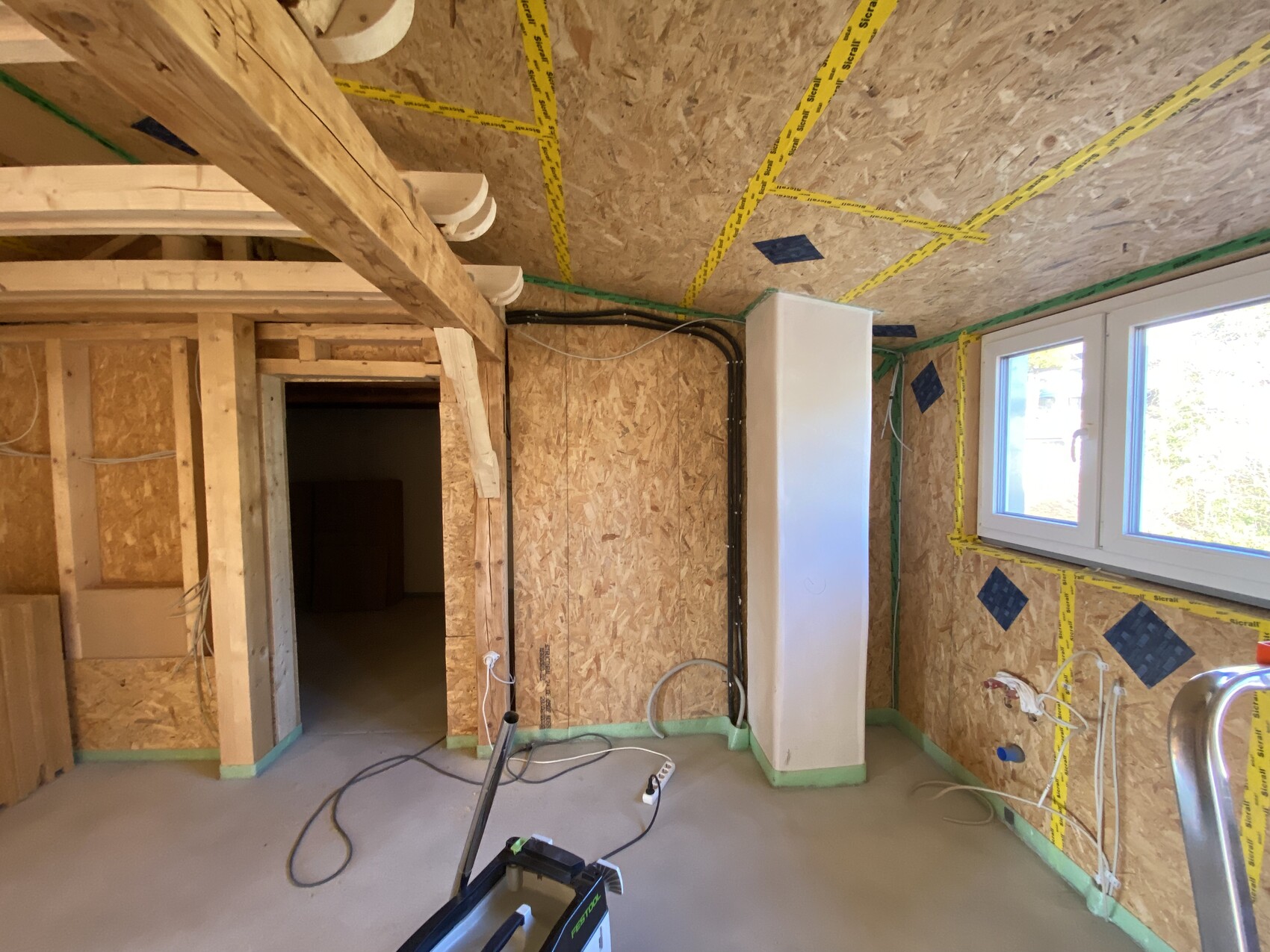
The walls and ceilings will be covered with gypsum board. Both an architect and the drywall installer said this is a very good combination.
Because of a minor issue, I started researching and found a lot of contradictory information out there.
Among other things, it is said that the expansion rates of OSB and gypsum board are so different that cracks often occur.
I don’t want to believe that. 😎
My question:
Is there anyone here who has cracks in the gypsum board that can be traced back to the OSB substrate?
A vapor retarder does not mean that the OSB does not absorb or allow water vapor to diffuse through.
That is not the point.
The materials gypsum board and OSB simply behave differently.
Since an architect is involved, they must plan according to the approval requirements of the regional building code anyway.
Just check the approval documents, where the layers are specified exactly.
Anything that has not been tested is unlikely to be effective.
That is not the point.
The materials gypsum board and OSB simply behave differently.
Since an architect is involved, they must plan according to the approval requirements of the regional building code anyway.
Just check the approval documents, where the layers are specified exactly.
Anything that has not been tested is unlikely to be effective.
 schubert793 Jun 2022 15:32
Our neighbor has the combination. Unfortunately, with the “wrong,” not vapor-tight OSB. Everywhere after switching from summer/winter/summer, there are cracks. Significant. Arguing with the building inspector and the drywall contractor.
There is no OSB that is vapor diffusion-tight, which would also be nonsensical. This is only about a vapor retarder, and what matters are the Sd-values and the layer thicknesses or the water vapor diffusion equivalent air layer thickness, which should decrease toward the outside.
 ateliersiegel3 Jun 2022 16:29
The possible cracks are certainly annoying, but they are "harmless". The important thing is that mold does not start to grow...
Similar topics