
R
Rowley6514 Sep 2013 09:59Hello,
we are considering installing continuous glued hardwood flooring in our large open-plan living and dining area with an open kitchen (with underfloor heating)…
While browsing online, I came across “bamboo parquet,” which is said to be ideal for this purpose (very hard, durable, low thermal resistance, and OF COURSE very eco-friendly).
I have already checked several suppliers’ websites (bambuskomfort.de, bambeau.de, bambusconcepts.de), with prices ranging from about 30 € per sqm (3 sq ft) to 80 € per sqm (7.4 sq ft).
Can anyone recommend a manufacturer or retailer? We would prefer a relatively dark parquet, visually similar to walnut wood or the like...
Greetings from Franconia
Alex
we are considering installing continuous glued hardwood flooring in our large open-plan living and dining area with an open kitchen (with underfloor heating)…
While browsing online, I came across “bamboo parquet,” which is said to be ideal for this purpose (very hard, durable, low thermal resistance, and OF COURSE very eco-friendly).
I have already checked several suppliers’ websites (bambuskomfort.de, bambeau.de, bambusconcepts.de), with prices ranging from about 30 € per sqm (3 sq ft) to 80 € per sqm (7.4 sq ft).
Can anyone recommend a manufacturer or retailer? We would prefer a relatively dark parquet, visually similar to walnut wood or the like...
Greetings from Franconia
Alex

We have this type of bamboo flooring.
T&W Boston Bamboo Flooring, dark bamboo with a matte finish.


It looks great and was easy to install, BUT: the floor build-up with the foam underlay is almost 18mm (0.7 inches) thick. You need to consider this if you want to install tiles next to it. Tiles are usually installed on a 12mm (0.5 inches) layer. A skilled tiler can manage this.
As for the flooring itself, from my experience, every sealed wood floor is very sensitive. Any small stone stuck between chair and floor, or any harder dust particle, will leave nice white scratches. What you actually see is not a scratch in the bamboo (grass fiber) itself, but in the finish.
This was so noticeable and bothersome that we have now placed a simple bamboo slat rug (costing around €100) under the dining table, despite having felt pads on the chair legs.
Our little one (10 months old) even managed to make a small dent in the flooring just last week.
I would say that it is a natural material and it lives with you in the home. Once enough scratches and dents accumulate, the individual ones don’t stand out as much anymore.
When laying the flooring, be sure to mix the boards well. The color tones vary quite a bit. At first, I was shocked, but once the room was finished, everything matched nicely again.
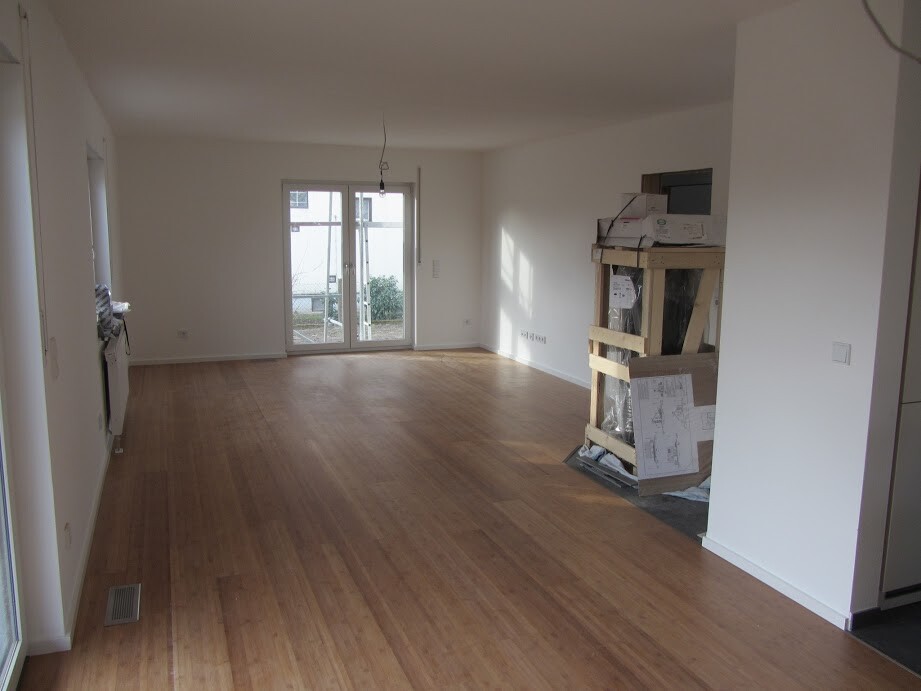

T&W Boston Bamboo Flooring, dark bamboo with a matte finish.
It looks great and was easy to install, BUT: the floor build-up with the foam underlay is almost 18mm (0.7 inches) thick. You need to consider this if you want to install tiles next to it. Tiles are usually installed on a 12mm (0.5 inches) layer. A skilled tiler can manage this.
As for the flooring itself, from my experience, every sealed wood floor is very sensitive. Any small stone stuck between chair and floor, or any harder dust particle, will leave nice white scratches. What you actually see is not a scratch in the bamboo (grass fiber) itself, but in the finish.
This was so noticeable and bothersome that we have now placed a simple bamboo slat rug (costing around €100) under the dining table, despite having felt pads on the chair legs.
Our little one (10 months old) even managed to make a small dent in the flooring just last week.
I would say that it is a natural material and it lives with you in the home. Once enough scratches and dents accumulate, the individual ones don’t stand out as much anymore.
When laying the flooring, be sure to mix the boards well. The color tones vary quite a bit. At first, I was shocked, but once the room was finished, everything matched nicely again.
R
Rowley6514 Sep 2013 10:37Thanks for the quick first response! Your parquet flooring really looks great.
Do you have underfloor heating? You mention that the entire floor assembly with foam foil is almost 18mm (0.7 inches), so did you install it as a floating floor? We would prefer gluing it down because of the lower thermal resistance...
Do you have underfloor heating? You mention that the entire floor assembly with foam foil is almost 18mm (0.7 inches), so did you install it as a floating floor? We would prefer gluing it down because of the lower thermal resistance...
Okay, it’s a draw: you didn’t look closely at the pictures, and I didn’t read the post carefully enough. In the first picture, there’s a white object hanging on the wall—these days it might be unfamiliar, but it’s a radiator. We hate underfloor heating.
Now, gluing down parquet flooring is a tricky subject—I’m not an expert on that. But I wonder how the wood is supposed to expand and contract, and how the parquet is protected from drying out. Our parquet definitely moves a lot, especially in the summer at 70% humidity and in the winter at 30–40%. You can particularly notice it at the edges. However, according to the description, it is supposed to be suitable for underfloor heating.
We paid €32 (about $35) per square meter, which is much less than what you typically see online. We bought it from a local specialist wood supplier. Aesthetically, it is one of our highlights.
Now, gluing down parquet flooring is a tricky subject—I’m not an expert on that. But I wonder how the wood is supposed to expand and contract, and how the parquet is protected from drying out. Our parquet definitely moves a lot, especially in the summer at 70% humidity and in the winter at 30–40%. You can particularly notice it at the edges. However, according to the description, it is supposed to be suitable for underfloor heating.
We paid €32 (about $35) per square meter, which is much less than what you typically see online. We bought it from a local specialist wood supplier. Aesthetically, it is one of our highlights.
R
Rowley6514 Sep 2013 11:18OKAY, yes, the white radiators can be easily overlooked.
I’ve also done some research on underfloor heating and parquet flooring – the parquet should ideally be treated only with oil and not fully sealed (to allow better breathability). And yes, you’re right, you have to pay attention to the humidity; it should always be between around 40 to 60% to avoid significant gaps forming.
If possible, we also want to buy locally and have it installed. I’m only checking online retailers in advance to see what shades and options are available...
I’ve also done some research on underfloor heating and parquet flooring – the parquet should ideally be treated only with oil and not fully sealed (to allow better breathability). And yes, you’re right, you have to pay attention to the humidity; it should always be between around 40 to 60% to avoid significant gaps forming.
If possible, we also want to buy locally and have it installed. I’m only checking online retailers in advance to see what shades and options are available...
Rowley651 schrieb:
It should always be between, I believe, 40 - 60% to avoid significant joint cracking.You can’t achieve this without external help. During our first winter in the house, we initially had around 20%, because the ventilation system also brings in dry air from outside. After we installed the moisture recovery unit, we averaged about 35%. To get any higher, I would have to constantly cook pasta or buy a humidifier. However, we didn’t have any plants yet.Similar topics