
Hello esteemed community,
we are currently looking for our floor tiles. We have now found a floor tile that appeals to us visually.
It has the following characteristics:
"The tile is rectified/calibrated and not through-bodied, meaning the body color is roughly the color of the tile. Additionally, the tile with R9 rating is universally applicable and, due to the extra glaze, extremely resistant to external influences and very easy to maintain.
Through-body coloring:
Many customers today ask for through-bodied tiles because they fear that in case of chipping a different color would show. Nowadays, tiles are fired very hard and have a tough surface that is highly resistant to external influences. The tile would most likely crack completely rather than chip. Even if a piece chips off, you would see this on a through-bodied tile just as on a non-through-bodied one, and it would also leave residues (dirt and water) during cleaning.
My recommendation:
Always calculate one extra package as a reserve. If something happens at some point, you will always have the option to replace one tile of the same batch. This is quite simple, quick, and always looks better than a crack or chip (whether through-bodied or not)."
What do you think? Is he right? Are there any other valid reasons against this tile (apart from the additional cost for the tile installer)?
Confused regards, ntsa86
we are currently looking for our floor tiles. We have now found a floor tile that appeals to us visually.
It has the following characteristics:
- Material: Porcelain stoneware
- Dimensions LxW: 90x45 cm (35x18 inches)
- Rectified: yes
- Slip resistance: R9
- Abrasion class: IV
- Glazed: yes
- Surface finish: matte
- Color: light beige
"The tile is rectified/calibrated and not through-bodied, meaning the body color is roughly the color of the tile. Additionally, the tile with R9 rating is universally applicable and, due to the extra glaze, extremely resistant to external influences and very easy to maintain.
Through-body coloring:
Many customers today ask for through-bodied tiles because they fear that in case of chipping a different color would show. Nowadays, tiles are fired very hard and have a tough surface that is highly resistant to external influences. The tile would most likely crack completely rather than chip. Even if a piece chips off, you would see this on a through-bodied tile just as on a non-through-bodied one, and it would also leave residues (dirt and water) during cleaning.
My recommendation:
Always calculate one extra package as a reserve. If something happens at some point, you will always have the option to replace one tile of the same batch. This is quite simple, quick, and always looks better than a crack or chip (whether through-bodied or not)."
What do you think? Is he right? Are there any other valid reasons against this tile (apart from the additional cost for the tile installer)?
Confused regards, ntsa86

- Material: porcelain stoneware --------------------> very hard, durable
- Dimensions LxW: 90x45 cm (35x18 inches) ---------------------------> tiles larger than 0.10 m² (1.08 ft²) are considered large format
- Rectified/Calibrated: yes --------------------------------> means the edges are beveled or chamfered/machined to a uniform size with 90-degree angles. Each tile is exactly the same size, allowing for narrower grout lines of 1.5 to 2 mm (0.06 to 0.08 inches), which I believe looks better with such large tiles.
- Slip resistance: R9 -----------------------> means safe to walk on with a slope angle between 3° and 10°
- Abrasion class: IV ---------------------------> suitable for use with footwear and light abrasive dirt
- Glazed: yes ------------------------------------> easier to maintain
- Surface finish: matte -----------> small scratches are less noticeable than on glossy tiles
- Color: light beige -----------------------------> a matter of personal taste; I find it attractive
All in all, I would agree with the supplier.
The substrate must be properly prepared for large-format tiles. There are certain tolerance limits for how many millimeters (inches) tiles can warp or bow, but I don’t have that information on hand right now. I would definitely inform the related trades about these requirements when choosing the tiles.
D
Doc.Schnaggls30 Aug 2016 12:36Hello,
We had the same tile size installed on our ground floor.
So here is a small tip from me:
Our tiler strongly advised against the planned brick bond pattern because tiles of this size, as @Neige correctly pointed out, tend to warp slightly.
Using a brick bond pattern can therefore result in noticeable unevenness.
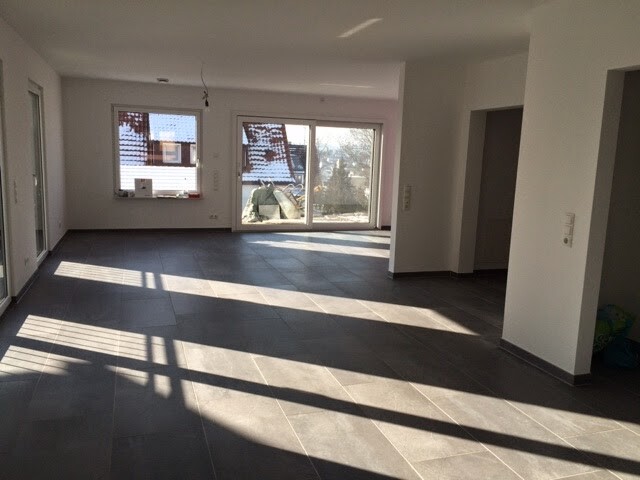
Following our tiler’s advice, we had them laid in a third-bond pattern instead, which we really like, although it was still quite a puzzle for the tiler to achieve a level surface.
Here is how it looks now:
Regards,
Dirk
We had the same tile size installed on our ground floor.
So here is a small tip from me:
Our tiler strongly advised against the planned brick bond pattern because tiles of this size, as @Neige correctly pointed out, tend to warp slightly.
Using a brick bond pattern can therefore result in noticeable unevenness.
Following our tiler’s advice, we had them laid in a third-bond pattern instead, which we really like, although it was still quite a puzzle for the tiler to achieve a level surface.
Here is how it looks now:
Regards,
Dirk
S
Sebastian7930 Aug 2016 13:18With a staggered bond pattern, you have the fewest problems and the lowest risk of cracks, etc. – just for the record.
Similar topics