
ᐅ Experience with 3 cm thick patio slabs – do they break easily?
Created on: 20 Jul 2022 10:08
Y
Ypsi aus NI
Hello, yesterday we talked with a mason / all-rounder about our terrace. We are planning to use slabs measuring 60 x 120cm (24 x 48 inches) with a thickness of 3cm (1.2 inches). He advised against this. According to him, because of the thickness, the slabs cannot be compacted with a plate compactor without breaking. He also said that the base would gradually settle over time (even if it was compacted without the slabs beforehand), creating voids that would cause the slabs to become loose.
Does anyone have experience with this? Specifically, have such “thin” slabs been installed for a longer period, and can confirm or deny this?
Thank you!
Does anyone have experience with this? Specifically, have such “thin” slabs been installed for a longer period, and can confirm or deny this?
Thank you!

Ypsi aus NI schrieb:
But that contradicts the other experiences mentioned here... That’s what it depends on
driver55 schrieb:
it stands or falls with the subsoil.
Highly compacted means 80cm (31 inches) deep, preferably 1m (39 inches) deep, first a frost protection layer, then compactable gravel, compacted layer by layer with a vibratory plate (every 20cm (8 inches)), the last layer already with a slope, and then a 5cm (2 inches) crushed stone bedding layer, compacted again.
Most construction guides mention 40–50cm (16–20 inches) depth, but then frost gets underneath, and part of it settles (unfortunately not all), causing movement. So in the end, it might really be easier to just make a concrete slab and work with pedestal supports. The slab may then settle only as a whole.
W
WilderSueden20 Jul 2022 18:05To my knowledge, adjustable pedestal supports can also be installed on paving slabs.
All neighbors who, against better judgment, laid 2-3cm (1 inch) slabs on gravel regretted it after a few years. That doesn’t hold up. Use either concrete slabs or stones thicker than 5cm (2 inches) in the gravel, or adhere them (to a base slab or mortar bed).
Pedestal supports are another option.
You can’t compact 3cm (1 inch) slabs.
Pedestal supports are another option.
You can’t compact 3cm (1 inch) slabs.
Y
Ypsi aus NI20 Jul 2022 20:45Does anyone have a recommendation for a stone that is thick enough (over 6cm (2.4 inches))?
Visually, it should be similar to the attached photo...
Standard street paving stones are usually plain gray and not very attractive.
Thanks for any suggestions!
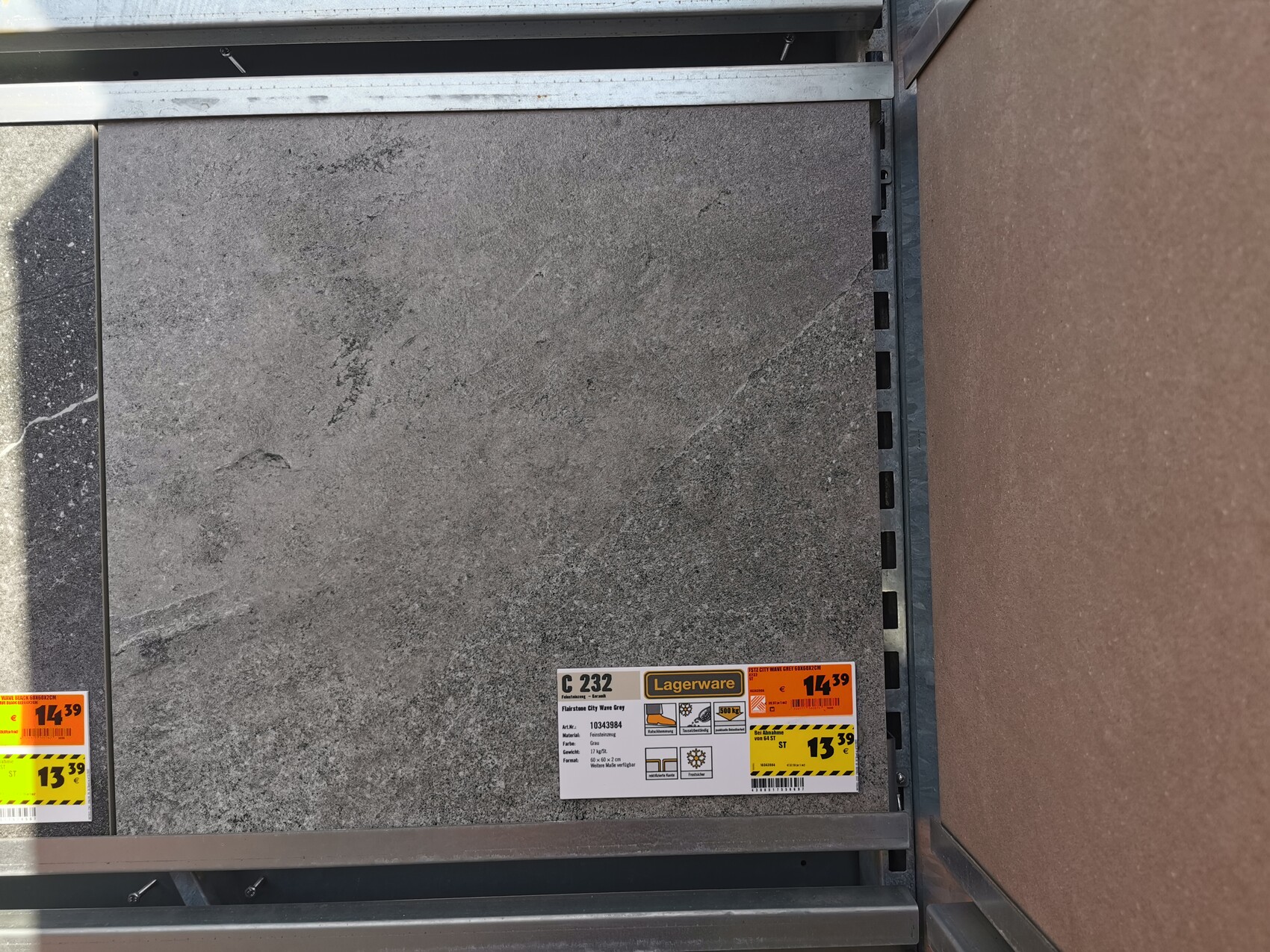
Visually, it should be similar to the attached photo...
Standard street paving stones are usually plain gray and not very attractive.
Thanks for any suggestions!
Ypsi aus NI schrieb:
Does anyone have experience with this? I mean such "thin" panels lying around for a longer time and can confirm or refute this? I can confirm: about 8 years now with 2cm (0.8 inch) thick, 60 x 60cm (24 x 24 inches) granite panels on a bed of crushed stone.
The wobbling is not the main issue, they do shift a bit, yes.
Joint sand doesn’t have space.. ants contribute as well.. so it’s not just everyday use on the patio 😎
B
Benutzer 100121 Jul 2022 00:04Ypsi aus NI schrieb:
We decided against a concrete slab because we weren’t sure how far the terrace would extend and whether we wanted stone or wood.
Now we want stone, have found a slab that looks good to us, and are facing all these new problems.
Thanks for sharing your experiences. I had hoped that joint sand/quartz sand could be the solution. Installing it into a mortar bed is just as labor-intensive, expensive, not easy to replace, and definitely carries the risk of frost damage and cracking. Please avoid using sand. After three years, I had to lift the slabs and reinstall them with a crushed stone base. Since then, no problems.
If I were to do it again, I would either use a mortar bed or build on pedestals only.
@ypg Don’t the edges crack if the slabs are laid without gaps?
Similar topics