
Hello everyone,
Based on my online research and conversations with demolition companies, I am still not really sure: Is it allowed to remove asbestos roofing tiles yourself and dispose of them properly? Of course, compliance with safety regulations (mask, asbestos bags, protective suit) is a prerequisite.
Does anyone here have experience with this?
Based on my online research and conversations with demolition companies, I am still not really sure: Is it allowed to remove asbestos roofing tiles yourself and dispose of them properly? Of course, compliance with safety regulations (mask, asbestos bags, protective suit) is a prerequisite.
Does anyone here have experience with this?
A
angoletti114 Sep 2021 08:23Hello,
we’ve been through this ourselves and I can share the following. No judgment or further comments — everyone has to decide for themselves what to do.
We had a quote from a company that was supposed to remove the asbestos from the facade. I don’t remember the price anymore, but they have to do the following:
The house would have to be fully scaffolded (up to this point, pretty normal). The scaffold then has to be completely wrapped in plastic sheeting, and the workers have to wear full protective gear to remove the material. I think there was even talk of negative air pressure systems, etc. When I saw the price, the details didn’t matter as much anymore. ;-)
We ended up doing everything ourselves: put up the scaffolding, no plastic wrapping, got proper respirator masks, and started at 6:30 AM on a Saturday. We were done by 1 PM. If any of the neighbors saw and reported it, they might shut down the site—that’s why we worked so fast. The material must be packed in special sealed big bags designated for asbestos waste. Dropping it off at the landfill was no problem. What I found a bit “strange” with all this effort was that the landfill just dumped the material into a corner and covered it with soil.
So yes, it’s possible to do it yourself, just pay attention to your health and gear up properly. The more fuss you make, the more alert the neighbors become. Instead of those intimidating full-body suits, we just used old rain jackets and threw them away afterwards.
If you try to deliver the material without using these special big bags, you’ll likely be sent right back home.
Alright, now feel free to bring on the moralizers—but I won’t comment further :-D
we’ve been through this ourselves and I can share the following. No judgment or further comments — everyone has to decide for themselves what to do.
We had a quote from a company that was supposed to remove the asbestos from the facade. I don’t remember the price anymore, but they have to do the following:
The house would have to be fully scaffolded (up to this point, pretty normal). The scaffold then has to be completely wrapped in plastic sheeting, and the workers have to wear full protective gear to remove the material. I think there was even talk of negative air pressure systems, etc. When I saw the price, the details didn’t matter as much anymore. ;-)
We ended up doing everything ourselves: put up the scaffolding, no plastic wrapping, got proper respirator masks, and started at 6:30 AM on a Saturday. We were done by 1 PM. If any of the neighbors saw and reported it, they might shut down the site—that’s why we worked so fast. The material must be packed in special sealed big bags designated for asbestos waste. Dropping it off at the landfill was no problem. What I found a bit “strange” with all this effort was that the landfill just dumped the material into a corner and covered it with soil.
So yes, it’s possible to do it yourself, just pay attention to your health and gear up properly. The more fuss you make, the more alert the neighbors become. Instead of those intimidating full-body suits, we just used old rain jackets and threw them away afterwards.
If you try to deliver the material without using these special big bags, you’ll likely be sent right back home.
Alright, now feel free to bring on the moralizers—but I won’t comment further :-D
A
angoletti114 Sep 2021 08:25Cost 12€, load capacity up to 800 kg (1764 lbs), the loops hold double that. 260 x 125 x 30 cm (102 x 49 x 12 inches)
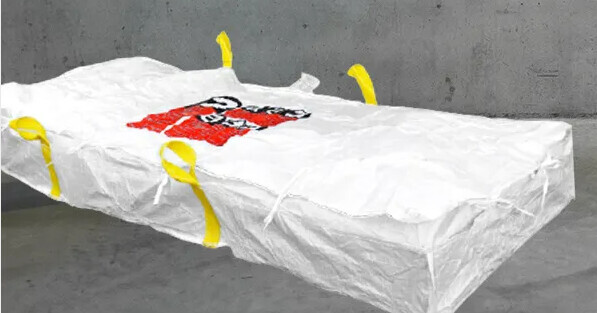
In our case, the scaffolding was not wrapped in plastic sheeting, and there was no negative pressure applied either.
Whole sheets should be bonded asbestos.
We paid 3500 euros in 2017, all-inclusive—from coordinating with the neighbor to disposal. The roof area was about 250 square meters (2700 square feet).
They used a truck-mounted crane with a lift because the roof was not allowed to be walked on—risk of breakage, and with us, a free fall of up to 10 meters (33 feet).
Each sheet was removed as carefully as handling a raw egg.
For storage heaters, if present, check with your local building authority (LRA) how they must be disposed of. In our area, you receive a certificate—then disposal is free of charge. The debris must be delivered intact and tightly wrapped in plastic sheeting.
Contracting this out was relatively expensive compared to the roof removal itself. You really only need a lot of physical strength (a few strong helpers), a trailer, and plastic sheeting. Nothing special.
Just call the nearest landfill that accepts asbestos. They can tell you whether it’s allowed in your area, what quantities, and which permits are necessary. In the end, they don’t care whether you or a company delivers it. They don’t aim to sell you anything.
Personal protective equipment (PPE) and handling should be regulated according to TRGS 519.
Whole sheets should be bonded asbestos.
We paid 3500 euros in 2017, all-inclusive—from coordinating with the neighbor to disposal. The roof area was about 250 square meters (2700 square feet).
They used a truck-mounted crane with a lift because the roof was not allowed to be walked on—risk of breakage, and with us, a free fall of up to 10 meters (33 feet).
Each sheet was removed as carefully as handling a raw egg.
For storage heaters, if present, check with your local building authority (LRA) how they must be disposed of. In our area, you receive a certificate—then disposal is free of charge. The debris must be delivered intact and tightly wrapped in plastic sheeting.
Contracting this out was relatively expensive compared to the roof removal itself. You really only need a lot of physical strength (a few strong helpers), a trailer, and plastic sheeting. Nothing special.
Just call the nearest landfill that accepts asbestos. They can tell you whether it’s allowed in your area, what quantities, and which permits are necessary. In the end, they don’t care whether you or a company delivers it. They don’t aim to sell you anything.
Personal protective equipment (PPE) and handling should be regulated according to TRGS 519.
 In der Ruine14 Sep 2021 09:42
angoletti1 schrieb:
We did everything ourselves, set up scaffolding around the house, no plastic sheeting, got proper respirator masks, and started at 6:30 AM on Saturday. The job was done by 1 PM. If any of the neighbors see this and report it, they can shut down your construction site, hence the "rush". The material has to be packed into specially designated big bags that can be sealed.
Alright, now the moral guardians can come, but I won’t comment further on that :-D This is only possible if you remove entire panels and no dust is generated. If you produce asbestos dust, you will rightly be reported.
What happens to you doesn’t matter, but if the dust blows toward your neighbors, that counts as bodily harm. If the dust settles on the ground, it will be spread by every breeze.
B
BauFamily14 Sep 2021 09:51The landfill accepts asbestos sheets. However, that is not my main concern… The question is whether I will face any issues if a neighbor reports it somewhere, even though I pack everything properly in big bags.
B
BauFamily14 Sep 2021 09:56motorradsilke schrieb:
Many building materials can still find buyers through classified ads who will dismantle them themselves.Which building materials were these? Did you list them individually on eBay Classifieds?
Similar topics