
Hello everyone,
I have a quick question because I haven’t been able to reach my local chimney specialist.
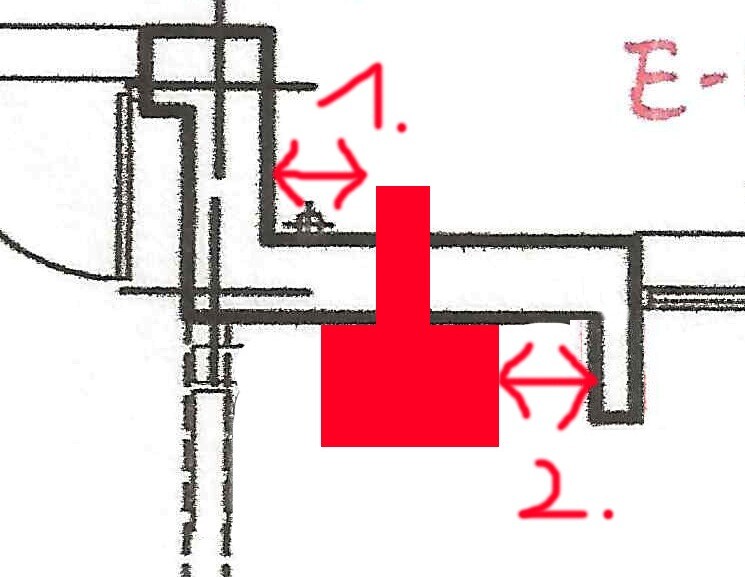
We are planning to install a stove inside, and next to it there will be a double wall where wood is intended to be stacked. The house has a bay window. In the corner between the bay window and the house wall, the chimney will extend upwards.
Now I have a question:
For walls or combustible materials, I believe the required clearance is 30cm (12 inches), correct? That would correspond to point 2 on the drawing.
But is there also a regulation regarding the clearance for point 1? There is also a rainwater pipe running along the wall.
So, what is the minimum distance the external chimney must maintain from the wall?
Please see the attached drawing.
Thank you.
I have a quick question because I haven’t been able to reach my local chimney specialist.
We are planning to install a stove inside, and next to it there will be a double wall where wood is intended to be stacked. The house has a bay window. In the corner between the bay window and the house wall, the chimney will extend upwards.
Now I have a question:
For walls or combustible materials, I believe the required clearance is 30cm (12 inches), correct? That would correspond to point 2 on the drawing.
But is there also a regulation regarding the clearance for point 1? There is also a rainwater pipe running along the wall.
So, what is the minimum distance the external chimney must maintain from the wall?
Please see the attached drawing.
Thank you.
20cm (8 inches) should be sufficient. At my brother’s place, it passes 5cm (2 inches) past the roof ridge. The building inspector approved that. The exterior chimney shouldn’t / shouldn’t get too hot anyway, since it will be properly insulated / protected – otherwise, there would be a risk of burns on the surface everywhere?! That must not happen!
P
PhoenixDH11 Oct 2013 10:08That’s useful information, thanks!
Then the plan works.
Then the plan works.
D
DerBjoern11 Oct 2013 10:23The stove’s clearance distances within the room should be specified in the stove’s technical documentation. For example, the stove I have chosen requires only 15cm (6 inches) clearance at the back. However, according to the manufacturer’s requirements, it is unlikely that any chimney sweep would approve otherwise...
PhoenixDH schrieb:
That’s some useful information, thanks!
Then the plan fits. I hope you understand that I’m not a chimney sweep! I’m just sharing my own experience here. Please don’t take this as a general rule. It simply means: it might work — but it doesn’t have to. Only your certified chimney inspector (BKM) can give you a definitive answer.
P
PhoenixDH11 Oct 2013 11:03Hi,
I understand 😉
But I found another technical document about the stove that also includes measurements for safety clearances, see attachment.
Here is how I see it:
9 cm (3.5 inches) at the back
14 cm (5.5 inches) on the side next to a wall
Additionally, the base plate below usually needs to extend 27.4 cm (11 inches), but if the stove is placed against a wall, this is not necessary.
I understand 😉
But I found another technical document about the stove that also includes measurements for safety clearances, see attachment.
Here is how I see it:
9 cm (3.5 inches) at the back
14 cm (5.5 inches) on the side next to a wall
Additionally, the base plate below usually needs to extend 27.4 cm (11 inches), but if the stove is placed against a wall, this is not necessary.
Since nothing can be seen from the view, no one can really say anything about it, but 9/14cm (3.5/5.5 inches) sounds very unlikely.
And regarding the topic of the board underneath with your "statement," I won’t say anything more except:
If you rely on "your opinion," then good luck.
Your opinion does not matter, there are regulations that decide.
And before you ask again; they are dictated by your building savings contract!
And regarding the topic of the board underneath with your "statement," I won’t say anything more except:
If you rely on "your opinion," then good luck.
Your opinion does not matter, there are regulations that decide.
And before you ask again; they are dictated by your building savings contract!
Similar topics