
Hello everyone,
We are still at the very beginning of planning our future house.
The bank is currently reviewing the possible loan amount, and once that’s settled, we will take a closer look at the zoning plan / building permit and start considering the general design of the house. After that, we will begin searching for a home construction company.
The first important decision will be about the material for the shell of the building:
- Solid construction (e.g., masonry or concrete)
- Timber frame with appropriate insulation
- Timber frame insulated with straw (straw bale house)
We are quite fascinated by the idea of a straw bale house because there are hardly any other building methods with such a good ecological footprint during the construction phase. The insulation provided by the 40 cm (16 inches) thick straw bales alone is very effective and should meet KfW40 standards (yes, we want KfW40, so please no discussion about that here).
According to our current research, the costs are not much lower than other options, but it does offer the opportunity for a lot of DIY work, which we are excited about!
The house will have one full story and an attic with a rather low knee wall (50 cm (20 inches), maybe a bit more). The zoning plan/building permit doesn’t allow for more.
Does anyone here have experience with a straw bale house or something similar?
Best regards,
Specki
We are still at the very beginning of planning our future house.
The bank is currently reviewing the possible loan amount, and once that’s settled, we will take a closer look at the zoning plan / building permit and start considering the general design of the house. After that, we will begin searching for a home construction company.
The first important decision will be about the material for the shell of the building:
- Solid construction (e.g., masonry or concrete)
- Timber frame with appropriate insulation
- Timber frame insulated with straw (straw bale house)
We are quite fascinated by the idea of a straw bale house because there are hardly any other building methods with such a good ecological footprint during the construction phase. The insulation provided by the 40 cm (16 inches) thick straw bales alone is very effective and should meet KfW40 standards (yes, we want KfW40, so please no discussion about that here).
According to our current research, the costs are not much lower than other options, but it does offer the opportunity for a lot of DIY work, which we are excited about!
The house will have one full story and an attic with a rather low knee wall (50 cm (20 inches), maybe a bit more). The zoning plan/building permit doesn’t allow for more.
Does anyone here have experience with a straw bale house or something similar?
Best regards,
Specki
As a counterargument, I can currently only share what I know:
You don’t just go to any random farmer and pick up straw bales intended for livestock and use them in construction.
There are specific regulations regarding how the straw bales must be processed. Experienced architects and carpenters are familiar with these requirements and probably know farmers who meet them. If not, you can look for a farmer who can comply with these standards. When everything is handled according to these regulations, there won’t be any rotten or moldy core. It is understood from the beginning that more care must be taken here because the straw is definitely NOT meant for livestock.
This is how I understand it so far, based on everything I have read.
You don’t just go to any random farmer and pick up straw bales intended for livestock and use them in construction.
There are specific regulations regarding how the straw bales must be processed. Experienced architects and carpenters are familiar with these requirements and probably know farmers who meet them. If not, you can look for a farmer who can comply with these standards. When everything is handled according to these regulations, there won’t be any rotten or moldy core. It is understood from the beginning that more care must be taken here because the straw is definitely NOT meant for livestock.
This is how I understand it so far, based on everything I have read.
Well, the real question is what are the advantages?
From my perspective, it’s mainly the environmental aspect. It’s important to keep in mind that insulation and wall construction are only one part (albeit a significant one) of a house’s overall ecological footprint.
Is it worth accepting the risks and disadvantages for this?
I personally wouldn’t do it.
From my perspective, it’s mainly the environmental aspect. It’s important to keep in mind that insulation and wall construction are only one part (albeit a significant one) of a house’s overall ecological footprint.
Is it worth accepting the risks and disadvantages for this?
I personally wouldn’t do it.
N
nordanney23 Jan 2020 14:13Specki schrieb:
This is how I understand it so far, based on everything I have read.For example, when I look at the FASBA website, straw bale houses are quite rare, and there really aren’t many specialists available everywhere (both designers and skilled craftsmen who work with straw and/or clay). It may be environmentally friendly, at least for the small part of insulation in house construction, but it’s too specialized for me. I would prefer a monolithic construction with stones instead.S
Sebastian Acht14 Apr 2021 00:36Hi, I have been living in a straw bale house myself for four years. I designed this house together with my wife and built it within a year with the help of two friends (excluding windows, flat roof, water and wastewater systems, and electrical installations). Issues like mold, mice, or other pests, as well as fire safety, are absolutely not a concern in a straw bale house. Our house achieves an efficiency rating equivalent to KfW 40+, and apart from a water-bearing wood stove, there is no other heating system installed throughout the building. Heating costs amount to around 250 to a maximum of 300 € per year. From mid-March, the stove remains unused about 80% of the time and is only fired up again around mid to late October. During this period, we burn approximately 3.5–4 m³ (124–141 cubic feet) of beech wood to heat the house and 1000 liters (264 gallons) of water in the buffer tank. In the remaining months, we heat the water exclusively with photovoltaic electricity. Inside, the house is plastered with clay and lime plaster. On the outside, the straw bales are covered with 6 cm (2.4 inches) thick wood fiberboards and 2.5 cm (1 inch) of lime plaster or larch cladding. The indoor air quality and living environment in a straw bale house are almost unparalleled and far superior to prefabricated houses or those built with conventional materials. It does not smell like straw or anything else, provided it is properly constructed and moisture cannot penetrate the straw. However, the same moisture risk exists with insulation made of mineral wool. The construction costs for our house were approximately 1200 €/m² (111 $/ft²), including 1600 m² (0.4 acres) of land. The FASBA is already a great resource to obtain a lot of information. Additionally, there is a wonderful DVD available online called Stroh im Kopf.
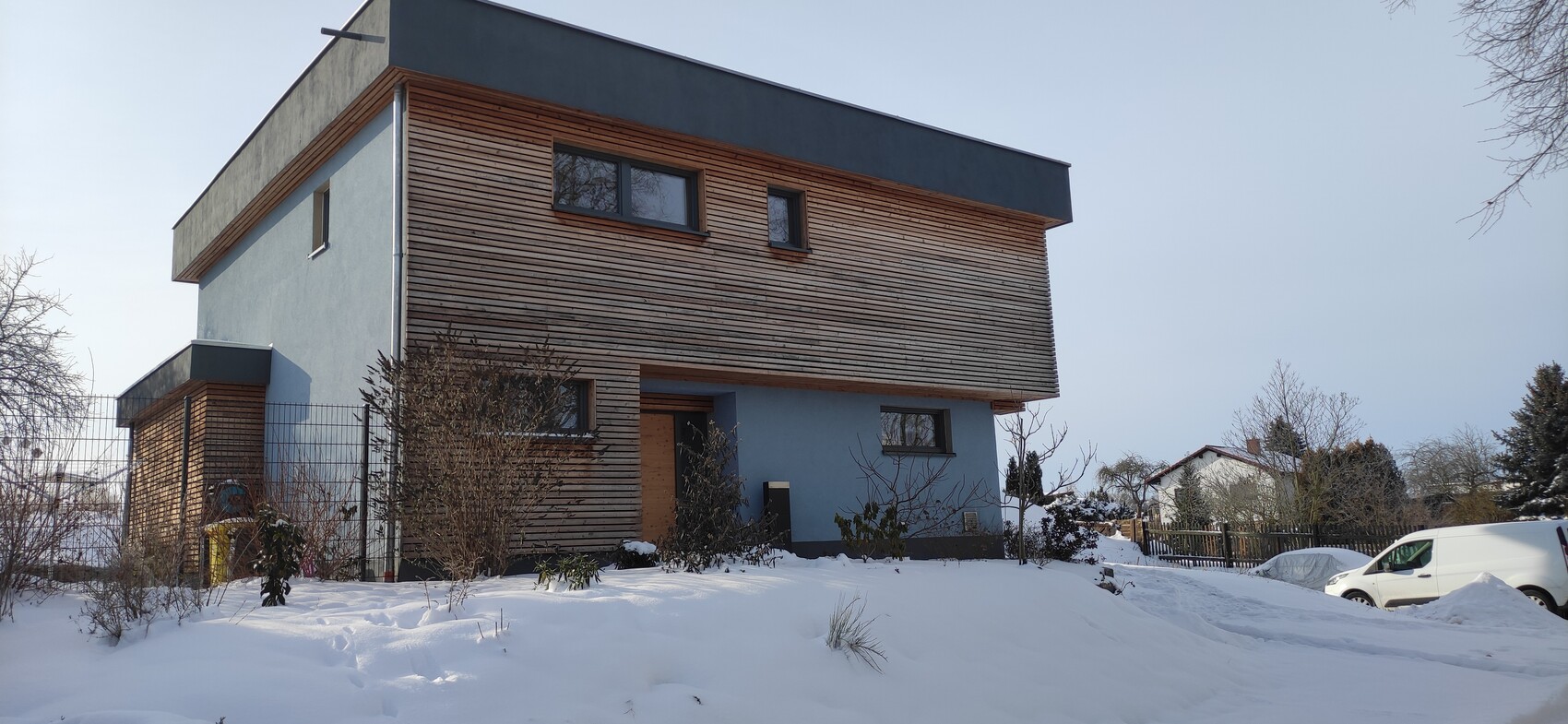

It is a myth that you always have to go with the flow. Our master carpenter is currently designing his own house, for example with walls plastered with clay. This is certainly unusual, although not as much as a straw bale house (a topic we also briefly considered as an option). These are not just dreamers or eccentrics who plan and carry out such projects—they are doers! "Keep going as usual" ultimately leaves a sad emptiness, not something for (our) children.
Similar topics