
Hello everyone,
The calculated energy demand for one of the houses we are interested in is as follows:
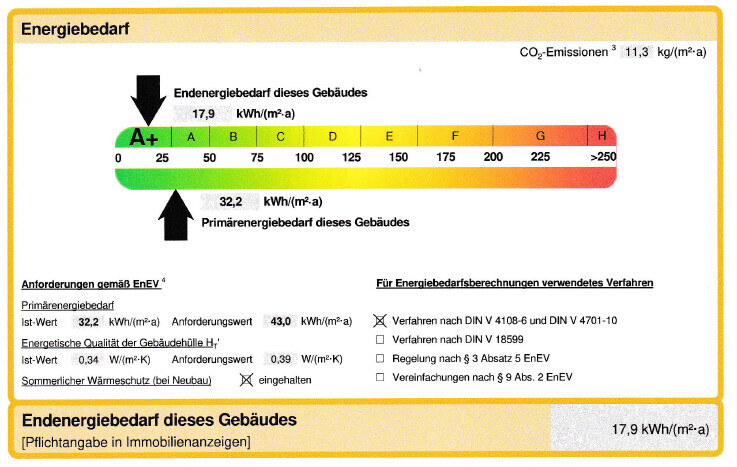
The house is built with Thermoplan S9 bricks, 36.5cm (14 inches) thick, the roof is fully insulated with 30cm (12 inches) of stone wool, and the windows are triple-glazed. I am not aware of any additional insulation measures. Heating is provided by an air-to-water heat pump.
The final energy demand of 17.9 kWh/(m²*a) seems very low to me, given that no additional insulation was applied. Is this achievable with the materials mentioned?
The calculated energy demand for one of the houses we are interested in is as follows:
The house is built with Thermoplan S9 bricks, 36.5cm (14 inches) thick, the roof is fully insulated with 30cm (12 inches) of stone wool, and the windows are triple-glazed. I am not aware of any additional insulation measures. Heating is provided by an air-to-water heat pump.
The final energy demand of 17.9 kWh/(m²*a) seems very low to me, given that no additional insulation was applied. Is this achievable with the materials mentioned?
N
nordanney21 Nov 2020 20:17vanny2705 schrieb:
Much nicer than polystyrene on the facade. You don’t see a difference. You don’t feel a difference. It’s just a different construction method.
No more, no less.
Besides polystyrene and monolithic construction, there are actually many other options.
V
vanny270521 Nov 2020 20:34Bookstar schrieb:
Most people still build with hollow bricks. Ytong is the worst case for sound insulation. I can't confirm that. The house is located close to a busy road, and you can barely hear anything inside.
V
vanny270521 Nov 2020 20:36nordanney schrieb:
You don’t see a difference. You don’t feel a difference. It’s just a different construction method.
Nothing more, nothing less.
By the way, besides expanded polystyrene and monolithic construction, there are many other options. That’s true, you can’t see a difference, but you know it when you live in it, and from a fire safety perspective, expanded polystyrene discouraged me.
A
AllThumbs21 Nov 2020 21:16vanny2705 schrieb:
That’s true, you can’t see a difference, but you know it when you live inside, and from a fire protection point of view, styrofoam discouraged me. We also debated several times whether the extra cost of a monolithic construction method (hollow brick) compared to an external thermal insulation composite system (ETICS) was worth it. There is a strong debate on this topic.
Ultimately, what convinced us was the statement that with proper installation, ETICS is absolutely fine, but it’s also easy to do a lot wrong. When we started paying more attention, we noticed quite a few houses with noticeable spots. At the points where the insulation was fastened with anchors, the exterior wall dries faster, and over time there are color differences caused by weather exposure.
Well, attachments like awnings are ultimately easier to mount.
vanny2705 schrieb:
I can’t confirm that; the house is located close to a busy road, and inside you can hardly hear anything. Maybe you have a special type of block? The standard Ytong blocks are, as you can see from the datasheet, quite poor in that regard.
Similar topics