
Hello dear housebuilding forum community,
I am new here and have a few questions about housebuilding and planning.
I should also mention that this topic is completely new to me, but I am slowly starting to get involved with it.
I am 27 years old and come from Lower Saxony.
And here are my question(s):
Is it possible to purchase a developed plot of land, which can be found relatively cheaply, and build your own house there using natural stone?
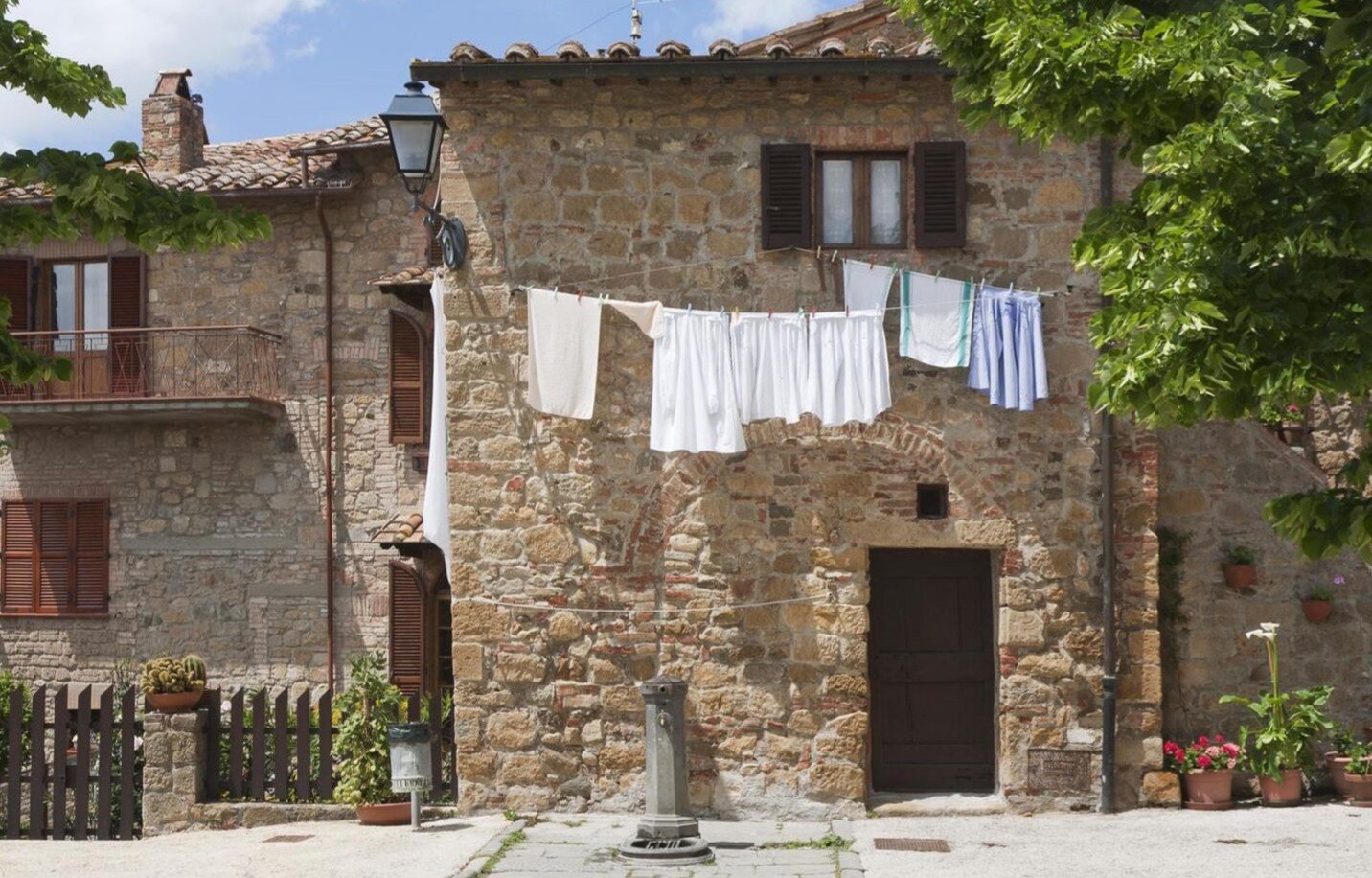
I am thinking of the type of construction often found in Italy. I have attached an example photo.
I have a good friend who owns very large forest areas, where there are countless sandstone boulders that I would be allowed to use. (Yes, I am aware that I would have to collect several tons of stone, but that was somehow done in the past as well.)
I would pour the foundation from concrete, and build the intermediate floors from wood or concrete.
To meet structural engineering requirements, I would hire an architect, and for the electrical, heating, and plumbing work, I would also hire professional companies.
I have access to roofers, carpenters, and masons.
I hope to be able to do as much of the building myself as possible and achieve significant cost savings.
The construction process would certainly take years, just to collect the stones, but I have the time.
I find this type of construction very beautiful and sustainable.
Do you think this plan is completely crazy or not feasible at all?
Or do you think it might be possible to consider this project more seriously?
Thank you very much in advance
Yuri
I am new here and have a few questions about housebuilding and planning.
I should also mention that this topic is completely new to me, but I am slowly starting to get involved with it.
I am 27 years old and come from Lower Saxony.
And here are my question(s):
Is it possible to purchase a developed plot of land, which can be found relatively cheaply, and build your own house there using natural stone?
I am thinking of the type of construction often found in Italy. I have attached an example photo.
I have a good friend who owns very large forest areas, where there are countless sandstone boulders that I would be allowed to use. (Yes, I am aware that I would have to collect several tons of stone, but that was somehow done in the past as well.)
I would pour the foundation from concrete, and build the intermediate floors from wood or concrete.
To meet structural engineering requirements, I would hire an architect, and for the electrical, heating, and plumbing work, I would also hire professional companies.
I have access to roofers, carpenters, and masons.
I hope to be able to do as much of the building myself as possible and achieve significant cost savings.
The construction process would certainly take years, just to collect the stones, but I have the time.
I find this type of construction very beautiful and sustainable.
Do you think this plan is completely crazy or not feasible at all?
Or do you think it might be possible to consider this project more seriously?
Thank you very much in advance
Yuri
P
pagoni202017 Oct 2020 22:20fach1werk schrieb:
I believe it’s a misconception that you absolutely need quarried sandstone blocks. The stone just needs to be hard and durable enough....that’s not the case with sandstone boulders that have been lying in the forest or underground for a long time. You can also quarry or shape them yourself to be ready for building. However, one should a) have the necessary skills and b) be able to invest enough labor and time—as desired here for an entire house—to prepare these stones on-site for construction. We were talking about boulders...Yuri Sagdiyev schrieb:
Yes, I am aware that I would need to gather several tons for this, but somehow it used to work in the past. In the past, there were slaves who built structures over several years. In between, there were workers who rarely lived past 40 because the work was so physically demanding that it wore them out. Nowadays, animal welfare regulations even prohibit donkeys from carrying loads.
It would be interesting to know your profession...
This is what garden walls are made of here.
Rough, untreated concrete is the best friend. Personally, I don’t like it at all.
We have some very old sandstone walls; in some places, the stone is already starting to crumble.
With sandstone, you have to be careful where and how you split it. If you’re unlucky, you end up with nothing but stone fragments. Even most masons nowadays hardly know how to do this anymore.
Regarding the climate: we have an above-ground sandstone cellar. The temperature remains relatively stable in both summer and winter. If you want to heat it, you need a forest because otherwise, you will get very expensive.
Weight: a sandstone block about the size of a milk carton weighs around 2.2 to 2.6 kg (4.9 to 5.7 lbs). A load-bearing wall of our house would weigh approximately 70 tons (about 77 US tons).
In the past: the whole village helped, and at least in our region, which is rich in stone, there were almost no stone buildings. Stone was used for parts in contact with the ground, such as retaining walls and foundations, while the rest was half-timbered construction.
Rough, untreated concrete is the best friend. Personally, I don’t like it at all.
We have some very old sandstone walls; in some places, the stone is already starting to crumble.
With sandstone, you have to be careful where and how you split it. If you’re unlucky, you end up with nothing but stone fragments. Even most masons nowadays hardly know how to do this anymore.
Regarding the climate: we have an above-ground sandstone cellar. The temperature remains relatively stable in both summer and winter. If you want to heat it, you need a forest because otherwise, you will get very expensive.
Weight: a sandstone block about the size of a milk carton weighs around 2.2 to 2.6 kg (4.9 to 5.7 lbs). A load-bearing wall of our house would weigh approximately 70 tons (about 77 US tons).
In the past: the whole village helped, and at least in our region, which is rich in stone, there were almost no stone buildings. Stone was used for parts in contact with the ground, such as retaining walls and foundations, while the rest was half-timbered construction.
haydee schrieb:
Bush-hammered concrete is the best friend. Exposed aggregate can also look quite good.
Similar topics