
ᐅ Looking for a construction company in the Greater Stuttgart area!
Created on: 18 Sep 2018 21:18
B
budbrd
Hello,
we have purchased a plot of land near Stuttgart and submitted a building permit application. Unfortunately, the cost estimates keep increasing.
The project is a single-family house with a living area of 250 m² (2690 sq ft), including a double garage and basement, KfW40+ standard.
Can anyone recommend a construction company in the greater Stuttgart area?
Thanks in advance!
we have purchased a plot of land near Stuttgart and submitted a building permit application. Unfortunately, the cost estimates keep increasing.
The project is a single-family house with a living area of 250 m² (2690 sq ft), including a double garage and basement, KfW40+ standard.
Can anyone recommend a construction company in the greater Stuttgart area?
Thanks in advance!
E
erazorlll31 Mar 2020 14:32Matthew03 schrieb:
You’ve already made your decision anyway... You list the above as a “+” even though you say yourself you have no idea or there are no data available. For the competitor, you list figures like decibels as a disadvantage, although no comparison with Hauser is possible... why? What are you trying to achieve with that?
I therefore refer to the first sentence: you decided a long time ago, no matter what you say now The statement in the construction specifications simply says that the sound insulation should be very high due to the high raw density. “Very high” is a very general and not comparable statement. Unfortunately, Hauser itself does not provide any data (decibel figures, U-value, etc.). I listed it under + because I think I read somewhere that Liapor walls have a bulk density of around 1,200 kg/m³ (75 lb/ft³) and the Ytong block about 350 kg/m³ (22 lb/ft³). Higher bulk density = higher sound insulation, or am I mistaken?
Please don’t get me wrong, I really have not made a decision yet. I like both companies; both have advantages and disadvantages and are priced similarly. I’m just trying to compare the two building materials/concepts with partly incomplete information.
C
cyberfabi31 Mar 2020 14:43The density becomes pretty much irrelevant beyond a certain point! It really depends on the windows. Didn’t you look at the table? Here is a similar table for brick walls, but it’s quite comparable for all building materials: if the windows only provide sound insulation of 32 dB (like standard ones), it doesn’t matter how much soundproofing the rest of the wall has—you will never exceed the limit set by the windows. For Liapor, we are talking about a maximum of 49–52 dB as a pure sound insulation value. The table shows what that means:
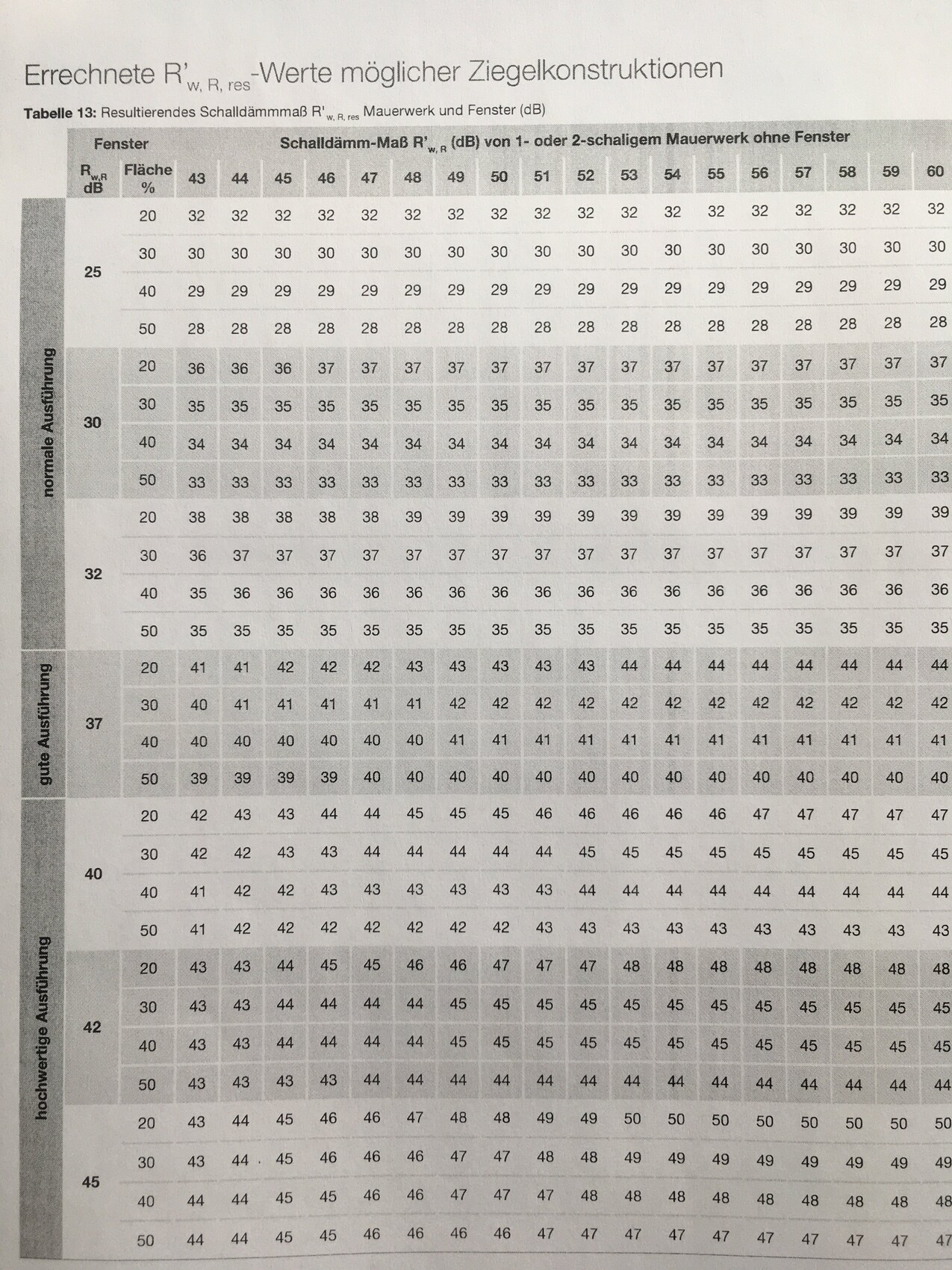

@erazorlll I’m familiar with aerated concrete from several of my father’s former apartments—one of them even on a busy street—and from my “company apartment” in the factory building, all of which had excellent sleep quality. Therefore, I can’t relate at all to the usual scary stories about sound insulation. With Liapor, you will have no trouble drilling, and there is now a wide range of products for fastenings through exterior insulation systems (EIFS / ETICS). However, a suspended ceiling installed because of electrical cables sounds to me like a design flaw; there are definitely smarter ways to solve that. Have you asked Dennert how they handle this? (Their stone wall components would be somewhat similar.)
That equation is oversimplified. Rigidity does help “immunize” against vibrations, yes—but that can definitely not be achieved by mass alone. So the argument is “correct,” but it still doesn’t work as a counterargument regarding other materials. In physics, many students settle for a “C” grade because advertising claims often have to be simplified to the point of being misleading.
https://www.instagram.com/11antgmxde/
https://www.linkedin.com/company/bauen-jetzt/
erazorlll schrieb:
Higher density = better soundproofing, or am I wrong?
That equation is oversimplified. Rigidity does help “immunize” against vibrations, yes—but that can definitely not be achieved by mass alone. So the argument is “correct,” but it still doesn’t work as a counterargument regarding other materials. In physics, many students settle for a “C” grade because advertising claims often have to be simplified to the point of being misleading.
https://www.instagram.com/11antgmxde/
https://www.linkedin.com/company/bauen-jetzt/
E
erazorlll31 Mar 2020 14:47cyberfabi schrieb:
The bulk density doesn't really matter beyond a certain point! It all comes down to the windows—did you check the table? Here’s a similar table for brick walls, but it’s roughly the same for all building materials: if the windows only provide sound insulation of 32 dB (like standard ones), it doesn’t matter how much soundproofing the rest of the wall has, you’ll never get past the limit set by the window values. For Liapor, we're talking about a maximum of 49-52 dB as pure sound insulation. The table explains what that means: I only saw your answer afterwards and took a look at the table. So the sound rating is basically irrelevant. Because the exterior wall has the windows, which are significantly worse, and the interior wall has the doors, which are probably significantly worse as well. Alright, then that topic is off the table.
E
erazorlll31 Mar 2020 15:0011ant schrieb:
@erazorlll A ceiling dropped because of electrical cables sounds like a construction mistake to me; there are definitely smarter ways to solve that. Have you asked Dennert how they handle this situation (they would have a similar case with the stone wall section)?Hauser’s statement is that all necessary components for the floor (underfloor heating, etc.) go into the floor itself, and the electrical installation (lighting connections, etc.) are placed in the dropped ceiling. This results in a lower floor build-up, and the dropped ceiling is an advantage because modifications can still be made afterwards.
I just checked again:
Floor: 40mm (1.5 inches) thermal insulation + 20mm (0.75 inches) underfloor heating fixing panel + 60mm (2.4 inches) calcium sulfate screed
Ceiling: I think I read somewhere 12–13cm (4.7–5.1 inches)
I didn’t ask Dennert about this because they were not on our list or we had no contact with them.
E
erazorlll31 Mar 2020 15:52According to the website, Dennert uses a 20cm (8 inches) hollow slab ceiling and apparently installs all the cables there. I can’t currently explain why Hauser does it completely differently.
Hauser: "Reinforced concrete hollow core slab (with thermal insulating polystyrene core) designed as a solid slab according to structural requirements"
Köhler: 22cm (9 inches) reinforced concrete ceiling
Hauser: "Reinforced concrete hollow core slab (with thermal insulating polystyrene core) designed as a solid slab according to structural requirements"
Köhler: 22cm (9 inches) reinforced concrete ceiling
Similar topics