
ᐅ Number of required recessed lights (halogen) and which types?
Created on: 18 Mar 2020 14:31
M
ms-t-89
Hello everyone,
we need some help planning the recessed downlights for our ground floor.
We’re not quite sure how many are necessary and how they should be arranged to achieve "proper" lighting conditions—not too bright, not too dark. The entire ground floor is to be fitted with recessed downlights, no pendant lights or similar fixtures, so no additional lamps.
We can only install the Halox housings into the ceiling; we have to purchase the bulbs and other components ourselves. So far, we don’t have any suggestions on this. Any tips would be much appreciated.
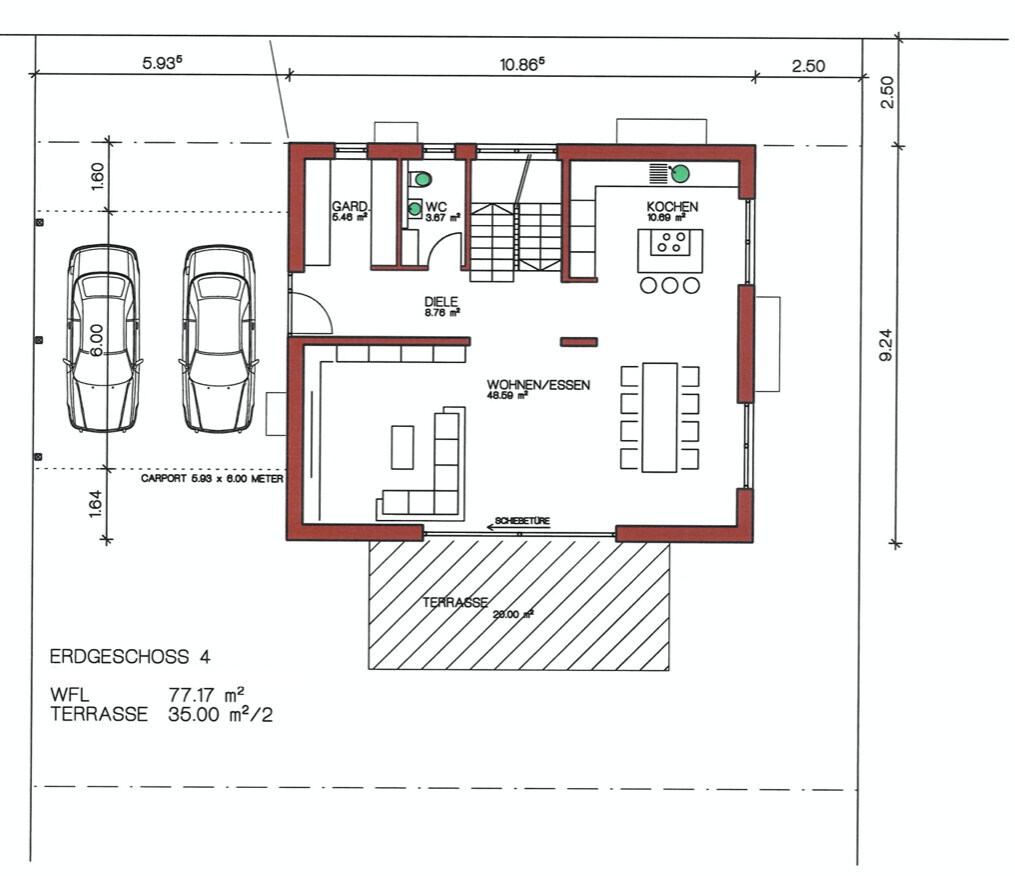
we need some help planning the recessed downlights for our ground floor.
We’re not quite sure how many are necessary and how they should be arranged to achieve "proper" lighting conditions—not too bright, not too dark. The entire ground floor is to be fitted with recessed downlights, no pendant lights or similar fixtures, so no additional lamps.
We can only install the Halox housings into the ceiling; we have to purchase the bulbs and other components ourselves. So far, we don’t have any suggestions on this. Any tips would be much appreciated.
Thanks for all the responses!
I sat down last night and reviewed the recommendations. They mentioned 100-150 lumens per square meter (lm/m²) for general lighting, and 250-300 lm/m² for the kitchen. I calculated based on the respective square meters and then divided by 400 lm (as an example) per LED again.
The kitchen island will now also get pendant lights since the ceiling LEDs might not provide sufficient lighting for cooking.
There doesn’t seem to be a lighting planner available nearby for us. It’s not about the cost, but I have to find a solution without a lighting planner.
Oh, right, I’ve always talked about spots, but that’s probably an important point. Which recessed downlights have you installed? I do want to learn more about this because you read so many contradictory things...
The ceiling on the ground floor won’t be prefabricated. The basement will, but there we agreed regular ceiling lights are enough. Regarding switches, it will be controlled later with KNX anyway. We’ve planned various circuits which I want to control via MDT glass push-buttons. If I split it up now, I can still control them together later via KNX but have more flexibility. Thanks again for the tip.
General lighting only, no indirect lighting or so. A floor lamp will be added but just for decoration.
I also feel that 21 downlights is quite a lot.
I sat down last night and reviewed the recommendations. They mentioned 100-150 lumens per square meter (lm/m²) for general lighting, and 250-300 lm/m² for the kitchen. I calculated based on the respective square meters and then divided by 400 lm (as an example) per LED again.
The kitchen island will now also get pendant lights since the ceiling LEDs might not provide sufficient lighting for cooking.
Alessandro schrieb:
If you only use recessed downlights, I would go to a lighting planner. They can simulate it. Costs around 500-700 Euros, depending on the size of the property. You'll regret it deeply if you forget something or if the ceiling ends up looking like it was hit by a nail gun.
There doesn’t seem to be a lighting planner available nearby for us. It’s not about the cost, but I have to find a solution without a lighting planner.
K1300S schrieb:
It’s important to decide in advance which recessed spotlights – and probably not spots, but ones for more diffuse lighting – you want to use because that determines where and how many mounting boxes you need to plan for. If you use simple recessed frames with GU10 bulbs, you will generally need more than with high-quality models since the latter have higher output.
Just as a guideline: For a similar living/dining area, we have four above the dining table and four above the sofa/coffee table, each switched in groups of two. On the lowest dim level, that provides pleasant ambient lighting; at full power, it’s dazzlingly bright. I would probably add three in the hallway and one each in the cloakroom and the WC. For the kitchen, we didn’t use recessed downlights so the light source sits lower and can be better directed. In total, we have eight lights plus under-cabinet lighting on the wall units.
If you have no plan at all and don’t want to at least familiarize yourself with basics (luminous flux, brightness, beam angle, ceiling height, visual planning, etc.), going to a lighting planner might be sensible.
Oh, right, I’ve always talked about spots, but that’s probably an important point. Which recessed downlights have you installed? I do want to learn more about this because you read so many contradictory things...
Steven schrieb:
Hello ms-t-89,
Are you getting a prefabricated ceiling or cast-in-place concrete? For larger rooms like the living room, I would always distribute the lighting over three switches. Say six fixtures on the longer side, so a total of 12. Then add two on each short side – 16 in total. You switch them on in combination. In the middle, one additional row is switched separately. I also have three in front of the window with a separate switch. They’re fitted with 3-watt bulbs with a slightly bluish light, which is pleasant when watching TV. You can vary infinitely.
Steven
The ceiling on the ground floor won’t be prefabricated. The basement will, but there we agreed regular ceiling lights are enough. Regarding switches, it will be controlled later with KNX anyway. We’ve planned various circuits which I want to control via MDT glass push-buttons. If I split it up now, I can still control them together later via KNX but have more flexibility. Thanks again for the tip.
Alessandro schrieb:
The question I have is whether you want general lighting like normal ceiling lamps and/or accent lighting usually installed 20-30 cm (8-12 inches) in front of the wall.
General lighting only, no indirect lighting or so. A floor lamp will be added but just for decoration.
K1300S schrieb:
Hopefully it’s becoming clear how important it is to decide on the fixtures. If I calculated correctly from Steven’s numbers, that’s 21 downlights in the living/dining area. That would be massive overkill for our model.
Another point: Recessed downlights are probably intended only for general lighting. This will be supplemented by accent lighting (floor lamps, wall lights, etc.). Keep that in mind when planning.
I also feel that 21 downlights is quite a lot.

If you plan to use GU10 China sockets and compatible bulbs, that could actually work out. Our fixtures are from Illuxtron. Even the 75mm (3 inches) versions provide about 1200 lumens each, which replaces three fixtures with 400 lumens (and also offers suitable beam angles). Additionally, there are various dimmable options available, allowing you to integrate them perfectly into a KNX system.
The HaloX housings are available in various diameters (18cm (7 inches) is probably standard) and initially come completely sealed with a cover that is then embedded in plaster. Afterwards, a suitable hole is drilled (matching the recessed light fixture) so that everything from zero up to about 16cm (6 inches) in diameter can be used. Depending on the option you choose, however, I would recommend installing all the housings with a tunnel for the LED driver.
J
Johanneslisa20 Mar 2020 06:24We installed a total of 83 Halox 250 units across three floors. For example, the living room has 6 units. Just search for LED recessed panels. Ours have a diameter of about 20cm (8 inches) and a light output of around 1000 lumens. There are dimmable and non-dimmable versions. In the kitchen, we have smaller ones with lower output but a higher quantity.
C
cyberfabi20 Mar 2020 09:42Johanneslisa schrieb:
... LED recessed panels. .Do recessed panels really offer that much more in terms of aesthetics compared to ultra-thin standard LED panels? For the recessed panels, you need expensive HaloX mounting boxes in the ceiling (at least 60 € per piece) as well as the LED panels themselves, which also protrude a few millimeters. However, the surface-mounted options are only about 20mm (0.8 inches) thick at most and have almost the same appearance, but are significantly cheaper overall. Or am I missing an advantage of the recessed option?
Similar topics