
ᐅ Room Layout Planning – But How? Challenges in Certain Spaces
Created on: 25 Feb 2019 21:41
G
Grantlhaua
Hello everyone,
I’m currently thinking about our plan for the recessed spotlights and am having trouble making progress.
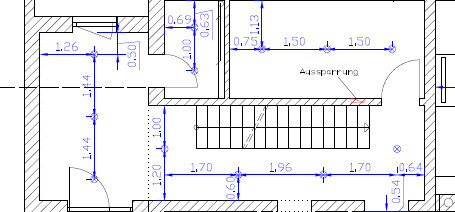
Ground floor hallway: I’m not happy with the transition between the different “hallway sections.”
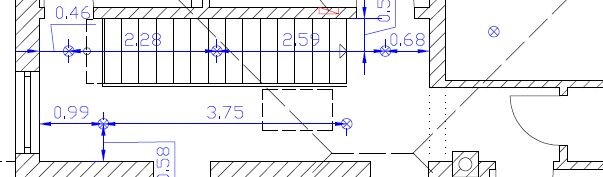
Upper floor hallway: The area behind the beam still needs to be integrated sensibly. Is there even enough light?
Basement hallway: Is the arrangement okay like this? Is the lighting sufficient?
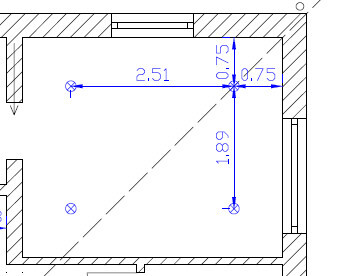
Bedroom spotlights: The bed will be placed against the wall at the bottom of the picture with two pendant lamps hanging from the ceiling as bedside lamps. Do I even need 4 spotlights, or would maybe 3 in a row on the opposite wall be enough?
At the moment, I can’t find any solutions without covering all the rooms with spotlights...
Maybe someone has better ideas.

I’m currently thinking about our plan for the recessed spotlights and am having trouble making progress.
Ground floor hallway: I’m not happy with the transition between the different “hallway sections.”
Upper floor hallway: The area behind the beam still needs to be integrated sensibly. Is there even enough light?
Basement hallway: Is the arrangement okay like this? Is the lighting sufficient?
Bedroom spotlights: The bed will be placed against the wall at the bottom of the picture with two pendant lamps hanging from the ceiling as bedside lamps. Do I even need 4 spotlights, or would maybe 3 in a row on the opposite wall be enough?
At the moment, I can’t find any solutions without covering all the rooms with spotlights...
Maybe someone has better ideas.

Actually, you have all the necessary information.
For the 60° spotlights, the maximum spacing is about 2 meters (6.5 feet).
Place them centrally in the walking paths (consider if there is furniture on the sides).
In the other rooms, start in the areas where you need light and then move outward. But please, no grid covering the entire ceiling 😉
As mentioned above, also consider possible glare, for example near the headboard at the bed.
There are several examples online showing how to arrange them along with pattern suggestions.
With these affordable spotlights, I would install the same type everywhere. We are talking about additional costs in the basement of maybe 150 euros. Plus two spare units (about 70 euros).
This way, it does not matter where one breaks down, and you won’t have problems with different light colors, illumination, etc.
Why not send an email to Voltus? Maybe they can provide you with a small plan...
For the 60° spotlights, the maximum spacing is about 2 meters (6.5 feet).
Place them centrally in the walking paths (consider if there is furniture on the sides).
In the other rooms, start in the areas where you need light and then move outward. But please, no grid covering the entire ceiling 😉
As mentioned above, also consider possible glare, for example near the headboard at the bed.
There are several examples online showing how to arrange them along with pattern suggestions.
With these affordable spotlights, I would install the same type everywhere. We are talking about additional costs in the basement of maybe 150 euros. Plus two spare units (about 70 euros).
This way, it does not matter where one breaks down, and you won’t have problems with different light colors, illumination, etc.
Why not send an email to Voltus? Maybe they can provide you with a small plan...
G
Grantlhaua26 Feb 2019 07:47Do you know if there is a Dialux file available for the Voltus spotlights? I can't find anything about it right now.
H
hampshire26 Feb 2019 08:32Grantlhaua schrieb:
I want to create a basic level of brightness throughout the space that can also be dimmed. Atmospheric lighting will then be provided by floor and wall lamps. Great – establishing a base level of brightness is the right approach. Here are some general tips:
1. To make sure you and the electrician are on the same page:
We are talking about recessed ceiling lights.
A spot has a narrow beam angle (like a spotlight on a stage focused on an actor). A flood has a wide beam angle (flooding a room with light).
2. For general, even illumination, you need floods.
3. Diffuser covers on the fixtures improve light uniformity and reduce potential glare.
4. To get flicker-free LED light when dimming, you need phase-cut dimmers. These cost extra. In hallways, you might be able to skip this and instead choose better quality fixtures. In bedrooms, dimmable lighting is recommended.
5. Luminous flux for hallways should be around 150 lm per sqm (14 lumens per sqft).
6. Luminous flux for bedrooms can be lower (since it’s dimmable), about 120 lm per sqm (11 lumens per sqft) is fine. Work areas would need around 300 lm per sqm (28 lumens per sqft).
7. Light color for hallways should be daylight-like, at least 3500 Kelvin, while bedrooms should be warmer, 3000 Kelvin or less; I personally prefer 2700 Kelvin.
8. In bedrooms, aim for a CRI (Color Rendering Index) above 91. The CRI indicates how accurately colors are rendered.
So: the larger the beam angle and the stronger the diffuser, the greater the distance between recessed fixtures can be while still achieving even lighting. This won’t necessarily be cheaper, though, because the fewer fixtures you use, the higher the luminous flux (lumens) each must emit to reach the recommended total light level.
Now you can experiment with the arrangement a bit.
G
Grantlhaua26 Feb 2019 14:01hampshire schrieb:
2. For general, even illumination, you need floodlights. Do you perhaps have an example product? I can’t find any recessed lights with a beam angle wider than 42°
Similar topics