
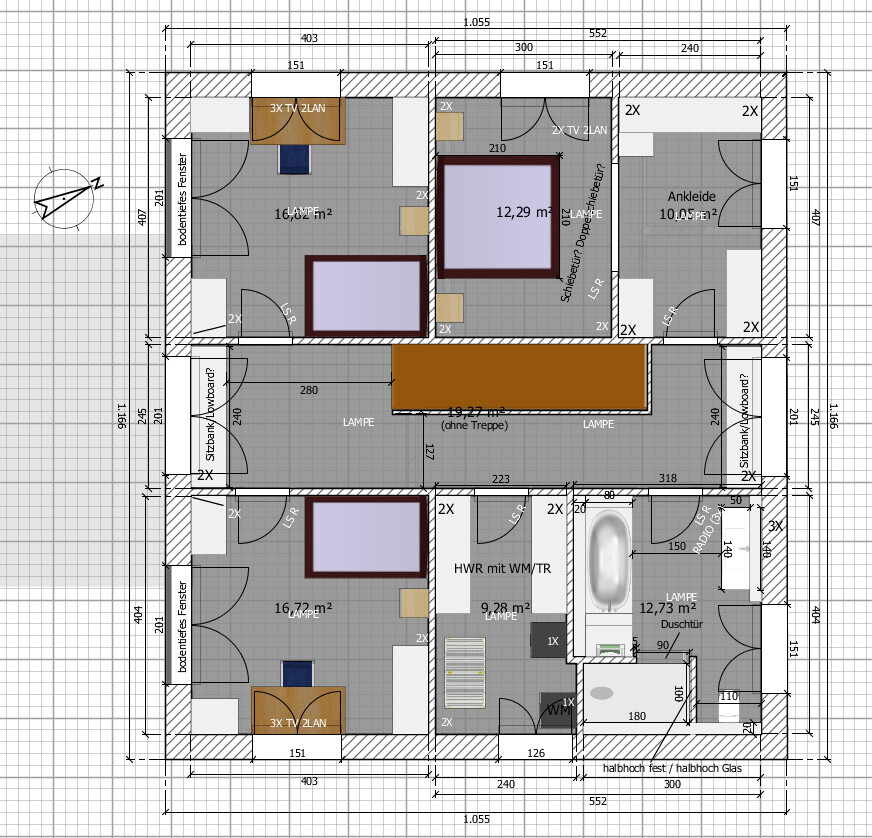
Ok, now let’s think about the topic from a practical perspective. I’m quite familiar with KNX, but I can’t really come up with a scenario where KNX would clearly benefit us. Here are our floor plans again:
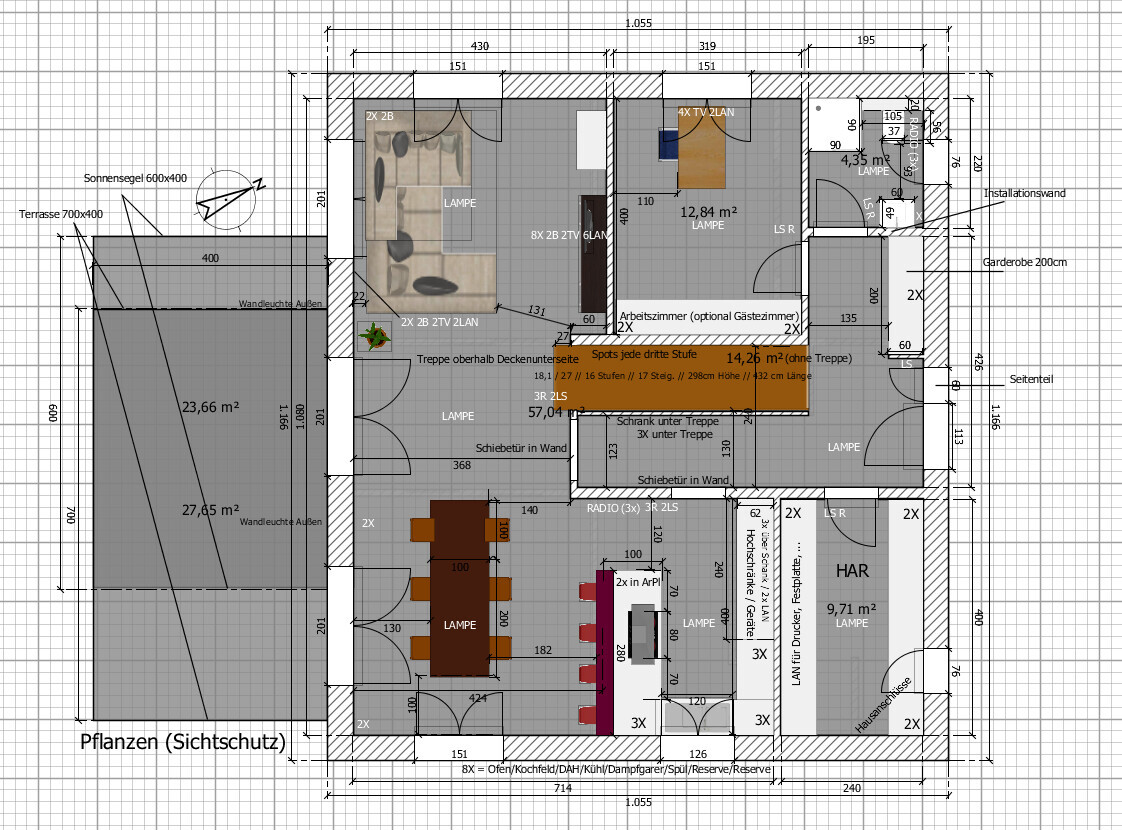
According to the current planning status, roller shutters will be installed everywhere (current planning status!). There will be a large sun sail to shade the central window and the dining room window from the sun. The dining room window facing east and the kitchen window will be in the shade shortly after noon.
A heat pump with cooling function and a ground loop exchanger for the controlled ventilation system are planned. Simple logic functions, such as bypass for the controlled ventilation or controlling the underfloor heating based on outside and return temperatures, are handled by the devices themselves. In winter, when the sun heats the floor, the return flow temperature rises, and the heat pump realizes it needs to heat less because of the external heat input. The ventilation system detects when the bypass should be activated.
Individual room control is pointless, or so everyone says in the pink forum. At least for our KfW55-standard building, it’s probably very unnecessary. Night setback is also not needed.
Energy-saving functions don’t interest me because the investment cost will always be higher than the electricity savings. Conventional smoke detectors will be installed, and please no hysterical discussions about this. There will be no gas, oil, or fireplace in the house. And if the house burns down while we’re away, it’s insured. There will be no photovoltaic system, and I’m not interested in any other extreme energy-saving measures. The washing machine has its own timer. Usually, we just load it in the afternoon and hang the laundry in the evening. It doesn’t need to run for three hours at night because of lower tariffs to save 0.3 cents per wash cycle.
The living/dining/kitchen area will have six roller shutters and four dimmable lights. Three shutters and two lights each will be controlled from switches next to the living room door and the kitchen door. The switches are arranged side by side so that the leftmost switch controls the left side of the room, and so on. So the west, south, and central living areas are controlled from the living room door; the south dining area, east dining area, and east kitchen are controlled from the kitchen door. For shading, only the two roller shutters next to the living room are relevant (south living room, as it is not under the sun sail, and west living room).
Currently, in the old building, we have internal blinds and a large west-facing facade. Apart from the five warmest days of the year, we don’t fully shade the windows. We just want to avoid direct sunlight where we are sitting, working, playing, etc. Depending on the situation, some blinds go up and others go down, and so on.
Constant light regulation is not desired. Even now, we switch lights on and off based on feeling. When we want to go to bed soon, the lights are usually off or more distant lights are on (kind of indirect lighting). I have different lighting preferences than my wife, and when we are together in the room, naturally, a compromise solution applies.
I sometimes work flexible hours, and sometimes I might sleep only four hours one night and seven hours the next day. A rule like “dim after xx o’clock” won’t work.
There is no defined TV lighting plan. It depends on the program. For briefly watching the news, all lighting can remain as is. For a moderately interesting football game, only the direct light is turned off, but indirect lighting can stay. For a ‘Game of Thrones’ episode or a good movie, everything should be off, especially since these often have dark scenes. Sometimes, for example, the hallway light stays on as indirect lighting for the living area (which makes sole hallway lighting with motion sensors pointless now).
Hallway lighting will have switches (two-way switches) next to each door, which can turn the lighting of the respective floor on and off. So yes, exactly one switch next to each door. The two lamps upstairs will switch on and off simultaneously. It is a floor-level switch. At stair landings, of course, there are exactly two switches: one for upstairs and one for downstairs. So, coming down the stairs, you can operate both switches to turn lights off upstairs and on downstairs. Or you turn off the upstairs light at the bottom of the stairs (top switch off = upstairs off; makes perfect sense to me).
Stair lighting could theoretically be controlled similarly, but that also depends a bit on the show effect, right? It could also be done with a timer or motion sensor. And if pets trigger the stair lighting, well, that’s just how it is. At the moment, we don’t have pets.
As for roller shutter control in the living/dining/kitchen areas, as I said before: short press for fully up/down and hold for precise positioning. But half-positioning is discouraged because temperature differences across the glass can cause damage. For example, next to the living room door, pressing the button three times briefly will raise (or lower) the three shutters. All other roller shutters follow the same principle and are arranged next to their respective doors. Only for bedrooms could I imagine a switch with a timer function, and I would only program the opening time for the next morning. I don’t need a closing time. A short press closes the roller shutter. But if I set my alarm clock to 6:53, I also set the roller shutter to 6:53 so that daylight wakes me at the same time (in the future, we will have joint wake-up times again, and my wife won’t have shift work anymore). BUT: all this can be done conventionally and very simply. So: the office (guest room), bedroom, and two children's rooms will have a switch (short = fully up/down) that allows an opening time to be set.
Just to summarize the shading logic during the day: roller shutters go down in the morning when leaving the room/living area and stay down until the first person returns home in the afternoon. This covers the first 10–12 hours of sunlight exposure.
The lighting in many rooms will be dimmable, but I don’t want expensive color lighting effects. The bulbs should have low blue light and good quality.
So, I think I’ve described the most important areas: roller shutters, lighting, heating, and a few other things...
How can automation like KNX help us now? What comfort gains are possible? What should we automate and why?
According to the current planning status, roller shutters will be installed everywhere (current planning status!). There will be a large sun sail to shade the central window and the dining room window from the sun. The dining room window facing east and the kitchen window will be in the shade shortly after noon.
A heat pump with cooling function and a ground loop exchanger for the controlled ventilation system are planned. Simple logic functions, such as bypass for the controlled ventilation or controlling the underfloor heating based on outside and return temperatures, are handled by the devices themselves. In winter, when the sun heats the floor, the return flow temperature rises, and the heat pump realizes it needs to heat less because of the external heat input. The ventilation system detects when the bypass should be activated.
Individual room control is pointless, or so everyone says in the pink forum. At least for our KfW55-standard building, it’s probably very unnecessary. Night setback is also not needed.
Energy-saving functions don’t interest me because the investment cost will always be higher than the electricity savings. Conventional smoke detectors will be installed, and please no hysterical discussions about this. There will be no gas, oil, or fireplace in the house. And if the house burns down while we’re away, it’s insured. There will be no photovoltaic system, and I’m not interested in any other extreme energy-saving measures. The washing machine has its own timer. Usually, we just load it in the afternoon and hang the laundry in the evening. It doesn’t need to run for three hours at night because of lower tariffs to save 0.3 cents per wash cycle.
The living/dining/kitchen area will have six roller shutters and four dimmable lights. Three shutters and two lights each will be controlled from switches next to the living room door and the kitchen door. The switches are arranged side by side so that the leftmost switch controls the left side of the room, and so on. So the west, south, and central living areas are controlled from the living room door; the south dining area, east dining area, and east kitchen are controlled from the kitchen door. For shading, only the two roller shutters next to the living room are relevant (south living room, as it is not under the sun sail, and west living room).
Currently, in the old building, we have internal blinds and a large west-facing facade. Apart from the five warmest days of the year, we don’t fully shade the windows. We just want to avoid direct sunlight where we are sitting, working, playing, etc. Depending on the situation, some blinds go up and others go down, and so on.
Constant light regulation is not desired. Even now, we switch lights on and off based on feeling. When we want to go to bed soon, the lights are usually off or more distant lights are on (kind of indirect lighting). I have different lighting preferences than my wife, and when we are together in the room, naturally, a compromise solution applies.
I sometimes work flexible hours, and sometimes I might sleep only four hours one night and seven hours the next day. A rule like “dim after xx o’clock” won’t work.
There is no defined TV lighting plan. It depends on the program. For briefly watching the news, all lighting can remain as is. For a moderately interesting football game, only the direct light is turned off, but indirect lighting can stay. For a ‘Game of Thrones’ episode or a good movie, everything should be off, especially since these often have dark scenes. Sometimes, for example, the hallway light stays on as indirect lighting for the living area (which makes sole hallway lighting with motion sensors pointless now).
Hallway lighting will have switches (two-way switches) next to each door, which can turn the lighting of the respective floor on and off. So yes, exactly one switch next to each door. The two lamps upstairs will switch on and off simultaneously. It is a floor-level switch. At stair landings, of course, there are exactly two switches: one for upstairs and one for downstairs. So, coming down the stairs, you can operate both switches to turn lights off upstairs and on downstairs. Or you turn off the upstairs light at the bottom of the stairs (top switch off = upstairs off; makes perfect sense to me).
Stair lighting could theoretically be controlled similarly, but that also depends a bit on the show effect, right? It could also be done with a timer or motion sensor. And if pets trigger the stair lighting, well, that’s just how it is. At the moment, we don’t have pets.
As for roller shutter control in the living/dining/kitchen areas, as I said before: short press for fully up/down and hold for precise positioning. But half-positioning is discouraged because temperature differences across the glass can cause damage. For example, next to the living room door, pressing the button three times briefly will raise (or lower) the three shutters. All other roller shutters follow the same principle and are arranged next to their respective doors. Only for bedrooms could I imagine a switch with a timer function, and I would only program the opening time for the next morning. I don’t need a closing time. A short press closes the roller shutter. But if I set my alarm clock to 6:53, I also set the roller shutter to 6:53 so that daylight wakes me at the same time (in the future, we will have joint wake-up times again, and my wife won’t have shift work anymore). BUT: all this can be done conventionally and very simply. So: the office (guest room), bedroom, and two children's rooms will have a switch (short = fully up/down) that allows an opening time to be set.
Just to summarize the shading logic during the day: roller shutters go down in the morning when leaving the room/living area and stay down until the first person returns home in the afternoon. This covers the first 10–12 hours of sunlight exposure.
The lighting in many rooms will be dimmable, but I don’t want expensive color lighting effects. The bulbs should have low blue light and good quality.
So, I think I’ve described the most important areas: roller shutters, lighting, heating, and a few other things...
How can automation like KNX help us now? What comfort gains are possible? What should we automate and why?
S
Sebastian7927 Aug 2016 09:51At some point, it becomes creepy
Sebastian79 schrieb:
I don’t understand the thread – with that mindset you would never install any automation, and Grym typically explains everything so logically for himself that any counterargument just gets dismissed.
Just do everything exactly the way you want it and then you’ll be satisfied.
Instead of a two-way switch wiring, I would recommend impulse relay control – it’s nicer anyway .KNX or other automation systems always depend heavily on personal usage habits. I've now put together our "planned" usage habits and am wondering how KNX/automation could help me?Tom1607 schrieb:
I’m in the same boat as Sebastian, I don’t understand what you want.
If you’ve looked into KNX, you know the possibilities. If you don’t need them, just go with a traditional setup. The advantage of KNX is group switching and automation. If you don’t want or need that, just build traditionally.I don’t see the added value so far. Heating makes it warm in winter. Cooling keeps it cool in summer. Ventilation provides fresh air and prevents mold. It saves me 30-60 minutes of ventilating every day.Personally, I’m a supporter of KNX, but if someone doesn’t need it, why should they be persuaded? That’s the impression this thread gives me.I don’t want to completely rule anything out in the house build, so I want to understand what KNX/automation can do for me.The benefits for blinds would be, for example, that you a) can raise and lower them automatically, b) create any groups you like. For example, all blinds on the west or south side.Now I’m wondering in what other tricky ways automation could reflect our usage habits? A south group wouldn’t make sense because the south-facing living room isn’t under the sunshade, but the other two are.Another advantage of KNX is that it reduces the number of switches. For example, in my case I have 6 blinds in the living room, so the scenes and group functions of KNX are very convenient. One button activates a specific scene, e.g. watching TV, blinds down, lights dimmed (or hallway light on ).This might sound strange, but I don’t want to lose control. Each blind should be individually controllable according to our needs. So we would still install all switches/dimmers. In our case, 3 blind switches and 2 dimmers next to the living room door, and 3 blind switches and 2 dimmers next to the kitchen door.Sure, you can do it traditionally by going to each window and pressing the switch, then going to the hallway and turning on the light.I would obviously put the blind switches next to the door. To me, blinds are light, so they belong with the light switches.The result is the same. Or you press five switches. I have 6 blinds and 4 ceiling lights in the living room. That would be 10 traditional switches or a single KNX switch like the MDT Smart 2 for €113 that fits into a flush-mounted box. With that, I can control everything individually or by scene—whatever suits me at the moment. And I don’t have two separate rows of five switches on the wall.Ah, okay, I’ll take a look at that one.There are many more things you can do with it. Many come to mind only once you actually live in the house. And since the wiring is different from a traditional setup, you have more options later.Well, if I decide later that I want to turn on light 3 when window 5 opens, I’d need a window contact on window 5. If that wasn’t planned from the start, it won’t be there.With a traditional installation, the cable runs from the distribution box to the switch and then from the switch to the ceiling. With KNX, the cable runs directly from the distribution box to the ceiling. This simplifies installation and makes it easier later to change the function. The same basically applies to power outlets and other loads. And of course, also to blinds.So with KNX, everything is just run from the electrical panel to the endpoint? Okay. Then it’s connected in the panel and still needs to be programmed, or does it work automatically?EinMarc schrieb:
For me, there’s one clear reason to go KNX/central control that can’t be beaten:
Central OFF at the front doorThat would be an option. But you’d have to reprogram it regularly because sometimes you charge your phone here, sometimes there. I wouldn’t want charging a phone to be linked to central off. Or is it really only for the stove?I’ve heard too many dramatic and tragic stories of burned-down houses whose owners weren’t at fault at all, so I want to avoid that as much as possible.I’ve never heard of a case and in all the new build areas we visited, I never saw a burned-down house. Do you work for the fire department?"If it burns down, I’m insured" is an attitude only someone who has never faced the actual consequences of a fire could have.Because it’s quite unrealistic. I didn’t want to start a hysteria discussion about it.BeHaElJa schrieb:
Just guessing – whether KNX can do this or not:
Door opens by facial recognitionSure, you can do that, but talking about comfort: the desired function of a heating system is to provide warmth when needed. The desired function of the front door is to open for authorized people from inside and outside, whether by key or facial recognition!?House detects whether people are still inside and switches off certain sockets otherwiseFor what purpose?House shows central power consumption (detecting forgotten devices or standby consumers)For what reason? Why? I get a yearly bill in the end, and it’s not high enough to warrant major savings.Intelligent presence simulation (with a certain random factor)I thought that topic was already settled? No burglar surveils a house for days where maybe €120 cash and some jewelry might be found. In doubt, they ring the doorbell, and if someone answers, they pretend to be Jehovah’s Witnesses. If no one answers, the house is empty.Light level is measured – light adjusts automatically (on/off/brighter)If at the same time my desired brightness level is measured, okay. I said constant lighting control is not wanted. Depending on mood, tiredness, and activity, light should vary.Phone calls run through voice control and speakers/microphones installed in rooms (house recognizes where the person is)The function was and still is phone calls. Like door opening by facial recognition, it gains me nothing. Also, I might not want everyone to overhear my calls – say, when we’re discussing the child’s birthday present.S
Sebastian7927 Aug 2016 10:04It’s simply not for you – I would move on from this topic and go to the next one.

Yes, I would do the same...
Every argument in favor always gets the same response: I don’t need it and my habits can’t be mapped.
Batteries for switches are also preferred...
So home automation is simply nonsense because you are opposed to it from the start.
Nothing will come of it later either. What I mean is, if you did install one... you would only end up frustrated, and it definitely wouldn’t work as you want.
I assume you have studied KNX extensively? Then questions like that wouldn’t even come up... that really is basic knowledge. (If you have worked with KNX)
Every argument in favor always gets the same response: I don’t need it and my habits can’t be mapped.
Batteries for switches are also preferred...
So home automation is simply nonsense because you are opposed to it from the start.
Nothing will come of it later either. What I mean is, if you did install one... you would only end up frustrated, and it definitely wouldn’t work as you want.
Grym schrieb:
So with KNX, everything is just pulled from the electrical distribution board to the connection point? Okay. Then it’s connected together in the distribution board but still needs programming or does it just work like that?
I assume you have studied KNX extensively? Then questions like that wouldn’t even come up... that really is basic knowledge. (If you have worked with KNX)
Mycraft schrieb:
For every argument in favor, the response is always: I don’t need that and my habits can’t be mapped. Well, maybe it can be mapped 'somehow' after all? I haven’t gone through every single sensor and actuator and whatever else yet. First, I’m trying to put into words a logic that would make sense. That’s where it already fails.
Switch batteries are also desired... Well, fine, it could be a wall-mounted tablet or a multifunctional glass switch like Tom described. The main thing is that everything can still be controlled.
So home automation is just nonsense because you’re basically against it from the start. I’m looking for reasons to be in favor.
But I don’t want it to be just a gimmick. Like, oh look, I can lower the blinds by voice command instead of pressing a button here. Oh look, I set the dining scene (tablet on, scene selection, dining scene, tablet off = 4 actions) instead of turning on the light here and dimming it there (dining light up; kitchen light down = 2 actions). But maybe beyond gimmicks, there is real benefit?
So maybe I can imagine 2-3 central functions at the entrance. You could display the status of all blinds, lower them all with one button press, and show the open/closed status of all windows. You could turn off the stove and other critical devices centrally (with status display showing if the stove is on/off). But that alone doesn’t justify a full KNX installation, does it? For these 2-3 central functions, which in my opinion really offer a comfort improvement, I’d install KNX. And with the display of window status for each window and with stove plus critical devices on/off, I have really gained two new functions (blinds and lighting I can switch with KNX as well as with conventional systems...).
Grym schrieb:
Well, maybe it can be mapped ‘somehow’ after all? I haven’t yet dealt with every single sensor and actuator and whatnot. I’m trying to put a logical concept into words that would make sense. That’s where I’m stuck.Yes, most things can be mapped... with 350 manufacturers and millions of devices offering a wide range of functions, you’re sure to find something for your needs.
Grym schrieb:
Well, I don’t mind a tablet mounted on the wall or a multifunctional glass switch like Tom described.I already advised you in the other thread to move away from tablets... that’s probably the worst starting point you can imagine for automation and control. It doesn’t make things easier, it just looks good... over time, when you want more, you can add a touch panel/tablet/PC or whatever on the wall to monitor and control the house.
Grym schrieb:
The main thing is that everything can still be controlled.If you want to, everything can be controlled manually. The only limits are in your mind and your budget.
Like my example with the kitchen... I can manually operate or trigger 17 functions from one place... but in reality, only a few buttons are manually pressed because everything else runs automatically.
Sure, I might have thought conventionally and just wanted fewer switch functions in the kitchen...
Grym schrieb:
But maybe there’s a real benefit beyond just playing around?I have never seen it as just playing around, because it isn’t. In my opinion, it’s simply more comfortable to press one button instead of four... or even none if I just want to go from the sofa to the bathroom. However, I don’t want to walk there in the dark... and if I (or you) don’t want the light on, the presence detector simply gets disabled.
Now, regarding central functions and group switching:
This is where the biggest cost and effort occur with conventional electrical wiring.
Because you have to rely on additional modules, which can make installation very expensive, often costing as much or more than some kind of bus system.
How do you want to handle your 19 roller shutters?
- Are you going to open and close them all manually every evening and morning?
- Will you install a timer switch for each shutter? (Costs)
- Will you set up group switching? (e.g., per floor, with additional costs)
- Or will you install one central switch for everything?
All four options are quite rigid and not very convenient. Anything else using conventional methods becomes extremely expensive and complicated. A central switch means many more cables and numerous separation relays (if you stick to conventional wiring). Of course, everything can be done wirelessly and then controlled by wireless central units placed strategically, but do you really want that in a new build?
With bus systems (regardless of which one), you can easily place switches or other control elements anywhere in the house and group your roller shutters as you like and control them from there.
For example:
- Central switches at the front door/bedroom/living room, etc.
- Group switches at the front door/bedroom/living room, etc.
And the best part is:
The switches can be reprogrammed. So if today you want one setup but six months from now want it differently, you just grab your laptop and in 10 minutes the switch will have different functions...
And later you can also MONITOR and control everything on your tablet/phone/workstation.
With conventional wiring, everything stays the same and you really have to plan everything now for how you want it in 10 years. Unless you tear down walls and lay new cables again.