
A
abc1507813 Jul 2016 12:32Hello everyone,
this is my first post in the forum, so please bear with me if not everything is described correctly.
Last November, we bought a house from the 1970s, with an extension from the 1980s that needs renovation.
On May 30th, we experienced heavy rainfall events in NRW, which caused water to enter the basement (about 3cm (1 inch) deep). In the meantime, we found out that the water came through the masonry. After drying the interior, we started working on waterproofing the basement from the outside. During this process, we noticed that a bitumen layer had already been applied, as well as polystyrene insulation. Overall, the basement is dry.
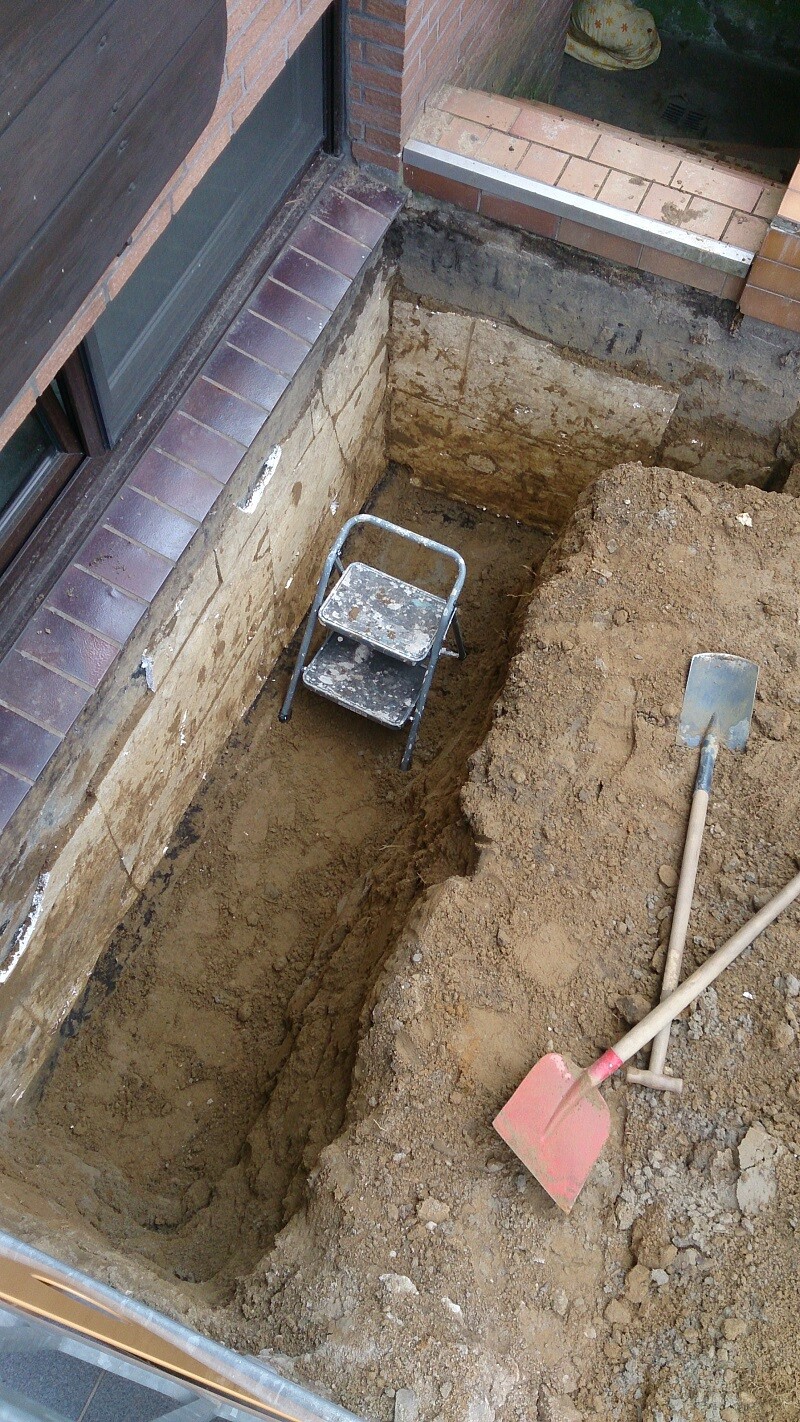
Now to the main questions. What is the best way to proceed? I have already excavated the ground down to the horizontal damp-proof course and removed the old polystyrene. On the web, I found two products that seem suitable for exterior wall repair.
1. pci barraseal® turbo
2. MEM Express-Dicht
Which of these two products is better suited for the work?
I would also like to renew the insulation. What do you suggest here?
Attached are some photos for a better understanding.
Thanks in advance for your help and advice.
Best regards
Patrick
this is my first post in the forum, so please bear with me if not everything is described correctly.
Last November, we bought a house from the 1970s, with an extension from the 1980s that needs renovation.
On May 30th, we experienced heavy rainfall events in NRW, which caused water to enter the basement (about 3cm (1 inch) deep). In the meantime, we found out that the water came through the masonry. After drying the interior, we started working on waterproofing the basement from the outside. During this process, we noticed that a bitumen layer had already been applied, as well as polystyrene insulation. Overall, the basement is dry.
Now to the main questions. What is the best way to proceed? I have already excavated the ground down to the horizontal damp-proof course and removed the old polystyrene. On the web, I found two products that seem suitable for exterior wall repair.
1. pci barraseal® turbo
2. MEM Express-Dicht
Which of these two products is better suited for the work?
I would also like to renew the insulation. What do you suggest here?
Attached are some photos for a better understanding.
Thanks in advance for your help and advice.
Best regards
Patrick
B
Bauexperte3 Jul 2016 18:53Hello Patrick,
I am always surprised when non-professionals take on tasks that, based on my professional experience, should only be handled by specialists!
Find an expert who is familiar with existing buildings and masonry before relying on half-knowledge and recommendations from the internet. This will of course cost money *upfront*, but it will ensure you take the right steps and ultimately enjoy your renovation project!
Regards, Bauexperte
I am always surprised when non-professionals take on tasks that, based on my professional experience, should only be handled by specialists!
abc150781 schrieb:Your basement cannot be both dry on one hand and have 3cm (1.2 inches) of standing water on the other. Water always finds its way – the cause of water ingress can be anything imaginable. It is also important to consider that a building structure from the 1970s requires a different type of renovation than a house from the 1990s, and so on.
What do you suggest here?
Find an expert who is familiar with existing buildings and masonry before relying on half-knowledge and recommendations from the internet. This will of course cost money *upfront*, but it will ensure you take the right steps and ultimately enjoy your renovation project!
Regards, Bauexperte

A
abc1507814 Jul 2016 07:17Neige schrieb:
Here I can already see what I consider a serious and dangerous mistake. The excavation pit is not secured.The excavation pit was unsecured only for a short time. In the meantime, there are boards protecting the pit.
Bauexperte schrieb:
...
Your basement cannot be both dry and at the same time have 3cm (1 inch) of standing water. Water always finds its way – the cause of the water ingress can be any imaginable reason.
...
Regards, BauexperteWe were able to observe the water ingress ourselves four weeks after the first incident. In front of the basement window there was a drainage shaft where the water flowed in. Since the bond between the bitumen layer and the polystyrene insulation was partly failing, water was able to penetrate between them. Eventually, the soil beneath could no longer absorb the water, and it was pushed through the masonry into the interior. This could only happen because the bitumen layer also had some cracks.
Bauexperte schrieb:
...
Find an expert who is familiar with existing buildings and masonry before you rely on half-knowledge from the internet and recommendations. That certainly costs money *up front*, but it ensures you take the right steps and enjoy your old building!
...
Regards, BauexperteIn principle, I agree with you. Some things really should be left to the professionals. However, it is always a matter of cost. The materials cost me about 200 - 300€ (approximately 220 - 330 USD). If I were to have a specialist company do the work, the cost would be about ten times higher.
@ALL:
Regarding my original question: Which manufacturer or product would you prefer?

Hello Patrick,
are you planning to just apply that material directly, install insulation in front, and then backfill?
I would make sure the water drains properly first, so a drainage system is needed. Then everything has to be properly protected (dimpled membrane, geotextile fabric) and compacted in layers. This isn’t something you do for $300.
Better to do it right now (and maybe spend more money) than have to redo everything in two years.
Listen to @Bauexperte and get professional expertise.
are you planning to just apply that material directly, install insulation in front, and then backfill?
I would make sure the water drains properly first, so a drainage system is needed. Then everything has to be properly protected (dimpled membrane, geotextile fabric) and compacted in layers. This isn’t something you do for $300.
Better to do it right now (and maybe spend more money) than have to redo everything in two years.
Listen to @Bauexperte and get professional expertise.
Hello
Now don’t be too hard on Patrick. When someone buys a house, they are often short on cash at first and cannot afford to spend several thousand euros (or equivalent). Or they simply don’t want to. Taking initiative is definitely commendable.
I’m just an amateur myself, but quite interested and have helped build on three houses so far.
1. Properly securing the excavation pit is important. If the soil shifts, it can be deadly.
2. I believe I can see the foundation at the bottom of the pit. It needs to be uncovered, and the tanking (also called waterproofing or damp-proofing) should be applied from there upwards. Thorough cleaning of the wall is essential.
3. The installation of the tanking is important. Your building materials supplier can offer competent advice here.
4. Maybe it’s worth spending some money on an expert. Possibly you can agree with them to identify the cause and propose a solution. Then roll up your sleeves and handle it yourself.
5. What you do yourself makes you proud, and you tend to do it right (as long as you know what needs to be done).
Steven
Now don’t be too hard on Patrick. When someone buys a house, they are often short on cash at first and cannot afford to spend several thousand euros (or equivalent). Or they simply don’t want to. Taking initiative is definitely commendable.
I’m just an amateur myself, but quite interested and have helped build on three houses so far.
1. Properly securing the excavation pit is important. If the soil shifts, it can be deadly.
2. I believe I can see the foundation at the bottom of the pit. It needs to be uncovered, and the tanking (also called waterproofing or damp-proofing) should be applied from there upwards. Thorough cleaning of the wall is essential.
3. The installation of the tanking is important. Your building materials supplier can offer competent advice here.
4. Maybe it’s worth spending some money on an expert. Possibly you can agree with them to identify the cause and propose a solution. Then roll up your sleeves and handle it yourself.
5. What you do yourself makes you proud, and you tend to do it right (as long as you know what needs to be done).
Steven
Similar topics