
ᐅ Insufficient concrete cover in basement "white tank" construction
Created on: 27 Jan 2023 19:51
D
domino55
Hello everyone,
The structural shell contractor agreed to build a basement using cast-in-place concrete. According to the reinforcement plan from the structural engineer, it concerns a “white tank” (watertight concrete structure). The reinforcement plan specifies the following concrete cover:
Reinforced concrete walls at the base area:
On the east side, a minimum cover of 16 mm (0.63 inches), on the west side 14 mm (0.55 inches), and on the south side 7 mm (0.28 inches) was found.
The basement walls will be insulated with 12 cm (4.7 inches) XPS insulation.
The contractor offers the following remedial measures:
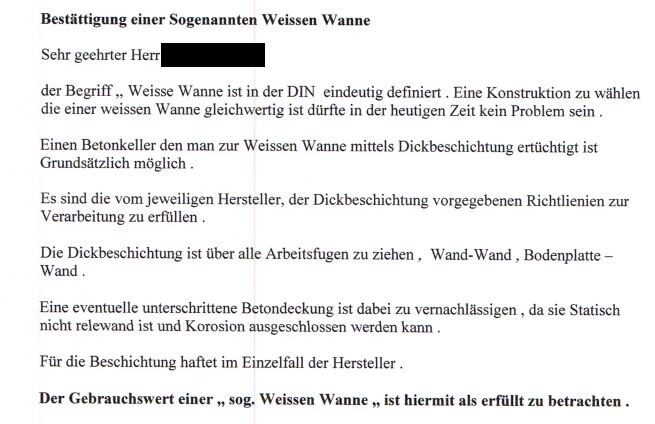
The structural contractor obtained the following letter from their own structural engineer, recommending reactive waterproofing:
Is what the structural engineer states correct?
Best regards
The structural shell contractor agreed to build a basement using cast-in-place concrete. According to the reinforcement plan from the structural engineer, it concerns a “white tank” (watertight concrete structure). The reinforcement plan specifies the following concrete cover:
- Base slab: 4.0 cm (1.6 inches)
- Basement walls: 3.5 cm (1.4 inches)
Reinforced concrete walls at the base area:
On the east side, a minimum cover of 16 mm (0.63 inches), on the west side 14 mm (0.55 inches), and on the south side 7 mm (0.28 inches) was found.
The basement walls will be insulated with 12 cm (4.7 inches) XPS insulation.
The contractor offers the following remedial measures:
- Reactive waterproofing
- Epoxy resin
- Shotcrete
The structural contractor obtained the following letter from their own structural engineer, recommending reactive waterproofing:
| Confirmation of a So-Called White Tank Dear Mr. XXXXX, The term “white tank” is clearly defined in the DIN standard. Choosing a construction equivalent to a white tank should not pose a problem nowadays. In principle, it is possible to waterproof a concrete basement as a white tank by means of a thick coating. The processing guidelines specified by the respective manufacturer of the thick coating must be followed. The thick coating must be applied over all construction joints: wall-to-wall and base slab-to-wall. Any insufficient concrete cover can be disregarded since it is not structurally relevant and corrosion can be excluded. The manufacturer is solely responsible for the coating’s performance in each individual case. The serviceability of a “so-called white tank” can hereby be considered fulfilled. |
Is what the structural engineer states correct?
Best regards
Allthewayup schrieb:
A real watertight concrete structure involves quite a bit more, which I won’t list here. Returning to your soil survey report: I’m quite surprised that groundwater was found at 19 m (62 feet). I remember the heavy dynamic probing only went down to a maximum depth of 7 m (23 feet). What were they looking for at depth, oil? Anyway. Not 19 m (62 feet) as I had mistakenly noted, but 25–27 m (82–89 feet).
Quote from the soil survey report:
After completing the exploratory work on 15.01.2021 and 01.02.2021, no groundwater level was measured during investigations down to the maximum exploration depth of 3.00 m (10 feet) below ground level, or -2.76 m (-9 feet) relative height. Only in test pit SCH 1 was a perched water horizon encountered at a depth of 1.20 m (4 feet) below finished ground level.
According to the Bavarian State Office for the Environment /U 9/, the groundwater level in the area of the construction project is indicated at approximately 303 to 305 m (993 to 1,001 feet) NHN or 25 to 27 m (82 to 89 feet) below ground in the bedrock (sandstone).
Allthewayup schrieb:
What does the soil survey say about the waterproofing of earth-contact components like the basement in general? It should say something like: “clayey soil, therefore periodically standing/pressure groundwater, load case 1, recommendation for waterproof construction,” or something similar. It doesn’t explicitly mention a “watertight concrete structure” in the soil survey report, but this is a new development area where all neighbors are building watertight concrete basements. There are already neighbors who didn’t build watertight basements and have experienced basement water damage.
A
Allthewayup27 Jan 2023 23:01Okay. Let’s look at this objectively again:
No one here except you knows the exact wording of the contract.
No one here except you knows the exact wording of the soil report.
Before you waste unnecessary time or make a hasty decision based on well-meaning advice here in the forum (including mine), consult an expert.
We also didn’t think it could happen to us, but we had to accept the situation and hire a professional to carry out an inspection.
This is about 1) a technically sound basement and 2) a significant amount of money.
Only a certified expert can fully assess your situation and tell you what you can do now. The forum might at best comfort you or cause you to panic. Neither will help you move forward.
No one here except you knows the exact wording of the contract.
No one here except you knows the exact wording of the soil report.
Before you waste unnecessary time or make a hasty decision based on well-meaning advice here in the forum (including mine), consult an expert.
We also didn’t think it could happen to us, but we had to accept the situation and hire a professional to carry out an inspection.
This is about 1) a technically sound basement and 2) a significant amount of money.
Only a certified expert can fully assess your situation and tell you what you can do now. The forum might at best comfort you or cause you to panic. Neither will help you move forward.
H
hanghaus202328 Jan 2023 09:38Is this a prefabricated basement?
Is the house already built?
Who determined the concrete cover and how?
In my opinion, sealing only the joints doesn’t make sense. The minimum concrete cover is probably present on the wall surface.
Renovation, price reduction, 30 years warranty, and warranty retention (bank guarantee) are the minimum requirements.
The expert will tell you exactly how the renovation should be carried out.
Is the house already built?
Who determined the concrete cover and how?
In my opinion, sealing only the joints doesn’t make sense. The minimum concrete cover is probably present on the wall surface.
Renovation, price reduction, 30 years warranty, and warranty retention (bank guarantee) are the minimum requirements.
The expert will tell you exactly how the renovation should be carried out.
It is a basement made of cast-in-place concrete.
The basement is not yet finished. It should be insulated soon and the excavation backfilled.
The concrete cover was measured by an engineering firm using a reinforcement locator (Hilti PS 200 S Ferroscan).
The minimum concrete cover is located on the lower base area of the basement exterior wall (outside), just above the floor slab.
Are there any examples of renovations and the amount of price reductions known?
The basement is not yet finished. It should be insulated soon and the excavation backfilled.
The concrete cover was measured by an engineering firm using a reinforcement locator (Hilti PS 200 S Ferroscan).
The minimum concrete cover is located on the lower base area of the basement exterior wall (outside), just above the floor slab.
Are there any examples of renovations and the amount of price reductions known?
H
hanghaus202328 Jan 2023 11:24The engineering firm that measured the concrete cover is your contact person. They should be able to advise you on professional repair methods. The structural engineer of the contractor has already mentioned three options to you.
It is best to clarify legal questions with a lawyer.
It is best to clarify legal questions with a lawyer.
A
Allthewayup28 Jan 2023 15:12hanghaus2023 schrieb:
Renovation, price reduction, 30 years warranty and retention of warranty (bank guarantee) are the minimum requirements. Depending on how large the actual deviation is from the expected one and how serious the technical issues are at this early stage of construction, it might even be necessary to consider demolition. This is something the expert assessor should clarify. If the basement does not comply with the current technical standards, you might face a lifelong exclusion from your building and natural hazard insurance. After the 30 years (which in practice are rarely accepted by the general contractor), you bear the full risk for the rest of your life. If you sell the house beforehand, you will incur a significant price reduction on the entire property if you have to disclose that the basement does not meet the requirements for the applicable design load case.
In short: It is not about the value of the basement alone, but about the value of the entire house with land, and the lifelong risk of damage originating from the basement.
By the way, we are facing the same dilemma, except that in our case the roof is already on the shell structure, which complicates matters.
hanghaus2023 schrieb:
The engineering firm that measured the concrete cover is your contact. They should be able to advise you on how to carry out a professional renovation. The structural engineer of the contractor has already mentioned three possible options to you.
Legal questions are best clarified with a lawyer. If I understand correctly, the engineering firm was not hired by the original poster but by the contractor. Therefore, I see little point in asking them now about possible renovation options.
From now on, your main contacts should be the expert assessor and, once the facts are established, possibly— as the colleague already suggested—a lawyer as well.
Personally, I sympathize with you. For us, the “worst case” has basically been confirmed, and we are meeting alternately with experts and attorneys. That is why I strongly advise you: Consult an expert assessor, preferably a publicly appointed and sworn expert, since no one would question their neutrality and their statements would hold up in court if necessary—which does not mean it has to come to that.
Similar topics