
Hello
I hope you can help me.
We have built with Ytong blocks that are placed directly on the concrete slab (the waterproofing membrane is, of course, still under the blocks). The first row of blocks is below ground level, and moisture got into this lowest layer during the winter, causing the Ytong to disintegrate. We then removed all the loose material, filled it with concrete, replastered, and applied a black waterproofing sealant. This held up until the next winter, when it froze again—the concrete did not properly bond with the Ytong block.
Now we have installed drainage to prevent water from rising so high.
What should I use to replace the damaged Ytong, and how should I plaster and waterproof it to prevent moisture from getting in again?
Here is a picture for better understanding:
Thank you very much in advance
Best regards, Mark
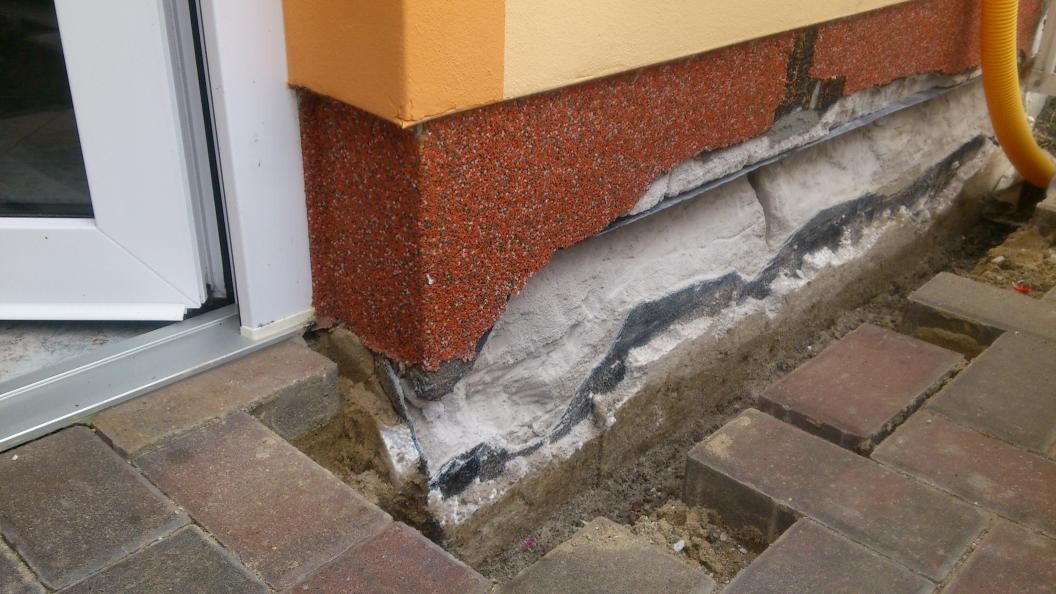
I hope you can help me.
We have built with Ytong blocks that are placed directly on the concrete slab (the waterproofing membrane is, of course, still under the blocks). The first row of blocks is below ground level, and moisture got into this lowest layer during the winter, causing the Ytong to disintegrate. We then removed all the loose material, filled it with concrete, replastered, and applied a black waterproofing sealant. This held up until the next winter, when it froze again—the concrete did not properly bond with the Ytong block.
Now we have installed drainage to prevent water from rising so high.
What should I use to replace the damaged Ytong, and how should I plaster and waterproof it to prevent moisture from getting in again?
Here is a picture for better understanding:
Thank you very much in advance
Best regards, Mark
B
Bauexperte8 Aug 2013 22:58Hello Mark,
Did you build the shell structure in EL?
Regards, Bauexperte
Did you build the shell structure in EL?
Kawa02 schrieb:No bitumen thick coating or perimeter insulation used?
So we used Ytong blocks that are placed directly on the slab (the waterproof membrane is, of course, still under the blocks). The first layer of blocks is below ground level, and moisture penetrated this lowest layer during winter, causing the Ytong to crumble.
Regards, Bauexperte
Yes, it was an electrician but with professionals from the field.
The problem was not the waterproofing, which was fine. The issue was that the paving stones went right up to the house wall and expanded due to frost, which then pierced the protective layer, allowing moisture to seep in.
The problem was not the waterproofing, which was fine. The issue was that the paving stones went right up to the house wall and expanded due to frost, which then pierced the protective layer, allowing moisture to seep in.
Hi
I would repair that again, ask your building material supplier what is suitable, or contact the manufacturer of the bricks directly. Then properly protect it with a bituminous thick coating and perimeter insulation, and avoid laying the paving directly against the house wall. It’s better to place an edging strip about 10 cm (4 inches) away from the wall and carefully fill the space between the edging strip and the perimeter insulation with crushed stone, then gravel, and finally pebbles or similar material. This way, the paving can no longer break through. It’s some effort, but then you’ll have no more problems.
I would repair that again, ask your building material supplier what is suitable, or contact the manufacturer of the bricks directly. Then properly protect it with a bituminous thick coating and perimeter insulation, and avoid laying the paving directly against the house wall. It’s better to place an edging strip about 10 cm (4 inches) away from the wall and carefully fill the space between the edging strip and the perimeter insulation with crushed stone, then gravel, and finally pebbles or similar material. This way, the paving can no longer break through. It’s some effort, but then you’ll have no more problems.
Hi, yes, this is roughly how we did it: filled with concrete, installed drainage, placed a dimpled membrane in front, and stopped laying the paving stones right at the wall.
Now we just have to keep our fingers crossed during winter; otherwise, a company might have to deal with it next time.
Best regards, Mark
Now we just have to keep our fingers crossed during winter; otherwise, a company might have to deal with it next time.
Best regards, Mark
Similar topics