
ᐅ Withholding Payments for Defects in the Shell Construction Phase
Created on: 9 Feb 2021 16:57
K
Kishihmen
Hello everyone,
The ceiling above the ground floor has just been concreted on our site. According to the payment schedule, a partial payment of approximately €30,000 is due.
However, our expert has identified several defects. These were formally reported to the general contractor (GC) with deadlines. The first deadline (2 weeks) passed without the defects being resolved; the second deadline is still running until Thursday (also 2 weeks).
So far, we have withheld about €17,000 of the €30,000. Our GC considers this amount far too high and insists on payment.
Since we are currently concerned about the potential insolvency of the GC (the structural builder, brick supplier, steel supplier, and light well supplier have not been paid), we want to keep the deduction as high as possible. However, since we are not construction professionals and want to avoid the risk that withholding too much for defects could backfire, I hope that some experts here can provide us with a rough cost estimate.
P.S. Our lawyer has been contacted, but the appointment is only scheduled for 17.02, and I fear we cannot hold off the GC until then.
Defect 1:
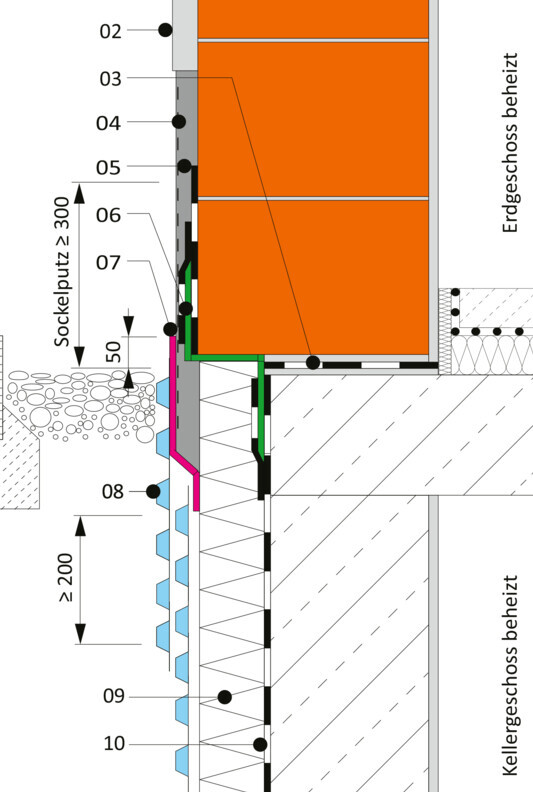
At the transition between the basement and the ground floor, no damp-proof course was installed at the base of the first course of blocks.
The basement is already fully lined with Styrodur insulation, and the excavation pit has been backfilled.
Defect 2:
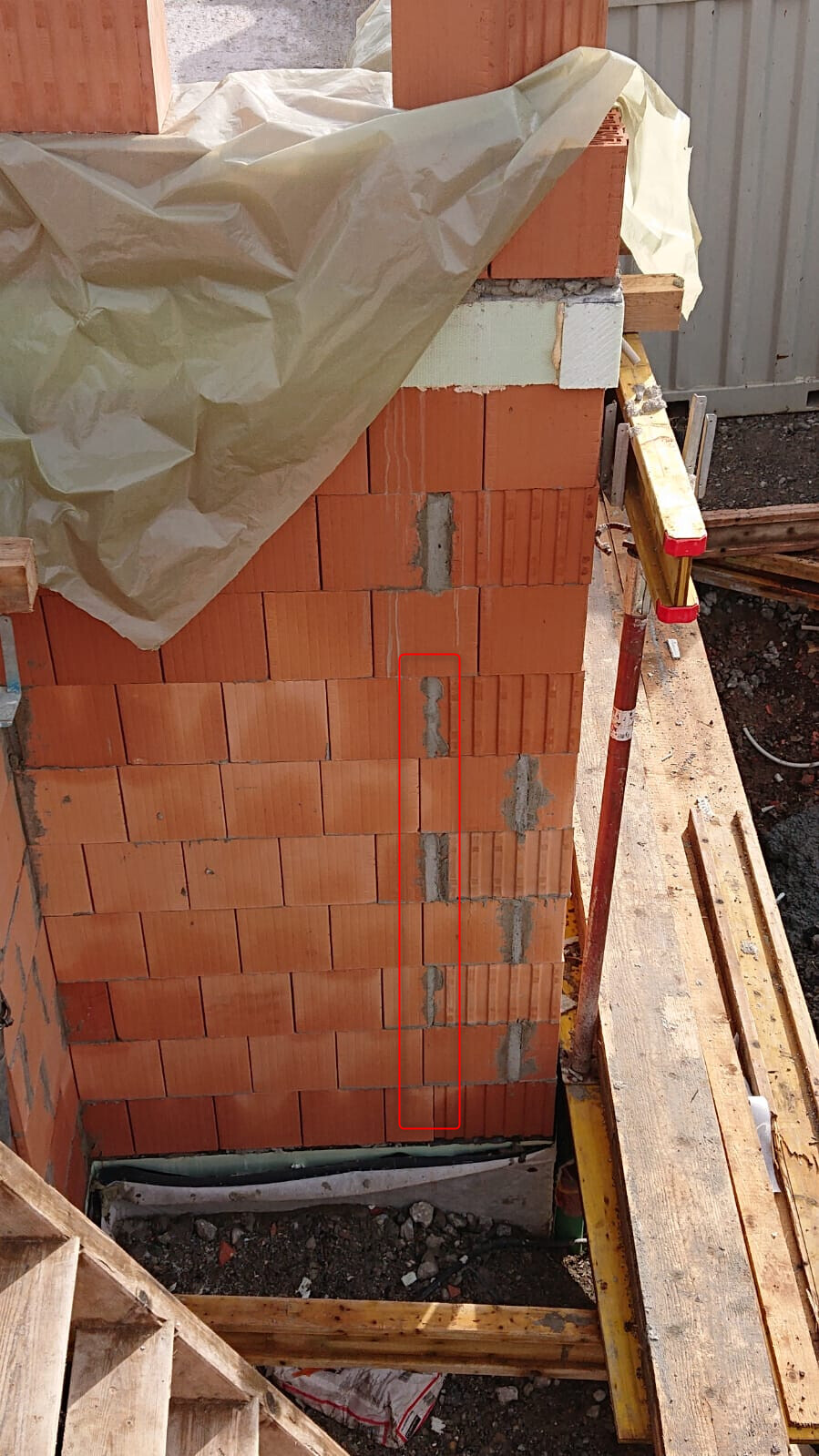
In some areas of the structural shell, the minimum offset of the bricks was not observed; in places, up to 7 courses of bricks were laid directly on top of each other.
Defect 3:
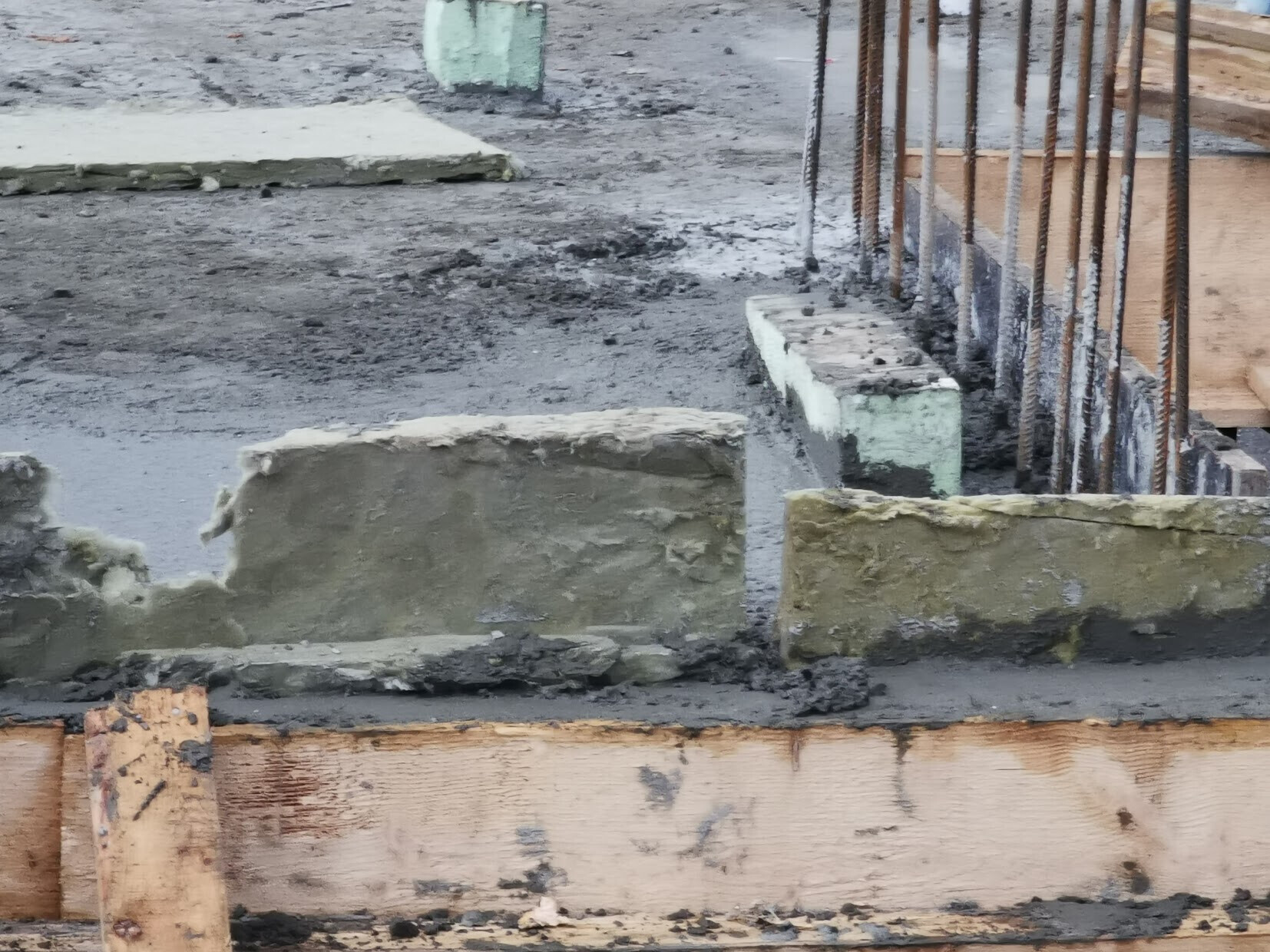
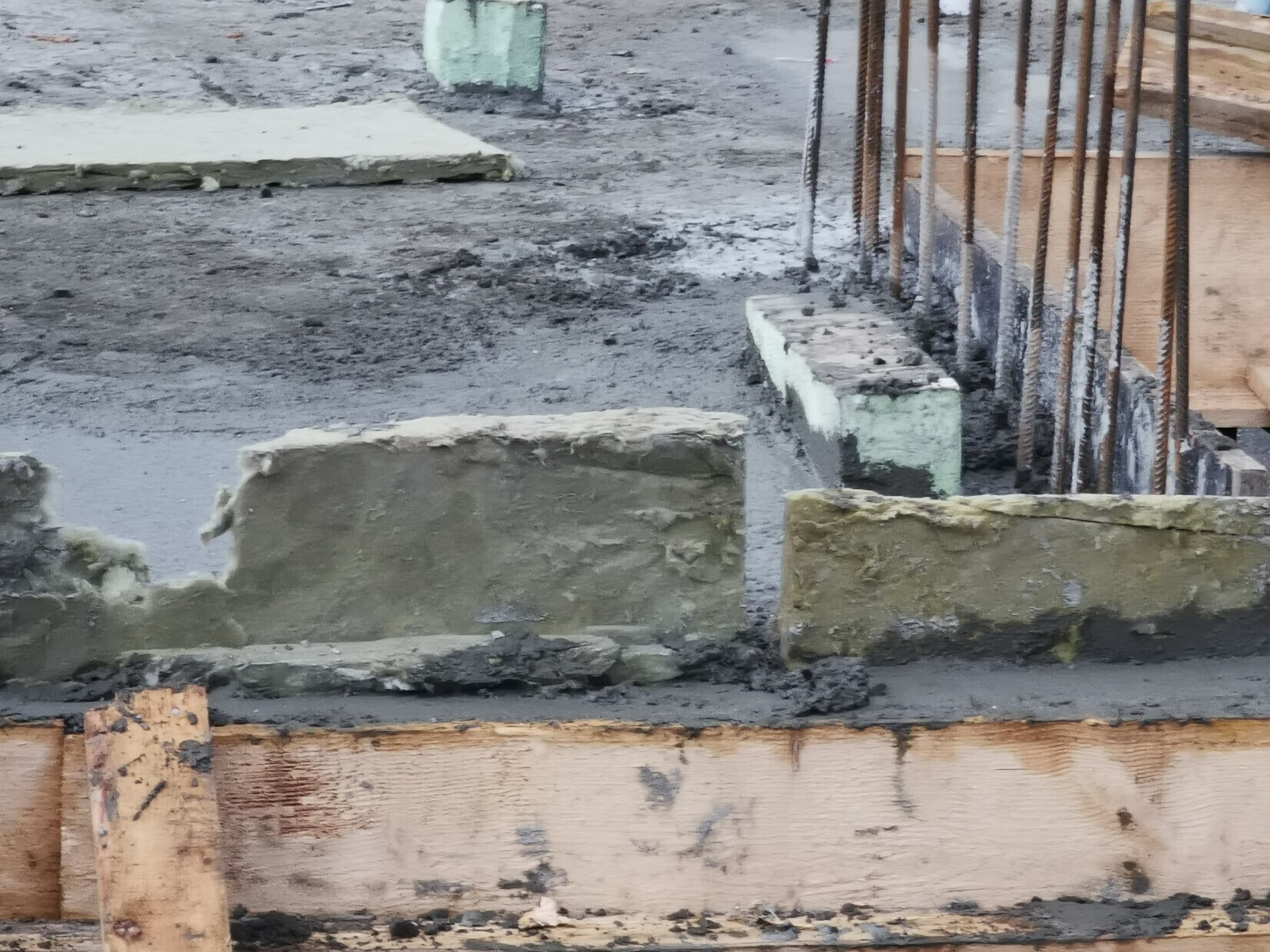
This is a row house. Mineral wool boards were installed between the buildings for sound insulation. At one externally visible spot, there is a gap of about 80cm (31.5 inches) depth and approximately 20cm (8 inches) height between the boards. After reporting the defect, the structural builder just “stuffed” mineral wool boards into the hole. According to our lawyer, this does not reliably ensure soundproofing.
Defect 4:
The area where the patio doors will later be installed was cast in concrete. Here, the reinforcing steel protrudes from the wall. According to the expert: This means that a proper bond between the reinforcing steel and concrete is not sufficiently ensured. It is assumed that adequate long-term corrosion protection of the reinforcement steel is not established. Furthermore, with insufficient concrete cover over the reinforcing steel, adequate fire protection is not guaranteed.
Defect 5:
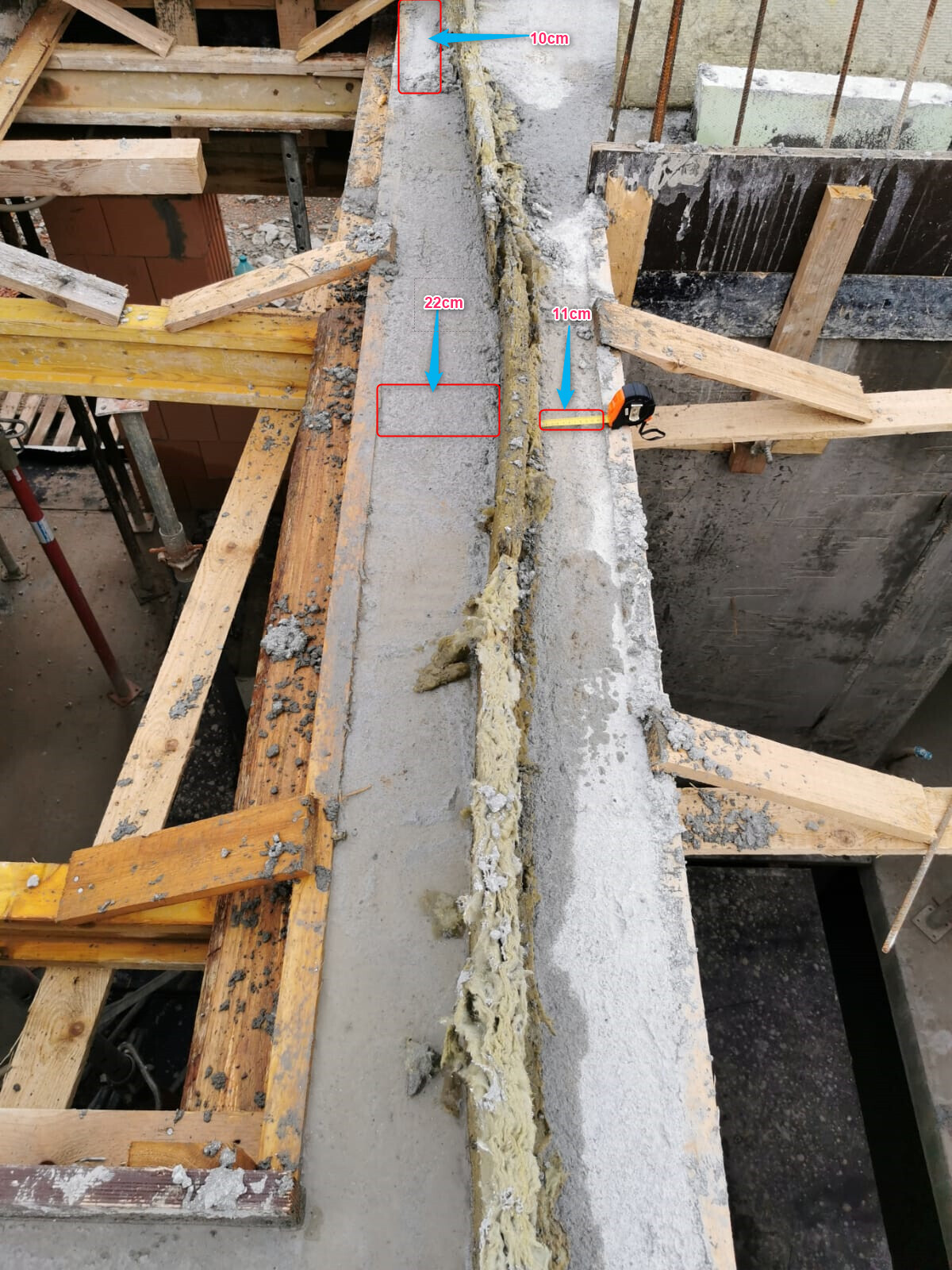
In the floor slab area, the mineral wool board was not properly secured. As a result, it is quite wavy. This is particularly problematic in the stairwell area, where in some places only 10cm (4 inches) of concrete remain above the mineral wool board. The partition wall bricks have a thickness of 17.5cm (7 inches), though.
Defect 6:
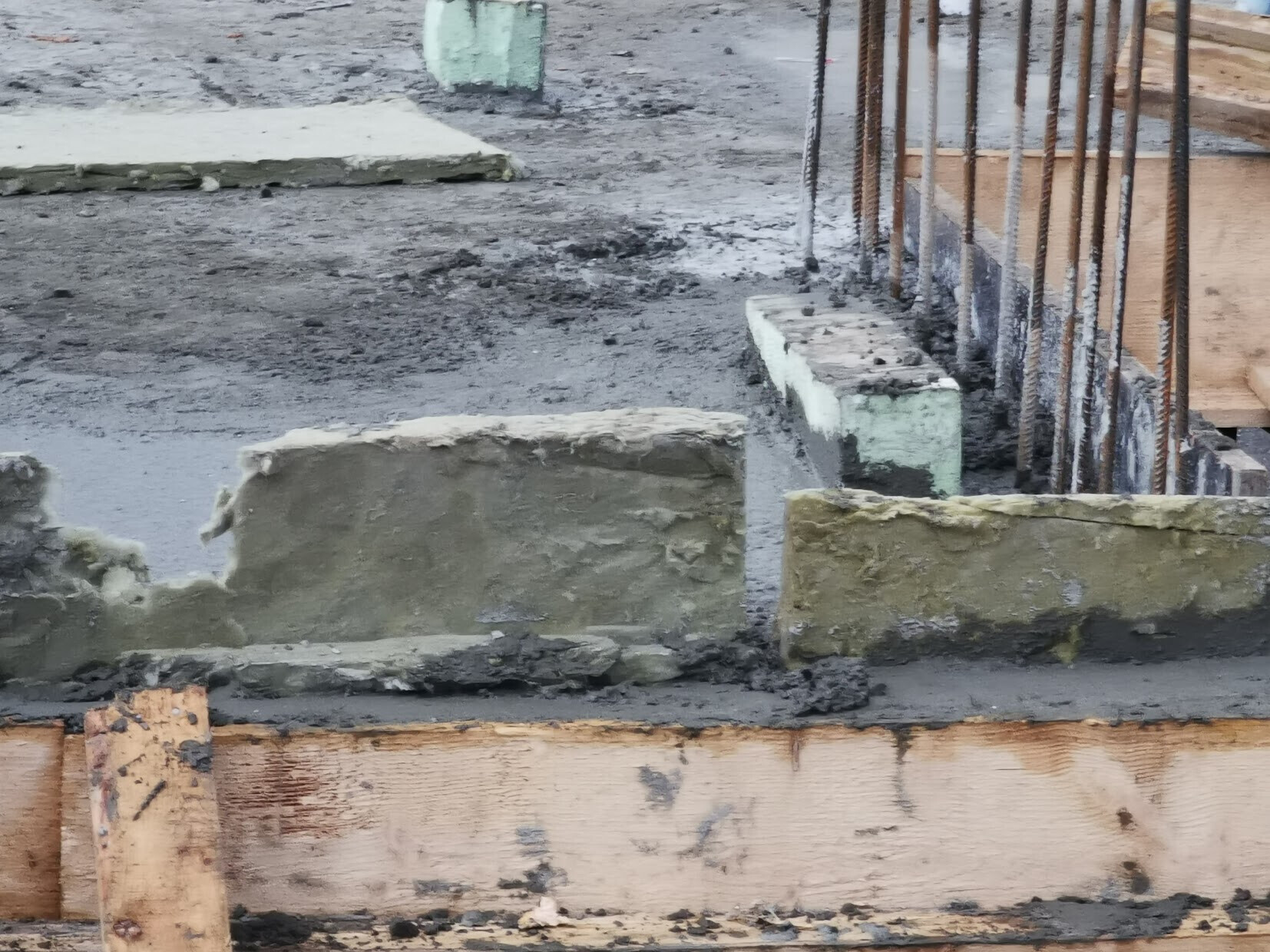
The mineral wool boards were not installed tightly enough in some areas, allowing concrete to seep between the boards and create a sound bridge.
These are the (known) defects so far. I would greatly appreciate it if anyone could roughly estimate the costs associated with these defects.
Thank you very much in advance.
The ceiling above the ground floor has just been concreted on our site. According to the payment schedule, a partial payment of approximately €30,000 is due.
However, our expert has identified several defects. These were formally reported to the general contractor (GC) with deadlines. The first deadline (2 weeks) passed without the defects being resolved; the second deadline is still running until Thursday (also 2 weeks).
So far, we have withheld about €17,000 of the €30,000. Our GC considers this amount far too high and insists on payment.
Since we are currently concerned about the potential insolvency of the GC (the structural builder, brick supplier, steel supplier, and light well supplier have not been paid), we want to keep the deduction as high as possible. However, since we are not construction professionals and want to avoid the risk that withholding too much for defects could backfire, I hope that some experts here can provide us with a rough cost estimate.
P.S. Our lawyer has been contacted, but the appointment is only scheduled for 17.02, and I fear we cannot hold off the GC until then.
Defect 1:
At the transition between the basement and the ground floor, no damp-proof course was installed at the base of the first course of blocks.
The basement is already fully lined with Styrodur insulation, and the excavation pit has been backfilled.
Defect 2:
In some areas of the structural shell, the minimum offset of the bricks was not observed; in places, up to 7 courses of bricks were laid directly on top of each other.
Defect 3:
This is a row house. Mineral wool boards were installed between the buildings for sound insulation. At one externally visible spot, there is a gap of about 80cm (31.5 inches) depth and approximately 20cm (8 inches) height between the boards. After reporting the defect, the structural builder just “stuffed” mineral wool boards into the hole. According to our lawyer, this does not reliably ensure soundproofing.
Defect 4:
The area where the patio doors will later be installed was cast in concrete. Here, the reinforcing steel protrudes from the wall. According to the expert: This means that a proper bond between the reinforcing steel and concrete is not sufficiently ensured. It is assumed that adequate long-term corrosion protection of the reinforcement steel is not established. Furthermore, with insufficient concrete cover over the reinforcing steel, adequate fire protection is not guaranteed.
Defect 5:
In the floor slab area, the mineral wool board was not properly secured. As a result, it is quite wavy. This is particularly problematic in the stairwell area, where in some places only 10cm (4 inches) of concrete remain above the mineral wool board. The partition wall bricks have a thickness of 17.5cm (7 inches), though.
Defect 6:
The mineral wool boards were not installed tightly enough in some areas, allowing concrete to seep between the boards and create a sound bridge.
These are the (known) defects so far. I would greatly appreciate it if anyone could roughly estimate the costs associated with these defects.
Thank you very much in advance.
Kishihmen schrieb:
How can I make these defects indisputable? Do I even have a chance?What does your expert report say about this?
In my opinion, the defects are present. The defects were reported and a deadline was set for remediation.
There are defects that a structural engineer could dismiss as harmless, others can be corrected with a reasonable effort. But there are also defects that cannot be remedied with a reasonable effort. The principle of proportionality applies here. Nobody would want to argue about something like this, not even their worst enemy.
Snowy36 schrieb:
Well, you’re asking me something difficult... it’s hard to find someone willing to continue where another left off because who wants to take responsibility for someone else’s mistakes... you have to rely on goodwill. The first step for the new general contractor should be to fix the faulty work. They will charge well for that. So why shouldn’t you be able to find contractors for that?
Make a counter-calculation of what the cost of remedying the defects would be. If the contractor does not carry out the defect repairs within the deadline, I would deduct this amount from the installment payment. Is the installment amount covered by the scope of work?
In my opinion, a two-week deadline is not reasonable for addressing these defects.
In my opinion, a two-week deadline is not reasonable for addressing these defects.
icandoit schrieb:
The first step for the new general contractor should be to fix the botched work. He gets paid well for that. Why shouldn’t you be able to find a contractor for that? Of course step. Unfortunately, I can’t edit it anymore.
icandoit schrieb:
The first step for the new general contractor should be to fix the poor workmanship. He charges well for that. Why wouldn’t you be able to find contractors for that? Because in the current situation, no one wants to take it on ... it smells like extra work and trouble for the tradesperson, so they’d rather accept another completely new job instead. There are already 10 others waiting in line, and they don’t even know which one to do first.K
Kishihmen10 Feb 2021 11:27icandoit schrieb:
What does your expert say about it?He says these are definitely defects. He also says he wouldn’t pay the main contractor any more and has advised us to consult a lawyer. However, he also mentioned that he is not familiar enough with the market prices on the "end consumer market" to give us precise figures.icandoit schrieb:
Do a counter-calculation for what it would cost you to fix the defects. If the contractor does not correct them within the deadline, I would deduct that amount from the progress payment. Is the progress payment amount actually covered by the work performed?That’s exactly my problem right now. I don’t know enough about the subject to prepare a proper calculation.icandoit schrieb:
In my opinion, a two-week deadline is not reasonable for fixing these defects.Why not? That’s more time than they actually needed of “effective” working hours to build the floor. What would be a reasonable deadline for the correction?